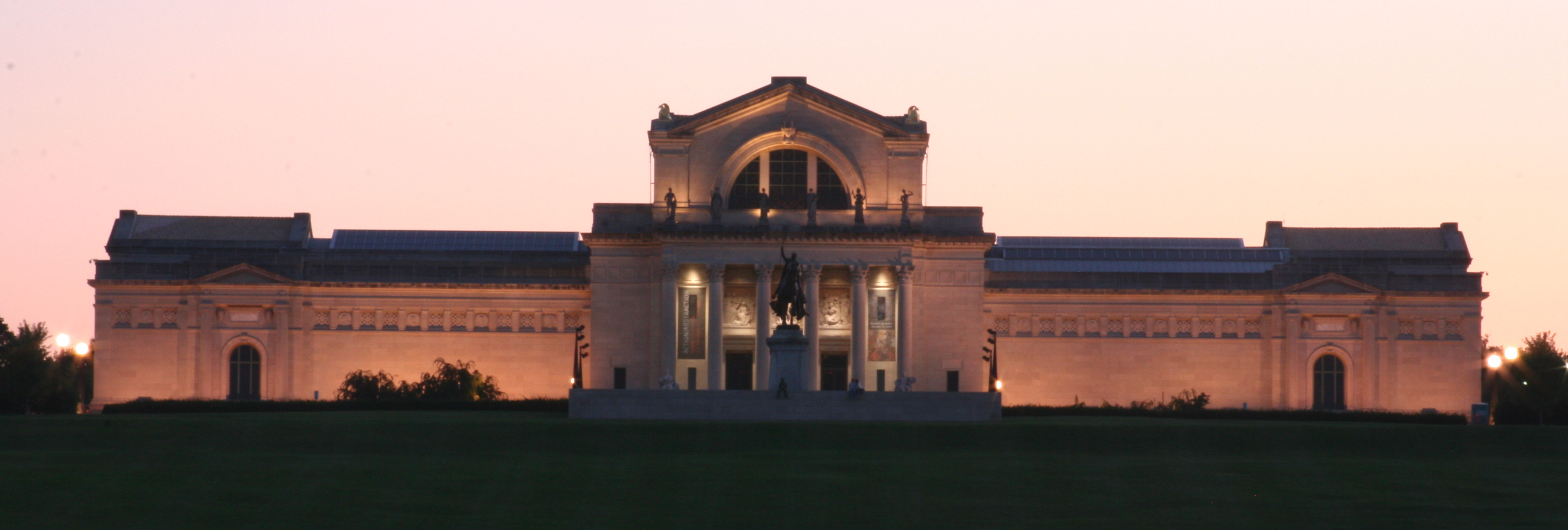
Saint Louis Art Museum
The building was supposed to be temporary. When architect Cass Gilbert designed the Palace of Fine Arts for the 1904 Louisiana Purchase Exposition, it was meant to serve the World's Fair and then disappear like everything else. Instead, it was the only fair structure built to last -- steel frame rather than the plaster-and-straw 'staff' that composed the other exhibition palaces -- and when the fair ended, it stayed. Today it crowns Art Hill in Forest Park, a Beaux-Arts monument that has watched over St. Louis for more than a century, housing 34,000 objects that span five thousand years of human creativity. Admission is free. It always has been.
The Palace That Stayed
Cass Gilbert, who would later design the United States Supreme Court building and the Woolworth Building in New York, created the Palace of Fine Arts as the centerpiece of the 1904 World's Fair's cultural program. Its position atop Art Hill gave it a commanding view of the fairgrounds and the Grand Basin below. While other fair buildings were designed as temporary structures -- elaborate facades over flimsy frames -- the Palace of Fine Arts was built with a steel skeleton and stone cladding intended to endure. After twenty million fairgoers went home, the building was handed to the City of St. Louis and became the permanent home of the art museum. Gilbert's design, with its columned facade and symmetrical wings, gave the institution an architectural gravitas that matched its growing ambitions.
Beckmann's Refuge
The Saint Louis Art Museum holds the world's largest collection of paintings by Max Beckmann, the German Expressionist who fled Nazi Germany in 1937 after the regime labeled his work 'degenerate art.' Beckmann spent a decade in Amsterdam before emigrating to the United States in 1947, teaching at Washington University in St. Louis until 1949. His connection to the city left a lasting mark on the museum's collection. Beyond Beckmann, the museum's holdings range from ancient Egyptian artifacts to contemporary installations. The collection includes significant works of European and American painting, pre-Columbian art, Asian art, and one of the strongest collections of Oceanic art in the country. A major expansion designed by David Chipperfield opened in 2013, nearly doubling the museum's gallery space.
Free by Design
The Saint Louis Art Museum's free general admission is not an accident or a marketing strategy. It is sustained by a dedicated tax district that voters in St. Louis City and County have repeatedly renewed, most recently reflecting broad public support for the principle that access to art should not depend on ability to pay. This funding model places the museum alongside the Saint Louis Zoo, the Science Center, and other Forest Park institutions in a rare American experiment: a cluster of world-class cultural institutions, all free, all in one park. The museum draws over half a million visitors annually, and its most popular event, Art Outside, brings temporary installations to the surrounding hillside and grounds of Forest Park.
Art Hill After Hours
Art Hill -- the grassy slope descending from the museum's front steps to the Grand Basin -- has become one of St. Louis's most beloved public spaces in its own right. In winter, it transforms into the city's favorite sledding hill, drawing thousands of families after every snowfall. In summer, outdoor film screenings and festivals fill the lawn. The view from the museum's steps looks east across the Basin, past the park's lakes and tree canopy, toward the downtown skyline and the Gateway Arch glinting on the horizon. It is one of the finest urban vistas in the Midwest -- a sightline that connects a World's Fair building, a public park, and a national monument in a single sweep. From above, Art Hill's geometry is unmistakable: a green triangle of lawn focused on a white columned building, with water reflecting sky below.
From the Air
Located at 38.639°N, 90.294°W atop Art Hill in Forest Park. The Beaux-Arts building with its columned facade is visible from altitude, especially with the Grand Basin reflecting pool extending south. Forest Park's 1,371-acre green footprint is a clear landmark. The museum sits on the park's eastern high ground. Nearest airports: KSTL (St. Louis Lambert International, 10 nm NW), KCPS (St. Louis Downtown, 8 nm SE). Washington University's campus is visible immediately to the west.