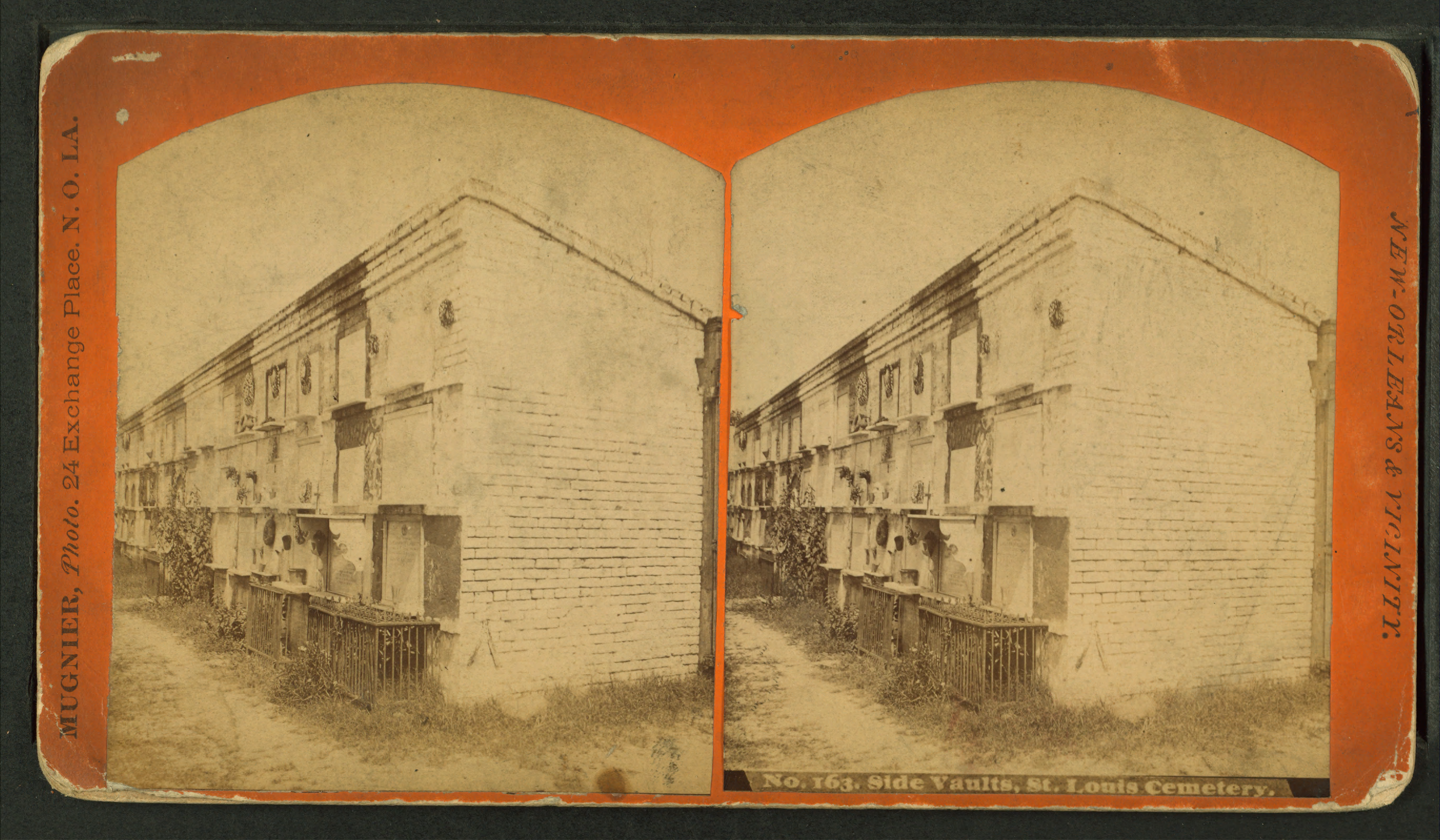
Saint Louis Cemetery
In 2010, Nicolas Cage purchased a nine-foot-tall pyramid-shaped tomb in Saint Louis Cemetery No. 1. It sits among weathered 18th-century vaults in a graveyard that spans just one square block yet holds many thousands of the dead. The pyramid is the newest and most conspicuous monument in a cemetery that has been in continuous use since 1789, but it is far from the strangest thing here. A few rows away lies the Glapion family crypt, believed to hold the remains of Marie Laveau, the most famous Voodoo priestess in American history. Nearby rests Paul Morphy, one of the earliest world champions of chess. The Saint Louis Cemeteries of New Orleans, three in number, are not merely places of burial. They are the city's autobiography, written in brick, plaster, and marble above the waterlogged ground.
Cities of the Dead
New Orleans buries its dead above ground out of necessity. The city's high water table, barely a foot or two below the surface in many places, made traditional interment impractical from the earliest colonial days. Coffins would float back to the surface during heavy rains. The solution was above-ground vaults, oven-like tombs stacked in rows and family crypts that gave the cemeteries their famous nickname: cities of the dead. Saint Louis Cemetery No. 1, opened in 1789 after a devastating fire prompted the city to redesign its layout and replace the older St. Peter Cemetery, sits just eight blocks from the Mississippi River on the north side of Basin Street, one block beyond the French Quarter's inland border. It is the oldest and most prominent of the three Saint Louis Cemeteries, and both No. 1 and No. 2 are listed on the National Register of Historic Places and the Louisiana African American Heritage Trail.
Pirates, Pawns, and Priestesses
The roster of residents in Cemetery No. 1 reads like a casting call for a sprawling historical drama. Etienne de Bore, the wealthy pioneer of the sugar industry and first mayor of New Orleans, lies here. So does Homer Plessy, the plaintiff in the landmark 1896 Plessy v. Ferguson Supreme Court decision that upheld racial segregation. Barthelemy Lafon, the architect and surveyor who allegedly became one of Jean Lafitte's pirates, rests nearby. Benjamin Latrobe, the architect who helped design the United States Capitol, was buried here in 1820 after dying of yellow fever while engineering the city's waterworks. The Voodoo priestess Marie Laveau draws the most visitors to the Glapion family crypt, where devotees once marked the tomb with three X's to petition her spirit. Delphine LaLaurie, the notoriously cruel slave owner whose Royal Street mansion concealed a torture chamber, is also believed to be interred in No. 1. And chess genius Paul Morphy, who dominated international competition before retreating into reclusion, found his final quiet here.
Three Grounds, Three Centuries
Cemetery No. 2, consecrated in 1823 three blocks behind No. 1 along Claiborne Avenue, expanded the burial ground as the city grew. Its residents include jazz and rhythm-and-blues musicians Danny Barker and Ernie K-Doe, along with Andre Cailloux, an African-American Union hero killed in 1863 during the Civil War. The Venerable Mother Henriette DeLille, a candidate for Catholic sainthood, rests here beside governors, senators, and Oscar Dunn, the first elected Black lieutenant governor of any U.S. state. Cemetery No. 3, opened in 1854 along Esplanade Avenue near Bayou St. John, features the most elaborate crypts of the three, with fine 19th-century marble tombs. Ragtime composer Paul Sarebresole, photographer E. J. Bellocq, painter Ralston Crawford, and self-taught jazz pianist Sweet Emma Barrett are among those entombed there. A Greek Orthodox section reflects the diversity of a city built by waves of immigrants.
Standing Through the Flood
Hurricane Katrina in 2005 tested the cemeteries as it tested everything in New Orleans. Cemetery No. 2 received minor flooding, and when the waters receded its tombs appeared virtually untouched save for a brownish waterline staining every structure. Cemetery No. 3, closer to the lake, flooded more heavily, but its above-ground vaults escaped with only plaster damage from floating debris. The design that colonial necessity had imposed, building upward rather than digging down, proved remarkably resilient against the worst natural disaster in the city's modern history. The tombs that had been engineered to resist a high water table withstood an actual flood. Since 2015, the Roman Catholic Archdiocese of New Orleans has restricted public access to Cemetery No. 1, citing increased vandalism. Guided tours are available through licensed companies, and families who own tombs can apply for visitation passes.
Resting Above, Remembered Below
Together, the three Saint Louis Cemeteries contain the compressed story of a city shaped by French and Spanish colonial rule, the sugar and cotton trades, the Civil War, Reconstruction, the jazz age, and the civil rights movement. The vaults hold formerly enslaved people beside former slaveholders, Union heroes beside Confederate officers, Voodoo practitioners beside Catholic saints-in-waiting. Dominique You, a privateer and Battle of New Orleans veteran, lies in No. 2 alongside Pierre Nord Alexis, who served as president of Haiti from 1902 to 1908. Bernard de Marigny, the French-Creole aristocrat who founded the Faubourg Marigny neighborhood, rests in No. 1. The cemeteries are not frozen relics. They remain active burial grounds where families still inter their dead in centuries-old family vaults, the tropical climate accelerating decomposition so that a single tomb can serve generation after generation. In New Orleans, the dead do not merely rest. They remain part of the neighborhood.
From the Air
Cemetery No. 1 is located at 29.959N, 90.071W on the north side of Basin Street, just beyond the French Quarter boundary. The white and gray above-ground vaults are visible as a distinctive pale block from low altitude, contrasting with surrounding rooftops. Cemeteries No. 2 and No. 3 are within a few miles along the same axis. Nearest airports: Louis Armstrong New Orleans International (KMSY), approximately 11 nm west; Lakefront Airport (KNEW), about 5 nm north. The cemeteries are best identified at 1,500-2,000 ft AGL by their grid of pale vaults. The Superdome and French Quarter grid provide orientation landmarks.