Saint Louis University
In 1944, Saint Louis University quietly admitted five African American students to its graduate programs, becoming the first university in any former slave state to voluntarily desegregate. There were no court orders, no federal mandates -- just a Jesuit institution deciding that its stated mission of social justice required action. The decision was controversial. Some alumni protested. The city of St. Louis was still deeply segregated. But the university had been navigating contradictions since its founding in 1818, when it became the oldest institution of higher learning west of the Mississippi, a Jesuit school in a frontier river town that would spend the next two centuries wrestling with questions of faith, race, and what education owes to the communities it inhabits.
Frontier Jesuits
Saint Louis University traces its origins to 1818, when Bishop Louis William DuBourg founded the Saint Louis Academy, a one-room school that served the children of the frontier town. The Society of Jesus took over the school in 1827, and it received its university charter in 1832, making it the oldest university west of the Mississippi River. In its early decades, the school operated with limited resources in a city that was still more trading post than metropolis. The Jesuits brought their educational philosophy -- the Ratio Studiorum's emphasis on classical languages, philosophy, and moral formation -- to a place where most residents cared more about fur prices and riverboat schedules. The university grew alongside St. Louis, adding a medical school in 1836 and a law school in 1843.
Enslaved Hands, Sacred Walls
The early history of Saint Louis University includes a truth that the institution has only recently begun to publicly reckon with: enslaved people labored on behalf of the university and the Jesuits who ran it. The Society of Jesus in Missouri held enslaved men, women, and children, and their labor contributed to the institution's operations and physical plant. In 2016, the university established a committee to research its historical ties to slavery, joining a growing number of American universities confronting this aspect of their past. The committee documented the names and histories of enslaved individuals connected to the Jesuits in Missouri. This reckoning sits in uneasy proximity to the university's pioneering desegregation in 1944, a reminder that institutions can be both complicit in injustice and agents of change within the same century.
Breaking the Color Line
The desegregation of Saint Louis University in 1944 was the work of Father Claude Heithaus, a professor of classical archaeology, who delivered a sermon in January of that year calling on the university community to accept Black students. His words were powerful and direct, and they caused a firestorm. Some Jesuit superiors disapproved. Heithaus was eventually transferred from the university. But five African American students enrolled that September, and the wall had been breached. By the time the Supreme Court decided Brown v. Board of Education a decade later, Saint Louis University had already been integrated for ten years. The university's decision influenced other Catholic institutions across the country and demonstrated that voluntary desegregation was possible even in a deeply segregated city.
Midtown Anchor
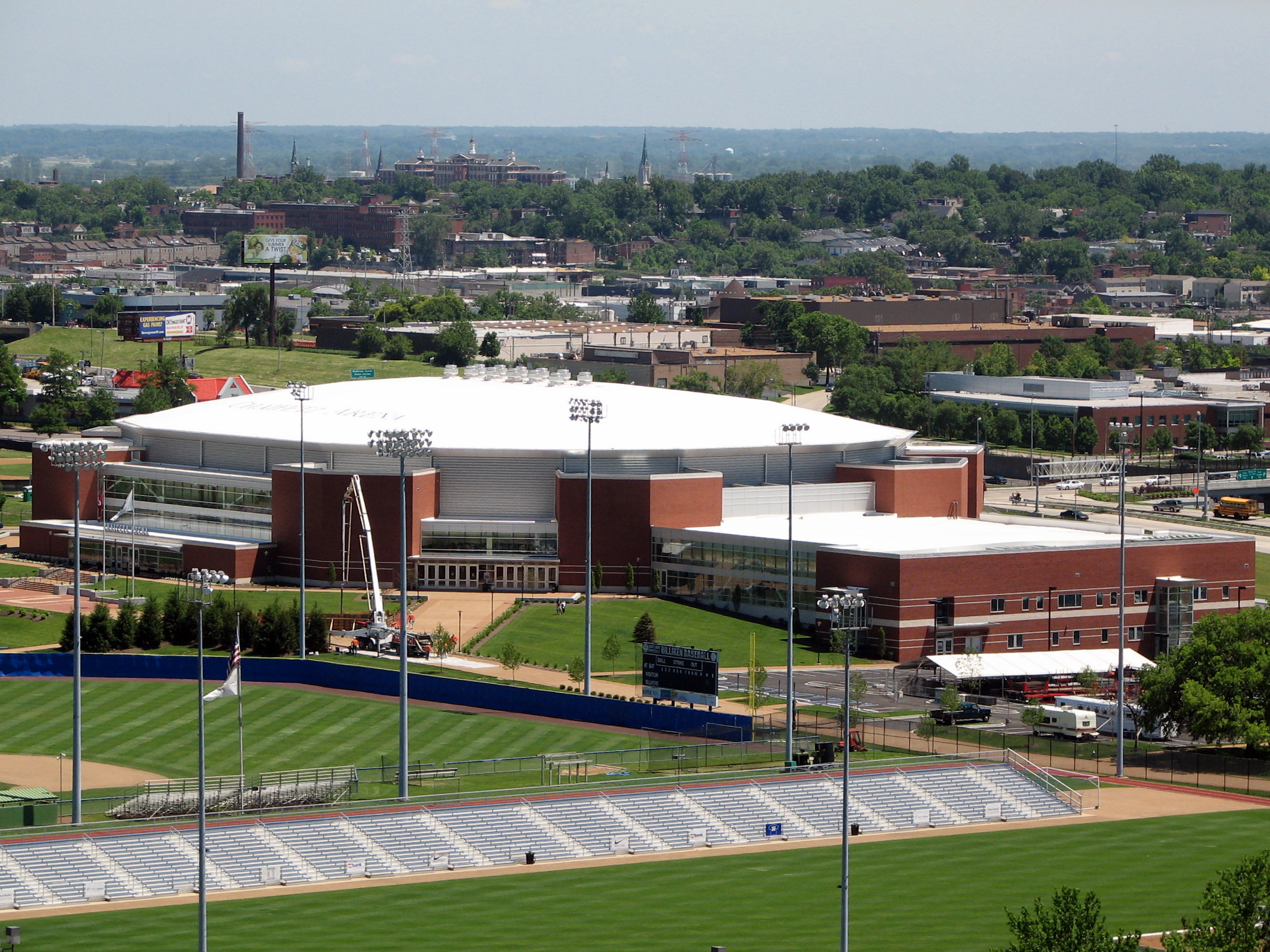
Saint Louis University's campus occupies a substantial footprint in midtown St. Louis, anchoring a neighborhood that has experienced the same cycles of decline and renewal as much of the city. The university's signature building, the Jesuit-run St. Francis Xavier College Church, is a landmark of 19th-century ecclesiastical architecture. In October 2014, the campus became the site of OccupySLU, a six-day protest in the wake of the shooting of Michael Brown in nearby Ferguson. Students and community members camped on the university's clock tower lawn, demanding that the institution take a stronger stand on racial justice. The university eventually agreed to a set of commitments called the Clock Tower Accords. It was a fitting continuation of the contradictions that have defined Saint Louis University since 1818: a school that has always been pulled between its ideals and the realities of the city it calls home.
From the Air
Located at 38.636°N, 90.234°W in midtown St. Louis. The campus is visible from altitude as a cluster of buildings south of I-64 and east of Grand Blvd. The twin spires of St. Francis Xavier College Church are a landmark. Forest Park is 2 nm west; the Gateway Arch is 3 nm east. Nearest airports: KSTL (St. Louis Lambert International, 11 nm NW), KCPS (St. Louis Downtown, 5 nm SE). The campus sits between the Forest Park Southeast and Grand Center neighborhoods.