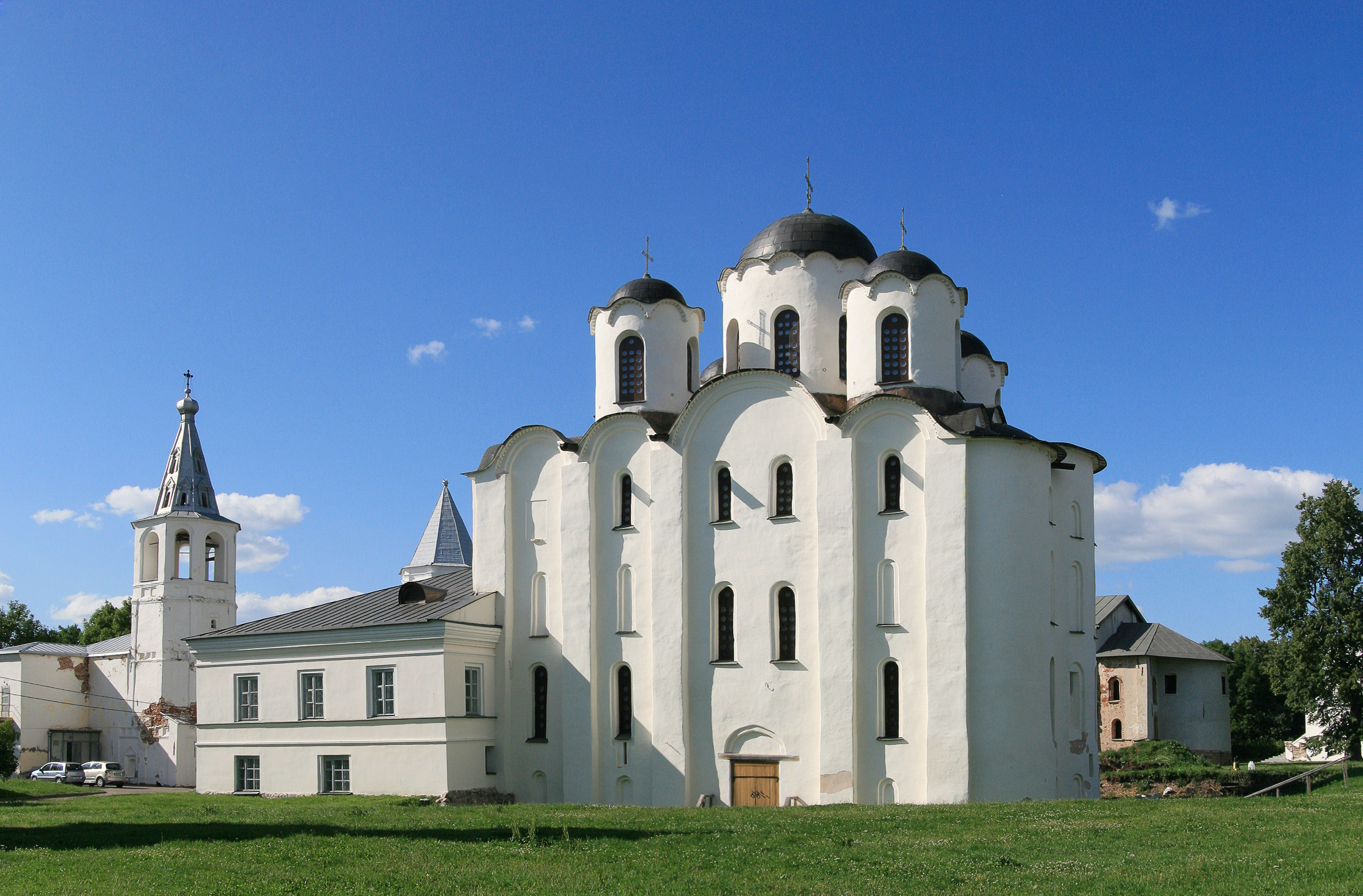
Saint Nicholas Cathedral, Novgorod
Mstislav the Great founded this cathedral in 1113. To put that in perspective: when the cornerstone was laid, England's King Henry I was three years from his Normandy disaster, the First Crusade had ended only fifteen years earlier, and the Aztec city of Tenochtitlan was still two centuries from being founded. Twenty-three years later, in 1136, the cathedral was consecrated. By then Novgorod had become a republic, and the prince who began the building was long dead. Saint Nicholas Cathedral is the second-oldest building still standing in the central part of Veliky Novgorod, and almost everything that happened to medieval Russia happened around it, beside it, or to it.
The Prince Who Built It
Mstislav Vladimirovich - Mstislav the Great in later chronicles - was the eldest son of Vladimir Monomakh and the great-grandson of Yaroslav the Wise. He served as Prince of Novgorod from 1097 to 1117, an unusually long tenure during which he founded a remarkable number of churches in the city and its dependencies. Saint Nicholas was meant as the prince's personal cathedral, attached to his residence at Yaroslav's Court on the right bank of the Volkhov River, just outside the kremlin walls. The construction took more than twenty years and stretched well past Mstislav's lifetime - he left Novgorod for Kiev in 1117 to become Grand Prince, and died there in 1132. By the time the cathedral was consecrated in 1136, Novgorod had thrown out his successors and declared itself a republic. The first event recorded inside the new cathedral was a betrothal: Prince Sviatoslav Olgovich married there that same year.
Yaroslav's Court and the Veche
The cathedral stands at the heart of Yaroslav's Court - the trading and political square that served as the secular twin to the kremlin across the river. Here the merchants of medieval Novgorod did business with Hanseatic League traders from across the Baltic. Here the great wooden veche bell would ring to summon all free male citizens to the popular assembly that elected princes and made law in the Republic. From the 13th century the cathedral itself belonged to the city of Novgorod rather than to any individual prince - a remarkable arrangement in medieval Russia, where ecclesiastical property was almost always held by ruler or bishop. The veche met in the open square just outside the cathedral doors. The bell that called them - silenced when Ivan III conquered Novgorod and ended the Republic in 1478 - was famously carted off to Moscow as a symbol of subjugation.
What Survived
The cathedral has the rough plan of an early medieval Russian church: roughly square in cross-section, four interior pillars supporting the roof, originally five domes. By the late 17th century one of the restorations had reduced this to a single dome - the heavy, almost helmet-shaped cap visible today. Two later additions extended the building outward (the western annex in 1809, the northern in 1822). The walls themselves are 12th century. Inside, fragments of original 1130s frescoes have survived, miraculously, in the upper levels - the best preserved is a depiction of Job, the Old Testament figure whose patience under suffering must have spoken to the long history of the building itself. The wall surfaces around the surviving fragments have been cleaned to bare stone in places and replastered in others, so you can see directly how the church was built and what almost nine centuries have done to it.
Through the Mongols and the Germans
Veliky Novgorod is unusual among medieval Russian cities for having escaped the worst of the Mongol-Tatar invasion of the 1230s and 40s - the swamps and forests that surrounded it kept Batu Khan's army from reaching it during the spring thaw. The city paid tribute, but its monuments survived. Saint Nicholas Cathedral made it through the 13th century intact. It made it through Ivan III's brutal annexation of the Republic in 1478 and the deportation of much of Novgorod's elite. It made it through Ivan the Terrible's massacre of 1570, when the city was ravaged for suspected disloyalty. It made it through the Time of Troubles. The Soviet period was harsh - religious functions ceased in the 1930s and the church became a museum in 1933 - but the building stood. Then came the Germans in August 1941.
The Worst Occupation
The Wehrmacht held Novgorod for 30 months, from August 1941 to January 1944. Saint Nicholas Cathedral, like most of the city's surviving medieval churches, was used as a barracks for German soldiers. The frescoes were defaced. The interior was gutted. When the Red Army retook the city in January 1944, large portions of medieval Novgorod were ruins - the Germans had blown up everything they could on retreat. Saint Nicholas survived structurally but was severely damaged. It returned to the Russian Orthodox Church in 1945, then was secularized again in 1962 and run as a museum. A major restoration between 1994 and 1999 - paid for partly by UNESCO funds after Novgorod's medieval ensemble was inscribed on the World Heritage list as Object 604 - finally stabilized the building. It now stands again, under its single dome, eight hundred eighty-eight years after it was first consecrated, on the same patch of ground beside the Volkhov where Mstislav's masons first set out the foundation stones.
From the Air
Saint Nicholas Cathedral sits at 58.52 degrees north, 31.29 east, on the right (east) bank of the Volkhov River in Veliky Novgorod, directly opposite the Novgorod Kremlin and within the Yaroslav's Court complex. From the air the medieval cathedral ensemble shows as a cluster of low white-walled, dark-domed buildings on a flat green floodplain, with the river separating them from the larger kremlin compound. The city of Veliky Novgorod has a small regional airport (ULNN) about 4 km east; nearest international gateway is Saint Petersburg's Pulkovo (ULLI) about 175 km north-northwest. Best viewed at low altitude in spring or autumn when the Volkhov runs full and the medieval churches stand out against the flat northern landscape. Lake Ilmen, just south of the city, is visible from any reasonable altitude on a clear day.