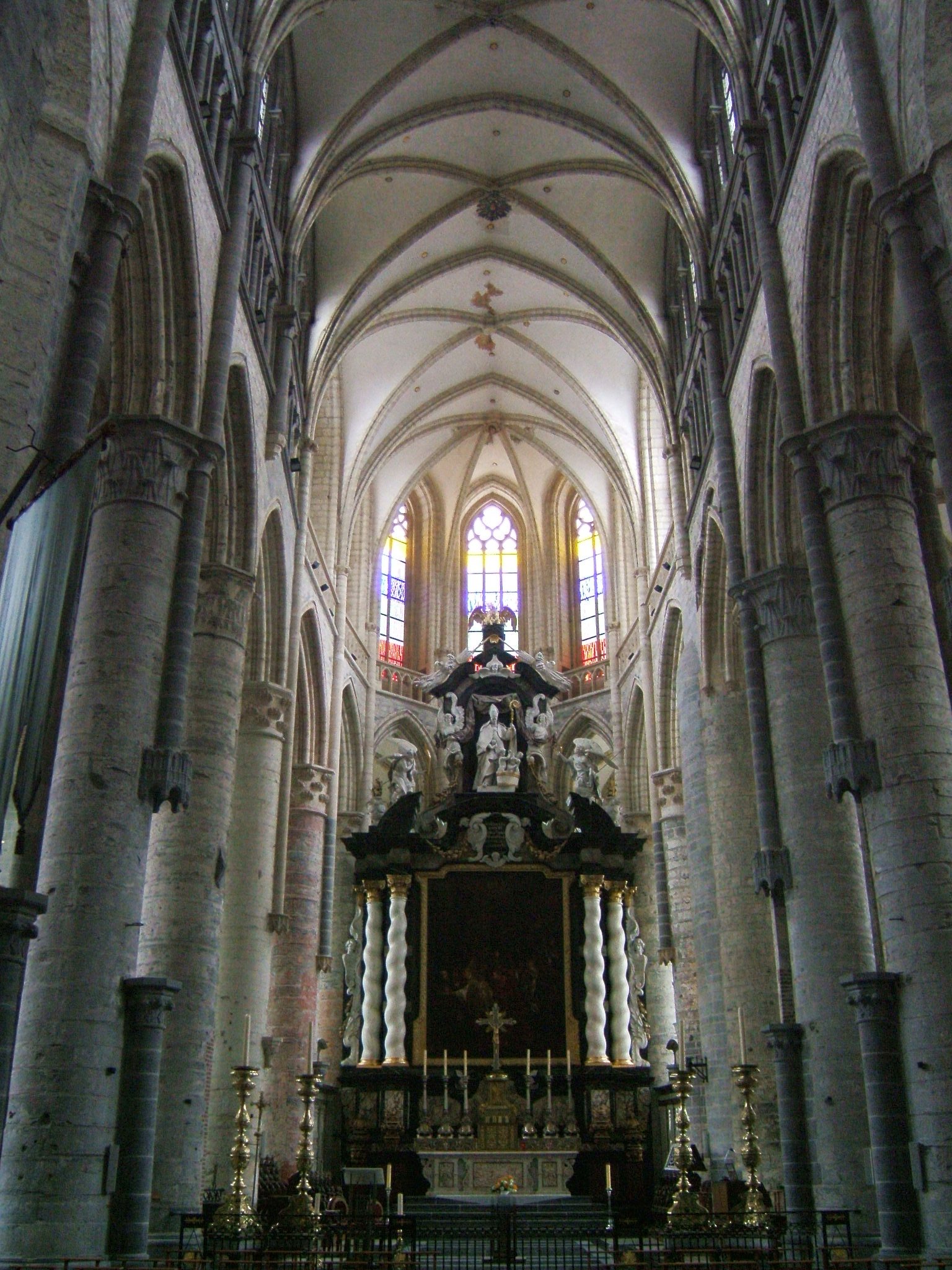
Saint Nicholas Church, Ghent
For sixty-four years, no one heard the great Cavaille-Coll organ at Saint Nicholas Church. During the long restoration of the building, workers boxed it inside a wooden case, disconnected its wind supply, and shoved its 3,200 pipes into storage. The organ that had been the first by Cavaille-Coll built in Belgium - one of the most important Romantic instruments in the country, inaugurated in 1856 by Louis Lefebure-Wely playing for a packed nave - simply vanished into a coffin of plywood. In 2010 the wood came off. In 2013 the loft was leveled by hydraulics. In 2025, finally, organists were playing it again. The church, like its instrument, has spent a long time being restored.
Built From the Scheldt
Saint Nicholas is older than the other two towers of Ghent's famous skyline. Begun in the early 13th century to replace a smaller Romanesque church, it grew up in the local style now called Scheldt Gothic, named for the river that supplied its bones. The blue-gray limestone came from quarries near Tournai, barged downstream and worked into walls that still carry that distinctive cool tint. A single large tower rises above the crossing instead of the twin western towers more common in northern Gothic. Slender turrets mark the corners. Look at the stone in late afternoon light, when the sun warms it from the southwest, and the church reads as carved out of the very water that runs past it.
The Guildsmen's Church
Ghent in the Middle Ages ran on cloth, and the cloth ran through the Korenmarkt - the Wheat Market, right outside Saint Nicholas's door. The merchants and craftsmen who worked the square treated this church as theirs. Guilds added chapels along the flanks in the 14th and 15th centuries, each one a small territorial claim in stone and glass. The weavers had a chapel. The fullers had a chapel. Side altars accumulated like the rooms of a large family home. The central tower, funded partly by the city itself, served a civic purpose: it held the town bells and worked as an observation post. For two hundred years, until the Belfry was built next door, Saint Nicholas was the literal voice of Ghent.
The Three Towers
Stand on Saint Michael's Bridge and look east, and you see them together: Saint Nicholas, the Belfry, Saint Bavo's, three towers strung on a single sight line less than half a kilometer long. Hardly any city in Europe announces itself so cleanly. The composition was not designed - it accumulated over four centuries of competition between civic, commercial, and religious power. The Belfry rose in the 14th century because the city wanted its own voice. Saint Bavo's reached its full height in the 16th century as the cathedral. Saint Nicholas, the oldest, anchored the line. When Henry van de Velde added the Boekentoren in 1942, he was joining a conversation that had been going on since 1200.
The Long Slow Ruin
By the 18th century the church was falling down. Cracks were plastered over rather than repaired. Windows were bricked up to take pressure off failing walls. Little shops and houses had been built right up against the facade, leaning on it for support, and from outside you could barely tell where the city ended and the church began. The whole structure was on a slow slide toward collapse. Around 1840 the first preservationists began arguing for the building as a monument. At the turn of the 20th century, serious restoration plans took shape. The attached houses came down. Walls were rebuilt. Generations of work, with pauses for two world wars, have gone into bringing the church back to something like itself.
Cavaille-Coll Returns
When Saint Nicholas finally got its great organ in 1856, it was the first instrument that the celebrated Parisian builder Aristide Cavaille-Coll had constructed in Belgium - a model for what was coming. Three manuals, sixteen-foot pipes facing the nave, reusing some of the older Van Peteghem material from 1840. Cavaille-Coll proposed three different schemes before the cathedral chapter accepted the third. Construction took three years. Lefebure-Wely played the inauguration concert on March 11, 1856. The organ was last played in 1961 before the restoration silenced it. For half a century it sat blind and mute behind plywood, then visible again but still mute after 2010, then leveled and prepared after 2013, then finally, in 2025, sounding once more across the nave. Three generations of Ghent residents grew up without ever hearing it. The first ones to come in and listen, that year, were hearing a sound their grandparents had heard.
From the Air
Located at 51.054 N, 3.723 E in the heart of medieval Ghent on the Korenmarkt. The church's distinctive single central tower sits on a tight east-west line with the Belfry of Ghent and Saint Bavo's Cathedral - all three visible at once from the air at 1,500-3,000 ft. The blue-gray Tournai stone reads cooler than the surrounding buildings even from altitude. Closest international airport: Brussels (EBBR), 60 km southeast. Ursel (EBUL) lies northwest within 30 km.