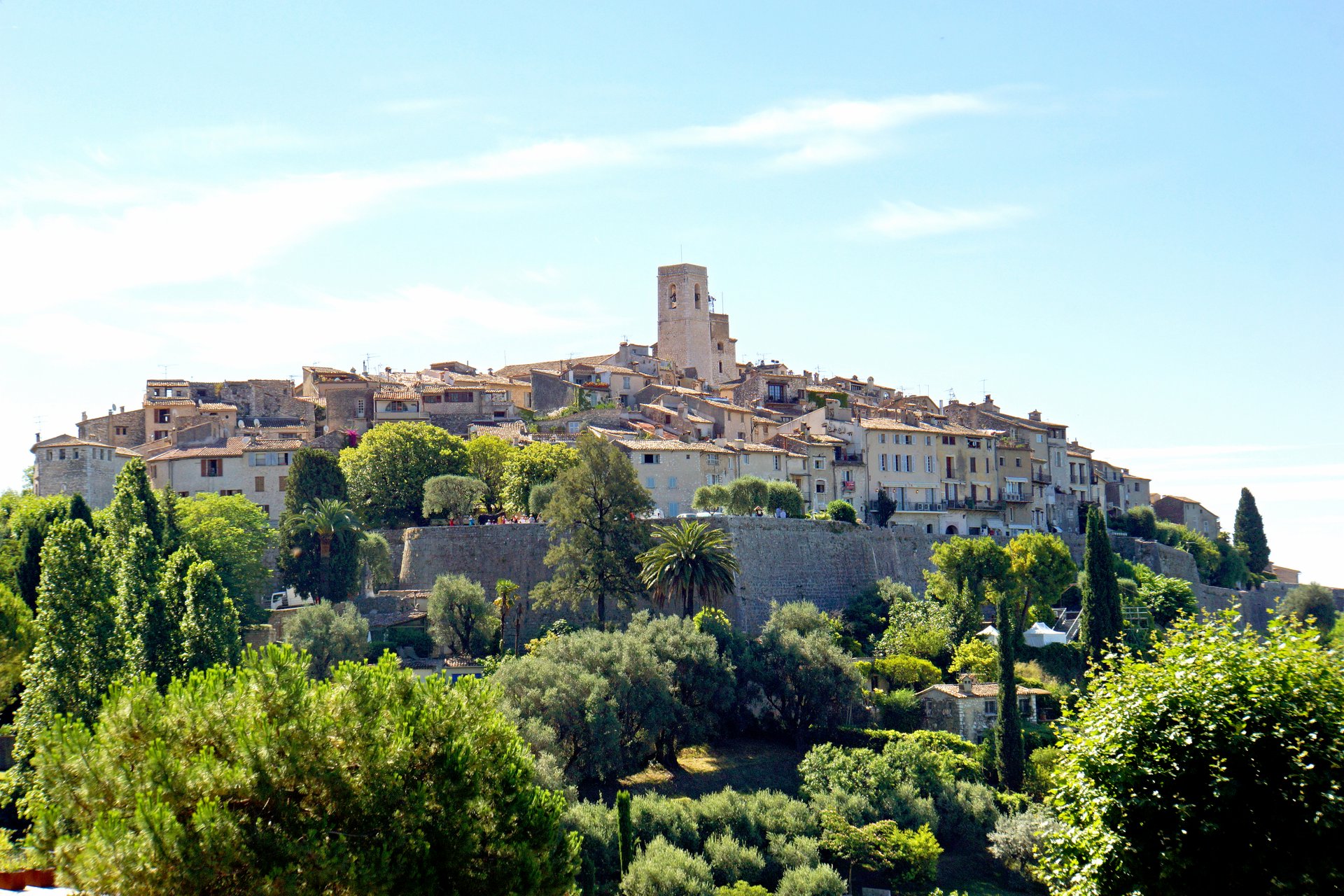
Saint-Paul-de-Vence
The guest book at La Colombe d'Or reads like a catalog of 20th-century genius. Pablo Picasso ate here. Jean-Paul Sartre argued philosophy at these tables. Marc Chagall lived nearby until his death and is buried in the village cemetery. What drew them all to this tiny medieval commune perched on a hill above the French Riviera was partly the light -- that particular Provencal clarity that painters have chased for centuries -- and partly the village itself, whose narrow stone streets and rampart walls have remained essentially unchanged since the 16th century.
The Hotel That Collected Art
Saint-Paul-de-Vence's transformation from medieval backwater to artists' colony can be traced to a single establishment. La Colombe d'Or began as a modest cafe in the 1920s, run by Paul Roux, who had the insight -- or the luck -- to accept paintings from his cash-strapped artist patrons in lieu of payment. As the village attracted more painters, poets, and writers, Roux accumulated a private collection that today rivals some museums. The hotel's walls hold original works by Picasso, Matisse, Braque, Leger, and Calder, among others. During the 1960s, the village became a gathering place for French cinema's elite: actors Yves Montand, Simone Signoret, and Lino Ventura frequented the narrow streets, alongside the poet Jacques Prevert. The village had become what it remains -- a place where creative people came to work, argue, and be inspired by the landscape and by each other.
Baldwin's Last Home
Among Saint-Paul-de-Vence's most significant residents was American writer James Baldwin, who lived in the village for seventeen years until his death in 1987. Baldwin, who had first come to France in 1948 to escape the racial oppression of the United States, found in Saint-Paul-de-Vence a place where he could write with the distance he needed from American life while remaining deeply engaged with it. From this hilltop village, he wrote some of his most important later works, living as one of the few Black residents in a community of wealthy expatriates and visiting celebrities. His presence in the village speaks to something the tourist brochures rarely mention: Saint-Paul-de-Vence was not just a pretty retreat, but a working place for artists and writers who needed separation from the demands of the worlds they depicted.
Stone, Light, and the Fondation Maeght
The village's physical character is defined by its medieval fortifications, built when Saint-Paul was a frontier stronghold between France and Savoy. Rampart walls encircle a labyrinth of stone houses, studios, and galleries that have been converted from their original purposes but retain their ancient proportions. Just outside the walls, the Fondation Maeght -- one of Europe's most important modern art museums -- opened in 1964, designed by the Catalan architect Josep Lluis Sert in close collaboration with the artists whose work it houses. The building itself is a work of art, with Giacometti sculptures in its courtyard, a Miro labyrinth, and Braque stained glass in the chapel. The foundation anchors Saint-Paul-de-Vence's identity as a place where medieval and modern coexist without contradiction.
A Village of Weddings and Burials
Gene Wilder and Gilda Radner were married by the mayor of Saint-Paul-de-Vence on September 18, 1984. Marc Chagall, who had lived in the village since 1966, was buried in its cemetery in 1985 -- his grave a pilgrimage site for art lovers from around the world. British actor Donald Pleasence lived in the village until his death in 1995. Former Rolling Stones bassist Bill Wyman keeps a home here. The village has a way of collecting notable lives and holding them, its stone walls absorbing the residue of so many creative presences that the place itself has acquired a kind of cultural gravity. Walk through the Porte de Vence and up the Rue Grande, and you pass through a space that has been continuously inhabited for over a thousand years, each generation leaving something behind -- a painting, a novel, a memory of Mediterranean light falling on old stone.
From the Air
Located at 43.70N, 7.12E on a prominent hilltop about 5 km inland from the coast, between Nice and Antibes. The fortified medieval village is visible from the air as a compact cluster of stone buildings on a conical hill. The Fondation Maeght is just outside the village walls. Nearest airports: Nice Cote d'Azur (LFMN), Cannes-Mandelieu (LFMD). Best viewed at 2,000-4,000 feet AGL. The village is surrounded by terraced hillsides and scattered villas.