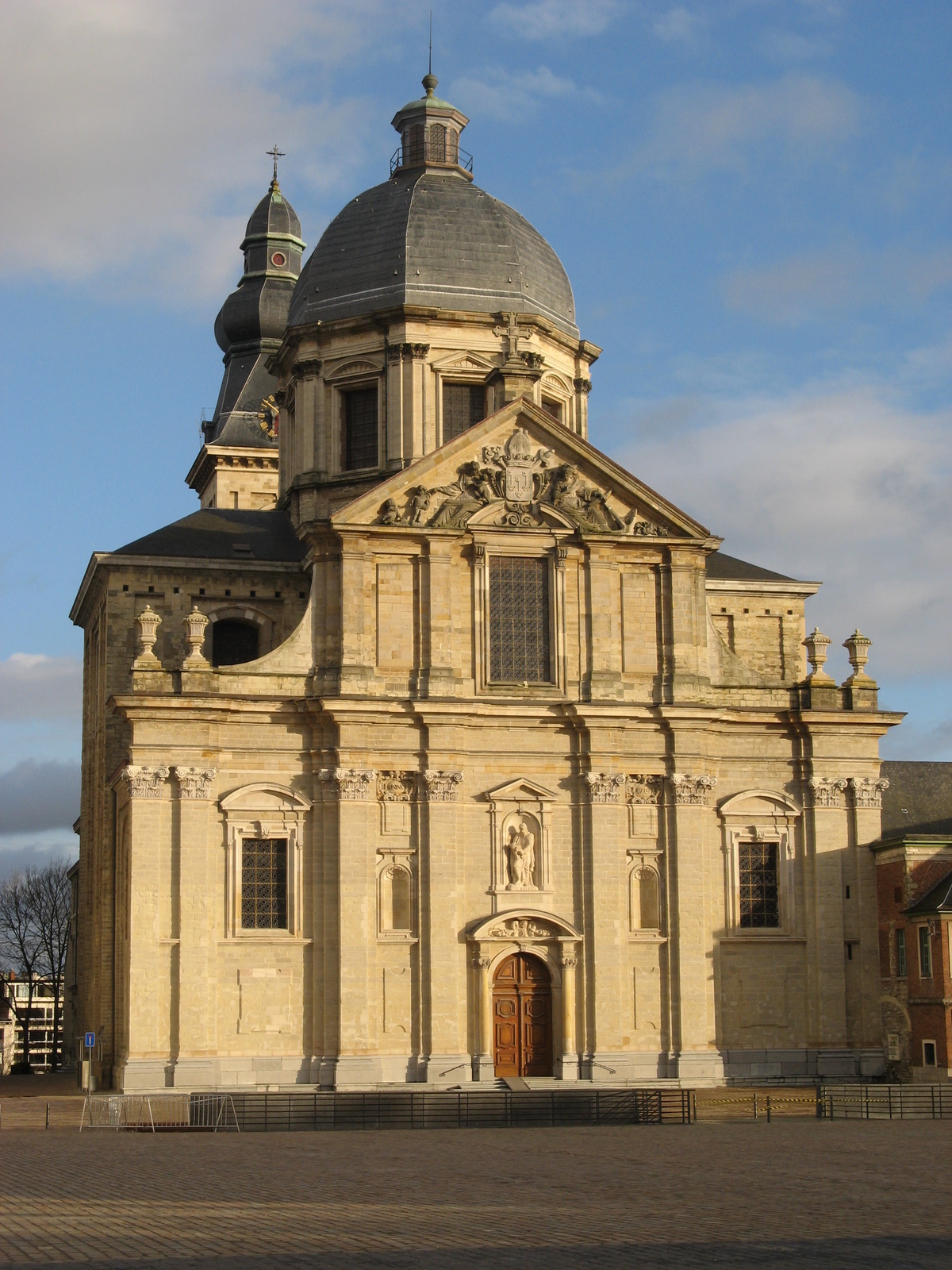
Saint Peter's Abbey, Ghent
Around the year 984, a letter arrived in Ghent from the cathedral school of Reims. The director, a brilliant young scholar named Gerbert of Aurillac, wanted to know whether students from his school could be admitted to Saint Peter's Abbey on the Blandijnberg. Gerbert would later become Pope Sylvester II, the first French pope, a man so learned in mathematics and astronomy that his contemporaries suspected him of having sold his soul to the devil. He wanted to send his pupils to Ghent. That is how good the abbey school on this hill once was.
A Missionary in the Marsh
In the late 7th century, the Frankish kings sent a missionary named Amandus into the swamps of the Scheldt-Leie confluence to convert the pagans who lived there. By tradition, his early efforts went so badly that he was thrown into the river more than once. He kept coming back. Around 650 he founded two monasteries in what would become Ghent: Saint Bavo's down by the rivers, and Saint Peter's up on the Blandijnberg - the highest ground in the city, a slight rise that gave the abbey its commanding view. Both abbeys would shape Flemish history for the next thousand years. Both would burn, get rebuilt, get burned again. Saint Peter's was the one with the school.
Vikings and Counts
During the winter of 879 and 880, Norse raiders sailed up the Scheldt and plundered Saint Peter's. The abbey was left poor for the better part of a century, recovering slowly until Count Arnulf I of Flanders decided to make it the burial place of his dynasty. From the 940s onward, the counts of Flanders gave Saint Peter's land, gave it relics, gave it bodies. Arnulf himself, Baldwin II, Baldwin III, Adele of Vermandois, Rozala of Italy - generations of the men and women who ran medieval Flanders were laid in tombs here. Sometime before 941, Arnulf replaced the abbey's secular canons with Benedictine monks. The reform stuck. By the second half of the 10th century, Saint Peter's was the wealthiest abbey in Flanders, with an income from estates that stretched all the way to Greenwich. Elthruda, niece of King Alfred of England, had donated Saint Mary's Church in Lewisham in 918.
The Year the Mob Came
In August 1566, the Beeldenstorm reached the Blandijnberg. Calvinist iconoclasts moved through the abbey smashing what was sacred - statues, altarpieces, reliquaries, anything they could reach. The destruction was so thorough that the abbey church and conventual buildings had to be largely rebuilt over the following century. The Baroque church that stands today, Onze-Lieve-Vrouw Sint-Pieterskerk, with its central nave designed by Pieter Huyssens, dates from that 17th-century rebuilding rather than the medieval original. The medieval abbey is gone. What you see is what the monks were able to put back. The 15th-century library, the scriptorium, the refectory - all the rooms where the school of Saint Peter's had once taught the artes liberales to students sent from Reims - had to be conceived again from the ground up.
The Quiet Modern Life
After Napoleonic France dissolved the religious orders, the abbey complex passed through a long series of secular uses. Today it functions as a museum and exhibition center. In 2000 it hosted a major exhibition for the Year of Emperor Charles, marking the 500th anniversary of Charles V's birth in Ghent. In October 2001, the 88th meeting of the European Council was convened in the abbey buildings, a particular kind of full circle: Frankish missionaries founded a school here to bind a continent together with Latin, and 1,350 years later the heads of European government sat down at the same address to bind that continent in a different language. Lu Zhengxiang - born in Shanghai, who served multiple times as China's minister of foreign affairs before becoming a Benedictine monk and later being appointed titular abbot of this abbey - is among the unlikely figures connected to this place. The abbey collects unlikely lives.
What the Hilltop Sees
The Blandijnberg is barely twenty-nine meters above sea level, which counts as a mountain in Flanders. From the abbey gardens you can read the geography that made Ghent: the slight rise where the dry ground met the wet, the bend in the Scheldt visible to the north, the spires of the three towers rising from the lower city. The monks of Saint Peter's were drainage engineers as much as they were scholars; through the 12th and 13th centuries they reclaimed forests, moors, and marshes for farmland, doing the heavy work that turned a confluence into a kingdom. Stand at the top of the abbey today and the work is invisible. The fields exist. The marsh does not. Whatever the monks did down there, in their patient centuries between Latin lessons, it stuck.
From the Air
Located at 51.042 N, 3.727 E on the Blandijnberg, the slight hill that forms the southern edge of Ghent's historic core. Best viewed from the air at 1,500-3,000 ft - the abbey complex reads as a long stretch of pitched roofs and a single church tower rising slightly above surrounding buildings, with the three medieval towers of central Ghent visible to the north. Closest international airport: Brussels (EBBR), 60 km southeast. Wevelgem (EBKT) lies 40 km southwest.