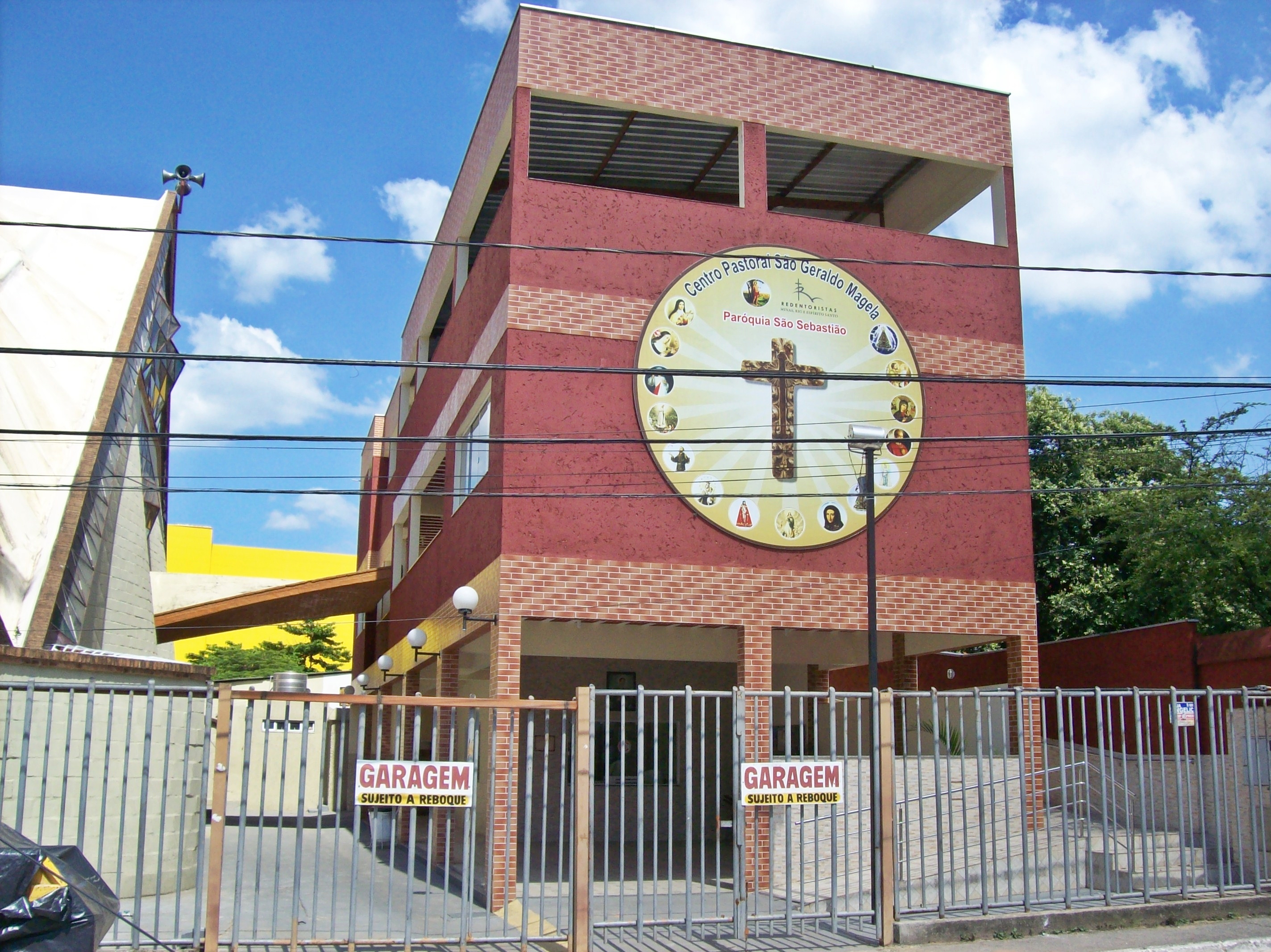
Saint Sebastian Cathedral, Coronel Fabriciano
The design idea came from Exodus 26:14 - the biblical instruction for a tent of coverings that would serve as the portable sanctuary of the Israelites in the wilderness. From there, it traveled across the world to the St. Mary's Cathedral in Tokyo, a 1964 hyperbolic-paraboloid structure by the Japanese architect Kenzo Tange. And from Tokyo, it traveled again, this time to Coronel Fabriciano, an industrial city in the Vale do Aço of Minas Gerais, where a parish priest and a local architect adapted the concept once more. The result, consecrated on 4 July 1993, is the Saint Sebastian Cathedral - a contemporary tent of concrete and glass seating 1,200 people, an architectural idea that crossed oceans twice to land in the hills of iron country.
A City That Outgrew Its Church
The original Saint Sebastian Parish Church was inaugurated in 1949, as Coronel Fabriciano was rising alongside the Belgo-Mineira and Acesita steel operations. The parish had been growing faster than the building could hold. By 1974, the larger religious celebrations had to move to the Dom Lélis Lara Parish Hall across the street. In 1979, Coronel Fabriciano was named a co-seat of the Diocese of Itabira, which became the Diocese of Itabira-Fabriciano, and the old parish church received the honorary designation of co-cathedral. But the honor did not solve the space problem. By February 1987, a campaign to build a new and larger temple was underway, driven by Father Élio da Silva Athyde and a parish that turned out for bake sales, musical shows, dances, and competitions to raise the money.
Tokyo to the Vale do Aço
The architect Ronei Lombardi Filgueiras developed the plans. His inspiration was St. Mary's Cathedral in Tokyo, a Kenzo Tange masterpiece completed in 1964, whose swooping walls rise in eight steel-clad curves like a tent made of silver. Tange himself had drawn from the same biblical passage - Exodus 26, describing the Tabernacle of meeting, the movable dwelling of God among the Israelites in the desert. Lombardi Filgueiras took the concept and adapted it for Brazil: a contemporary concrete structure, softer in line than Tange's Tokyo design, large enough to seat 1,200 worshippers at once. The cornerstone was laid on the morning of 20 January 1988, after a solemn mass and procession from the old parish church. Five and a half years of construction followed. On 4 July 1993, 38 religious dignitaries attended the consecration ceremony.
What It Holds
Inside, the cathedral gathers the particular objects of a working parish. A large sculpture of Saint Sebastian - the Roman soldier martyr whose iconography shows him bound and pierced with arrows - was donated by José Avelino Barbosa in 1992. His father, the merchant Rotildino Avelino, had donated the patron-saint images to the city's first church in 1929 and again to the parish church in 1949, a family tradition of patronage spanning three generations of Coronel Fabriciano's Catholic life. A miniature of the Calado Station, a nearby railway point significant to the region's history, stands inside. So does a pipe organ acquired by Dom Lélis Lara - listed as a municipal cultural heritage object - whose sound fills the space during the feast days. The Blessed Sacrament Chapel was reinaugurated in 2015, and a memorial to Dom Lélis Lara, the bishop who shepherded the parish for decades, was added after his death in 2016.
A Roof That Fell
On the night of 12 May 2022, part of the cathedral's roof collapsed. No one was inside. The building had to be closed by Civil Defense, and the community that had raised the money for its construction nearly thirty years earlier had to raise money again for its restoration. For many parishioners, the damage was personal. The cathedral had become the center of their communal life - Ash Wednesday observances, Holy Week processions, the Coronation of Mary in May, the Misa de Gallo at Christmas, and above all the feasts of Saint Sebastian in January. The Corpus Christi celebration had shifted its route in the 1990s to run through the Santa Helena and Professores neighborhoods around the cathedral, and the carpet of colored sawdust laid for the procession was recognized as cultural heritage. When the roof came down, it took a piece of civic rhythm with it.
From Above
Coronel Fabriciano sits in the narrow valley of the Piracicaba River, surrounded by the steel towns of Ipatinga and Timóteo that together make up the Vale do Aço - the Valley of Steel. From the air, the cathedral reads clearly: a white contemporary tent set against the urban grid, different from the red-tile colonial churches dotting the region. To the east, the Rio Doce State Park holds the forest that used to cover all of this country. To the west, the steel plants send their plumes into the sky. The cathedral marks the center, in both its geographical and its spiritual senses - a place where a biblical idea traveled from Sinai, through Kenzo Tange's Tokyo drawings, to the working-class pews of a twentieth-century Brazilian industrial city, and found a home.
From the Air
Coordinates 19.52°S, 42.62°W place the cathedral in Coronel Fabriciano, Minas Gerais, in the Vale do Aço industrial corridor. Recommended viewing altitude 3,000-5,000 feet AGL to appreciate the cathedral's distinctive tent-like profile against the urban grid. Nearest airport is Usiminas Airport (SBIP) at Ipatinga, about 10 km east. The cathedral is roughly 35 km west of the Rio Doce State Park and 180 km east of Belo Horizonte's Tancredo Neves International (SBCF).