Saint Valentine's Day Massacre
Sergeant Clarence Sweeney of the Chicago Police Department leaned over Frank Gusenberg in the hospital and asked the question. Gusenberg had been shot multiple times and had crawled several feet from where he fell. His brother Peter was already dead. "Who shot you?" Sweeney asked. "No one," Gusenberg replied. "No one shot me." He died shortly afterward. The gangland code of silence held even in death. On the morning of February 14, 1929, seven men had gathered in a garage at 2122 North Clark Street in Chicago's Lincoln Park neighborhood. Between four and six men entered, two dressed as police officers. The seven were lined up against a wall and executed with Thompson submachine guns and a shotgun. Seventy rounds from the Thompsons, one cartridge from the shotgun. Six died instantly. Gusenberg, the seventh, lived long enough to say nothing. The Saint Valentine's Day Massacre became the single most notorious act of Prohibition-era violence in America -- and the event that convinced the country the experiment had gone too far.
Whiskey, Territory, and Bad Blood
The massacre grew from a bitter rivalry between two criminal empires fighting for control of Chicago's illegal liquor trade. On one side was Al Capone's Chicago Outfit, the largest and most powerful criminal organization in the city, with an estimated annual income of over $40 million by 1929. On the other was the North Side Gang, led by George "Bugs" Moran, whose nickname came from his intense stare and homicidal temper. The two organizations had been at war since the mid-1920s, trading assassinations and attempted killings. In 1925, Moran and Hymie Weiss ambushed and nearly killed Capone's predecessor, Johnny Torrio, shooting him multiple times. Torrio survived but was so shaken that upon his release from the hospital, he handed the entire Outfit to Capone and fled to New York. In 1926, Capone survived a spectacular drive-by attack on his Hawthorne Hotel headquarters in Cicero -- ten cars spraying machine gun fire into the building, over a thousand rounds fired. Despite the mutual hostility, the gangs still did business. Capone sold Canadian Old Log Cabin whiskey to Moran's speakeasies. When Moran tried to cut costs by buying cheaper whiskey, his customers revolted. He asked Capone to resume supply. Capone refused. Moran began hijacking shipments instead.
Ten Minutes on Valentine's Day
Sources disagree on why the seven men were in the garage that morning. Some historians say Moran had been lured with an offer of hijacked whiskey. Others contend that the men were Moran's inner circle, assembled for a meeting -- they were all in expensive suits, an unlikely outfit for unloading trucks. What is certain: seven men were there by 10:30 a.m. Five were North Side Gang members, including Moran's second-in-command Albert Kachellek, bookkeeper Adam Heyer, and enforcers Frank and Peter Gusenberg. Two were not gang members -- Reinhardt Schwimmer, a former optician who liked associating with gangsters, and John May, a mechanic fixing a truck wheel, who had brought his dog Highball. A black Cadillac pulled up. Two men in police uniforms and three in civilian clothes entered the garage. The seven men were forced to face the wall. Then came the Thompson submachine guns, fire directed methodically along the line at the head, chest, and stomach. The coup de grace was delivered to two victims with a shotgun. The gunmen left through the front door -- the men in civilian clothes with hands raised, followed by the fake officers holding Tommy guns, as if conducting an arrest. It was the neighbors, alerted by Highball's frantic barking, who called the real police.
"Only Capone Kills Like That"
The massacre's intended target, Bugs Moran, was late. He drove past the garage, saw what he thought was a police car, and ducked around the corner for coffee to avoid what he assumed was a raid. When he learned what had happened, he checked into a hospital under a false name. Tracked down by a reporter, Moran delivered the line that became inseparable from the crime: "Only Capone kills like that." Capone, meanwhile, was in Florida. Newspapers covered the slaughter with unprecedented intensity, selling millions of copies. The public was stunned. As Capone's biographer Jonathan Eig wrote, people reached the conclusion that "a line had been crossed, that the violence had become too much to bear, that the experiment known as Prohibition had blown up once and for all." Four separate investigations launched within hours -- by the police, the detective bureau, the Illinois Attorney General, and the coroner. Calvin Goddard, a pioneer in forensic ballistics, was brought to Chicago to establish a laboratory, where he proved the police department's own Thompson guns had not been used in the killings.
The Long Trail to Nowhere
The investigation turned up tantalizing leads but no convictions. Police found a partially burned 1927 Cadillac in a garage on Wood Street with a police siren, a Thompson drum magazine, and a Luger pistol. A second vehicle, a 1926 Peerless touring car, was blown up in suburban Maywood -- possibly a plant to confuse investigators. Jack McGurn, one of Capone's most notorious hit men, was arrested but his girlfriend provided his alibi. John Scalise and Albert Anselmi were charged; the charges were dropped for lack of evidence. Capone later murdered all three at a dinner in their honor after learning they were plotting against him. The break came in December 1929 when Fred Burke, drunk, crashed his car in St. Joseph, Michigan, and shot the patrolman who intervened. A police raid on Burke's home turned up two Thompson submachine guns forensically matched to the massacre weapons. Burke was convicted of the patrolman's murder and sentenced to life in prison; he was never tried for the massacre. In 1935, lookout Byron Bolton confessed to the FBI, naming Fred Goetz, Gus Winkler, Fred Burke, Ray Nugent, and Bob Carey as the killers, claiming Capone had ordered the hit. But by then most of the named men were dead. The coroner closed his inquest in 1931 with three words: "persons unknown."
The Wall, the Law, and What Remains
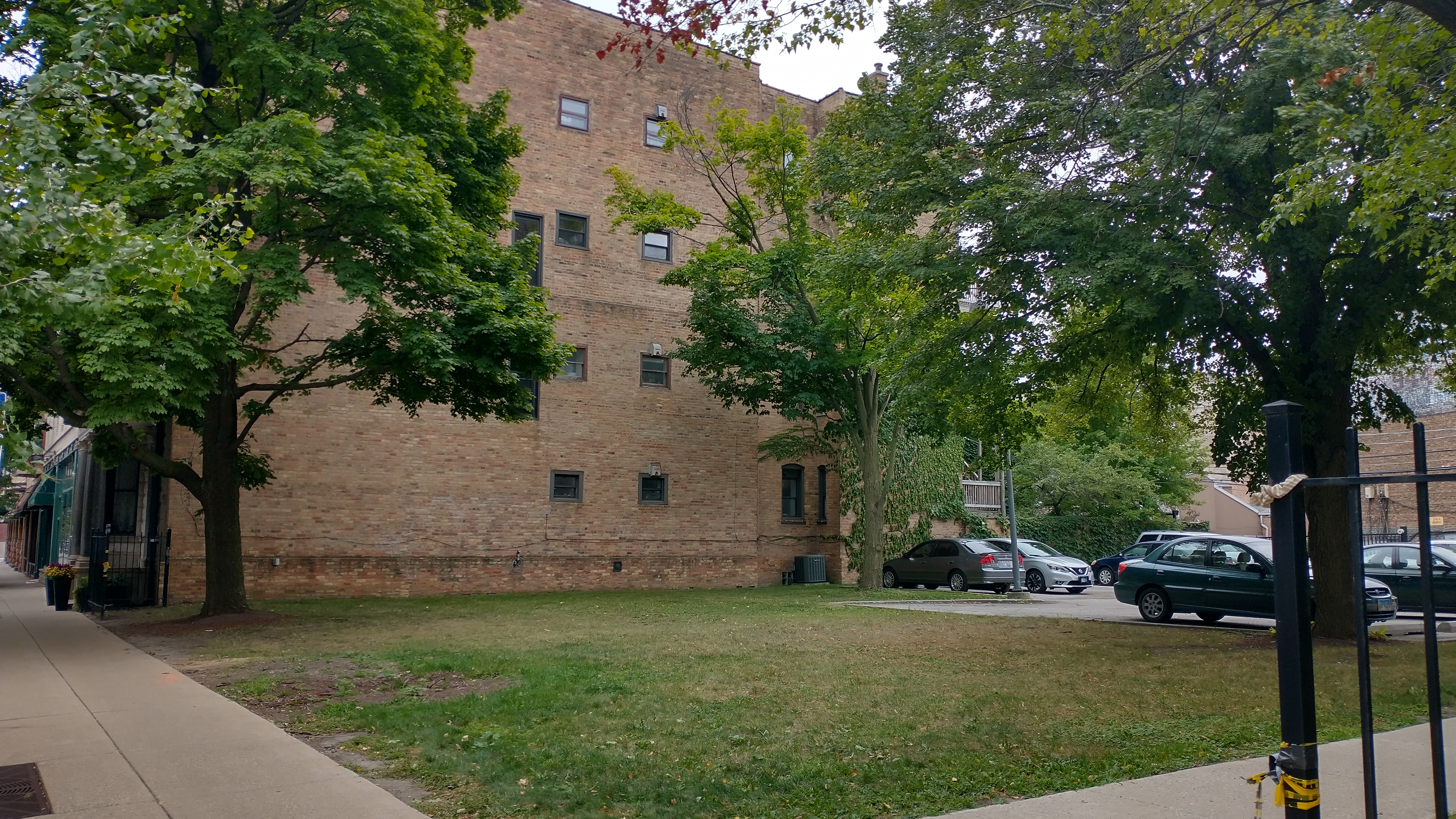
The garage at 2122 North Clark Street was demolished in 1967. The north wall -- the one the seven men faced -- was purchased by a Canadian businessman who displayed the bricks in crime-themed novelty exhibits for years. Many were later sold individually; the remainder reside at the Mob Museum in Las Vegas. The site itself is now an unremarkable patch of grass in front of a building, marked by nothing except the knowledge of what happened there. But the massacre's consequences outlasted its physical traces. The Thompson submachine gun's role in Prohibition-era slaughter, combined with the machine gun-led crimes of John Dillinger and the killing of Chicago Mayor Anton Cermak during an assassination attempt on President-elect Franklin Roosevelt, pushed Roosevelt to propose federal gun regulation. The result was the National Firearms Act of 1934 -- not the bill Roosevelt wanted, since Congress stripped the handgun restrictions, but it imposed a $200 tax on every machine gun (doubling their cost) and created a dealer licensing system. Capone himself was indicted on 22 counts of income tax fraud in June 1931 and sentenced to eleven years in prison. The conflict between the Outfit and the North Side Gang ended by 1931, with Capone's organization absorbing its rival's territory. The massacre did not end organized crime in Chicago. But it ended the idea that such violence could be tolerated.
From the Air
The site of the Saint Valentine's Day Massacre was at 2122 North Clark Street in the Lincoln Park neighborhood of Chicago's North Side, at approximately 41.921N, 87.636W. The garage was demolished in 1967; the site is now a lawn. The location is roughly two blocks west of the lakefront, between West Dickens Avenue and West Webster Avenue. Lincoln Park stretches along the lake to the east. Nearest airports: Chicago O'Hare International (KORD), approximately 13nm northwest; Chicago Midway International (KMDW), approximately 10nm south-southwest. From altitude, the Lincoln Park green corridor along the lakefront and the grid of the North Side provide orientation.