Sainte-Chapelle: A Reliquary Turned Inside Out
The relics cost more than the building. King Louis IX paid 135,000 livres for what he believed was the Crown of Thorns worn by Christ during the Passion -- a sum he handed to Venetian bankers who held the crown as collateral from the cash-strapped Latin Emperor in Constantinople. The chapel he built to house it cost 40,000 livres. That arithmetic tells you everything about Sainte-Chapelle: it was conceived not as a church but as the world's most expensive jewelry box, a structure whose purpose was to be worthy of its contents.
The Politics of Sacred Shopping
Louis IX's relic purchases were not merely devotional. With the imperial throne at Constantinople occupied by a count of Flanders and the Holy Roman Empire in disarray, Louis positioned himself as the central monarch of western Christendom. Owning the Crown of Thorns meant that Christ had, symbolically, crowned Louis with his own crown -- a point Pope Innocent IV made explicitly. The relics arrived in Paris in August 1239, carried from Venice by two Dominican friars. For their final approach, Louis himself bore them barefoot and dressed as a penitent, a scene later immortalized in the chapel's own stained glass. He spent another 100,000 livres on a silver chest to display them. The chapel was merely the container for the container.
Walls Made of Light
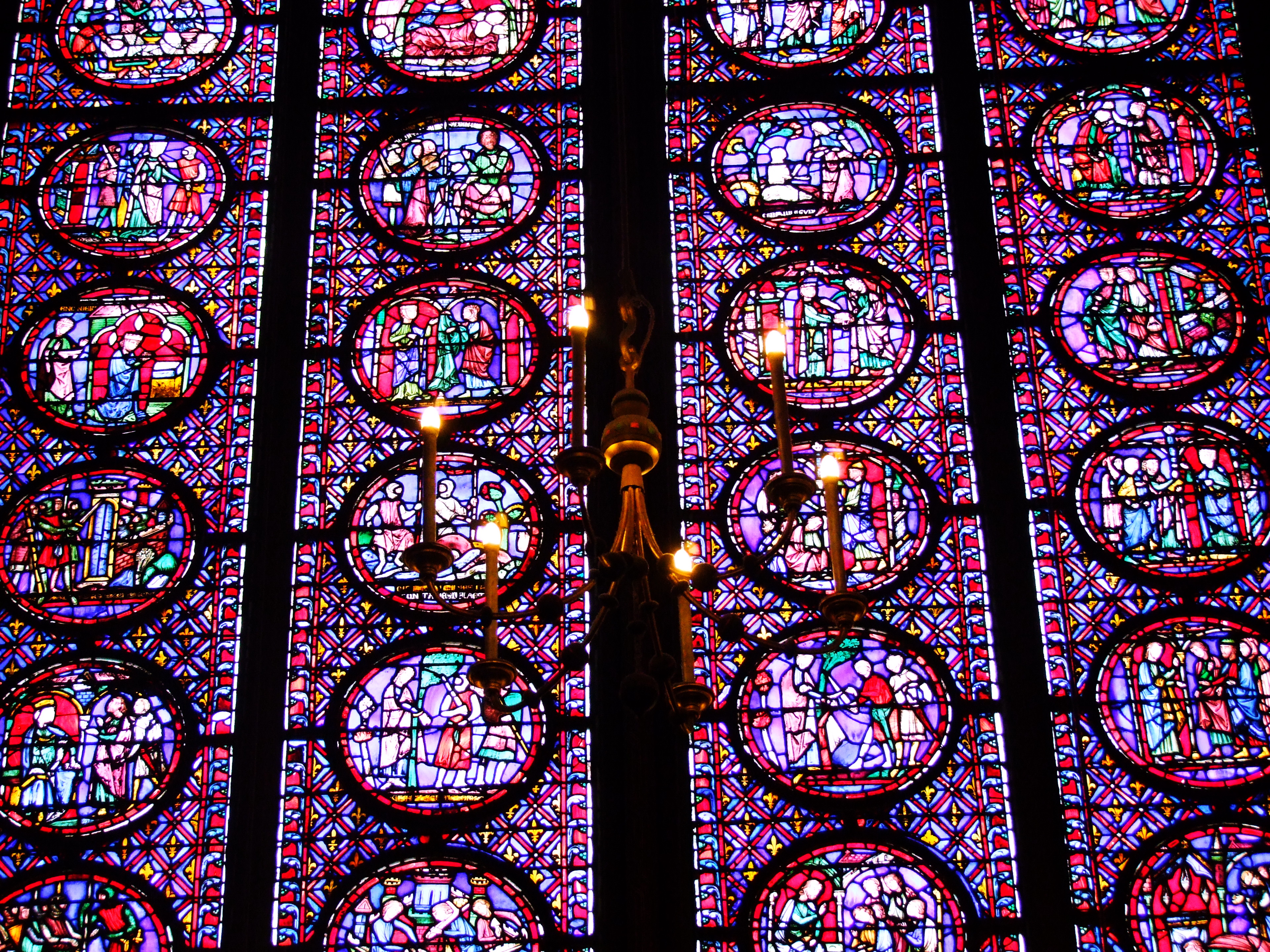
Construction began around 1242, and the chapel was consecrated on April 26, 1248. What the builders achieved in six years remains staggering. The upper chapel's walls are nearly all glass -- 670 square meters of stained glass depicting over 1,100 biblical scenes in deep blues and reds that shift in intensity hour by hour. The stone framework between the windows is so slender it almost disappears, each vertical support disguised as a bundle of seven thin columns. Hidden iron chains brace the windows at two levels, and additional metal supports under the eaves resist wind pressure. The engineering is invisible; the effect is transcendent. Art historian Louis Grodecki identified three distinct workshops in the glass, each with recognizable styles -- supple forms from one, elongated figures with angular draperies from another, subtler facial details from a third.
Two Chapels, Two Worlds
Sainte-Chapelle is actually two churches stacked vertically. The lower chapel, dedicated to the Virgin Mary, served the courtiers, servants, and soldiers of the royal palace. At just 6.6 meters high, its ceiling is held aloft by an ingenious system of small arched buttresses connecting inner and outer columns, reinforced by metalwork hidden beneath paint and plaster. The upper chapel, reserved for the royal family, is reached by narrow spiral stairways in the towers. Here Louis and his queen worshipped in small alcoves set into the walls, their archivolts richly decorated with painted angels. The king could pass directly from his palace into this private heaven of colored light -- just as the Byzantine emperor could walk from his palace into the Hagia Sophia, a parallel Louis was keen to exploit.
Revolution, Storage Room, Resurrection
As both a symbol of religion and royalty, Sainte-Chapelle was an obvious target during the French Revolution. The spire was pulled down, exterior sculpture smashed, and royal emblems destroyed. The sacred relics were dispersed, their precious reliquaries melted down. Between 1803 and 1837, the upper chapel served as a filing cabinet -- literally a document storage room for the Palace of Justice archives, with the lower stained glass removed to let in working light. Restoration began in 1840 under Felix Duban, then Jean-Baptiste Lassus, with the young Eugene Viollet-le-Duc assisting. The campaign lasted twenty-eight years and became a training ground for a generation of restorers. About two-thirds of the stained glass is original; the rest was painstakingly recreated from surviving medieval glass and Gothic-style reproductions.
The Crown Returns
The Crown of Thorns survived the Revolution, passing through various hands before receiving a new reliquary of gold and crystal and finding a home in Notre-Dame's treasury. When Notre-Dame burned on April 15, 2019, the crown was among the first relics rescued from the flames. It was stored temporarily in the Louvre before returning to the restored cathedral in December 2024. Sainte-Chapelle itself underwent a seven-year, ten-million-euro restoration beginning in 2008, including the cleaning of all stained glass and the application of thermoformed protective layers. The flamboyant rose window on the west facade, installed in the 15th century with its eighty-seven panels depicting scenes of the Apocalypse, was completed in time for the 800th anniversary of Saint Louis's birth in 2015. The building Louis IX built as a political statement and an act of devotion endures as one of the supreme achievements of Gothic art.
From the Air
Sainte-Chapelle (48.855N, 2.345E) stands on the Ile de la Cite in central Paris, adjacent to the Palais de Justice. Its spire is visible from the air alongside Notre-Dame, 300 meters to the east on the same island. Paris Charles de Gaulle (LFPG) is 25km northeast; Paris Orly (LFPO) is 14km south. Best viewed at lower altitudes; the chapel's slender spire and the Seine island setting are distinctive from 2,000-3,000 feet.