Sakanoue no Tamuramaro: The Shogun Who Became a Legend
Every August, three million people flood into Aomori Prefecture to watch enormous illuminated paper floats parade through darkened streets. The floats blaze with painted warriors and mythical figures, carried by chanting teams while crowds roar encouragement. The festival is called Nebuta, and its origin story traces back twelve centuries to a single military stratagem: a general who ordered giant lanterns placed on hilltops so the curious Emishi would approach to investigate -- and be captured. That general was Sakanoue no Tamuramaro, only the second person in Japanese history to bear the title Sei-i Taishogun, "Great General Who Subdues the Barbarians." His tomb sits quietly in Yamashina Ward, Kyoto, overlooking the ancient capital he helped protect. But his real monument is something stranger -- a transformation from historical commander into supernatural folk hero, a man whose story grew so large it swallowed the boundary between history and myth.
A Warrior With Foreign Roots
Tamuramaro was born in 758, the son of Sakanoue no Karitamaro. His family, the Sakanoue clan, traced its lineage to the Yamatonoaya clan, whose origins lay on the Korean peninsula. According to the Nihon Shoki, compiled in 720, the clan descended from immigrants from the ancient kingdom of Baekje. Later sources muddied the picture further, with the Shoku Nihongi claiming descent from Emperor Ling of Han and the Shinsen Shojiroku pointing to Emperor Xian of Han. Modern scholarship leans toward Gaya confederacy descent, specifically from Ara Gaya. Whatever the precise genealogy, Tamuramaro rose through the court of Emperor Kanmu to hold some of the highest offices in the land: Dainagon (Senior Counselor), Minister of War, and Major Captain of the Right Division of Inner Palace Guards, reaching the court rank of Junior Second Rank.
The Campaigns That Pushed the Frontier North
Emperor Kanmu gave Tamuramaro the task that would define his career: subjugating the Emishi, the indigenous peoples of northern Honshu. The Emishi Seibatsu -- the conquest of the Emishi -- was a sustained imperial project to extend Japanese control into the Tohoku region. Tamuramaro was only the second to carry the title Sei-i Taishogun for this purpose; the first had been Otomo no Otomaro. But Tamuramaro was more effective. He pushed imperial authority deep into the northeast, though historical records show no evidence he ventured farther north than present-day Iwate Prefecture. Many Emishi remained in Tohoku as subjects of the expanding empire, later establishing semi-independent Fushu domains. Evidence also suggests a migration of Emishi from northern Honshu to Hokkaido between the seventh and eighth centuries, possibly driven by this very policy of military expansion. After Emperor Kanmu's death, Tamuramaro continued to serve both Emperor Heizei and Emperor Saga, his authority undiminished across three reigns.
The Builder Behind Kiyomizu-dera
Tamuramaro's name is not only etched in military history. He is linked to the construction of Kiyomizu-dera, one of Kyoto's most famous temples, through payments he made for building projects there in the late eighth century. The connection between warrior and temple is fitting -- Kiyomizu-dera, the "Pure Water Temple," sits in the Higashiyama foothills where springs still flow, and Tamuramaro himself was considered an avatar of Bishamonten, the Buddhist guardian of the north and a deity of warriors. The historical accounts in the Azuma Kagami also record an episode in which Tamuramaro and Fujiwara no Toshihito fought together to subdue a band of Emishi bandits at the Taya Caves on the road back to Kamakura -- a detail that blurs the line between his administrative career and the adventurous life that legend would later inflate into something extraordinary.
From General to Demon-Slayer
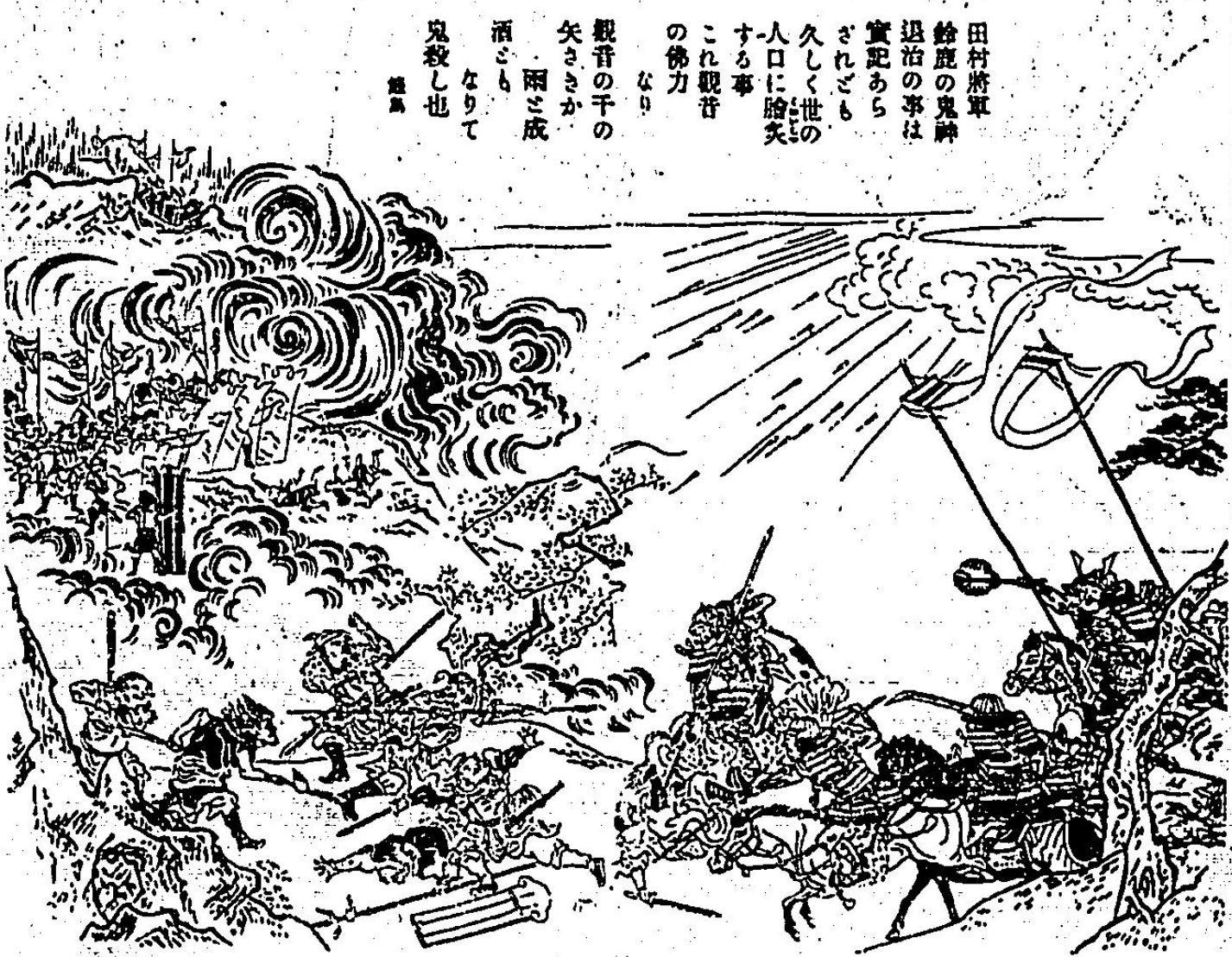
When Tamuramaro died in 811 at the age of 54, Emperor Saga mourned him extravagantly, distributing silk, cotton, and rice in his honor. By imperial order, Tamuramaro was buried with his bow, arrows, quiver, and sword. His descendant Urabe no Suetake inherited the bow. But death was only the beginning of Tamuramaro's second career. In the centuries that followed, he became a fixture of Japanese folklore -- no longer just a general who fought border wars, but a supernatural hero who slew demons and bandits across the land. According to legend, he killed Ootakemaru, one of the Great Three Evil Yokai of Japan. Other tales connect him to the mysterious Suzuka Gozen, a figure he variously marries or battles. Their daughter Shourin, the stories say, became the guardian deity of the Suzuka Mountains. Tamuramaro carried legendary swords and received blessings from Senju Kannon and the god Takeminakata.
Lanterns on the Hilltops
The Nebuta festival in Aomori City and the Neputa festival in Hirosaki City stand as Tamuramaro's most visible legacy. Both celebrations feature massive, elaborately painted paper floats that glow from within, illuminating summer nights as they move through crowded streets. The tradition holds that these lanterns recall Tamuramaro's clever tactic against the Emishi: bright lights set on hilltops to draw curious tribespeople into the open. Until the mid-1990s, the prize for the best float was called the Tamuramaro Prize. Historians note that no record places Tamuramaro farther north than Iwate -- Aomori lies well beyond his documented reach. But the legend was never about strict geography. It was about a figure who grew too large for the facts to contain, a general whose real accomplishments gave way to something more powerful: a story a nation could celebrate, year after year, under glowing paper light.
From the Air
Tamuramaro's tomb is located in Kanshuji Higashikurisunocho, Yamashina Ward, Kyoto, at approximately 35.00N, 135.79E. The site sits on the eastern edge of Kyoto, east of the Higashiyama mountain range. From 3,000-5,000 feet AGL, look for the Yamashina district nestled in the valley between the Higashiyama hills and the ridgeline to the east. The Kamo River runs north-south through central Kyoto to the west. Nearest major airport is Osaka Itami (RJOO), approximately 25 nautical miles southwest, with Kansai International (RJBB) about 50 nautical miles south.