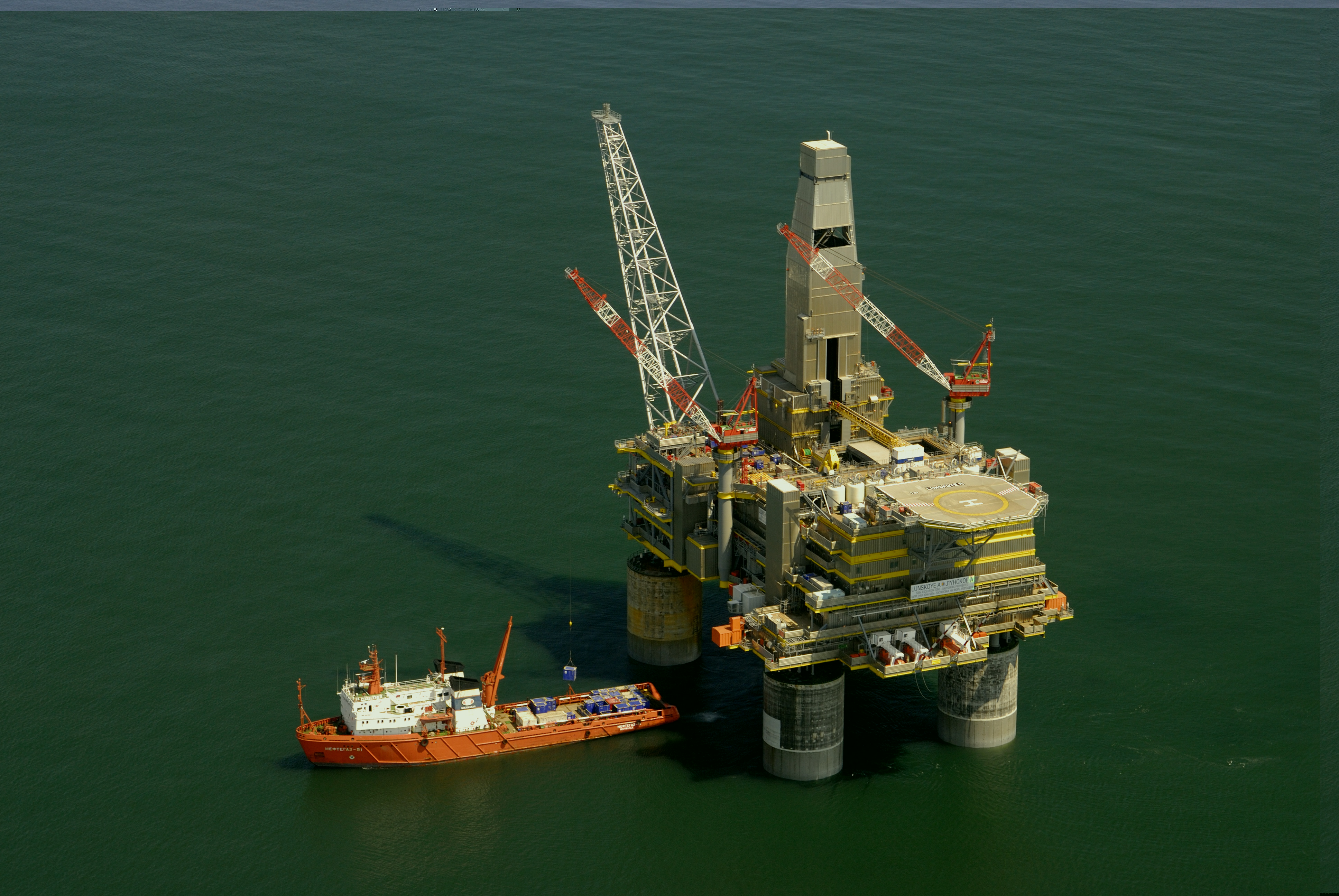
Sakhalin-II
Somewhere beneath the frigid waters of the Sea of Okhotsk, two enormous offshore platforms stand on legs driven into the seabed, extracting oil and gas from fields that took millions of years to form. The Sakhalin-II project, Russia's first liquefied natural gas operation, pumps hydrocarbons from waters so cold that ice floes can shear through steel. It is one of the most technically challenging energy developments ever attempted, built in an area previously untouched by industry -- and one where western gray whales come to feed each summer.
The Consortium That Changed Hands
The story of Sakhalin-II begins in 1992, when a consortium led by Marathon Oil, McDermott, and Mitsubishi won a tender from the Russian government. Royal Dutch Shell joined later that year, and by 1994 the group had incorporated in Bermuda as Sakhalin Energy Investment Company. Shell eventually became the dominant partner, investing billions in what would become one of the world's largest integrated oil and gas projects. But in 2006, the Russian government began pressuring Shell over alleged environmental violations. By December of that year, Gazprom had acquired a 50-percent-plus-one-share stake, giving the Russian state effective control. The takeover was widely seen as a strategic move to reassert sovereignty over Russia's energy sector -- a pattern that would repeat across the country's resource landscape.
Engineering Against the Elements
Building Sakhalin-II required engineering solutions for conditions that push technology to its limits. The Molikpaq, a steel caisson originally built for Arctic drilling in Canada, was towed across the Pacific and modified to serve as the Piltun-Astokhskoye-A platform. It sits in waters where winter sea ice exerts crushing force against its hull. The Lunskoye-A platform, installed 15 kilometers offshore in 2006, processes over 50 million cubic meters of natural gas daily. Connecting these offshore platforms to the mainland required the TransSakhalin pipeline system, running hundreds of kilometers across an island scarred by seismic activity, river crossings, and some of the harshest terrain in the Russian Far East. At the southern end, near Prigorodnoye, Russia's first LNG plant chills natural gas to minus 162 degrees Celsius for export to energy-hungry markets in Japan, South Korea, and beyond.
Whales in the Crosshairs
The western gray whale is one of the most endangered whale populations on Earth, and its summer feeding grounds overlap directly with Sakhalin-II's offshore operations. Environmental groups have raised alarms since the project's inception, arguing that seismic surveys, underwater noise, and the risk of oil spills threaten a population numbering only around 150 individuals. In 2006, the International Union for Conservation of Nature established a dedicated advisory panel to monitor the project's impact on the whales. The tension between energy development and conservation here is not abstract -- it plays out in real time, every feeding season, in the waters just beyond the platform lights.
A Geopolitical Weathervane
Sakhalin-II has functioned as a barometer of Russia's relationship with the West. When Shell led the consortium, the project represented international cooperation and foreign investment in post-Soviet Russia. Gazprom's 2006 takeover signaled a shift toward resource nationalism. Then, in July 2022, following Russia's invasion of Ukraine, President Putin signed a decree creating a new domestic entity to replace the existing operator, effectively forcing Shell to exit entirely. Shell wrote down its Sakhalin-II holdings, and its stake was eventually acquired by Gazprom, which now holds approximately 77.5% of Sakhalin Energy. Japan, heavily dependent on LNG imports, scrambled to maintain its supply contracts through the geopolitical turbulence, with government-backed insurance keeping tankers moving through contested waters. The project that once symbolized global energy partnership had become a case study in how quickly such partnerships can unravel.
The View from the Ice
From the air, Sakhalin's eastern coast is a study in contrasts. The dark platforms rise from gray-green seas, connected by pipeline corridors that cut across a landscape of taiga forest and river deltas largely unchanged since the last ice age. In winter, pack ice encases everything, and the platforms become isolated outposts serviced by icebreakers. The LNG plant at the island's southern tip glows against the surrounding wilderness at night. Sakhalin-II is a reminder that the modern world's energy appetite reaches even into places where nature still dominates -- and that the cost of extraction is measured not only in dollars and cubic meters, but in the survival of species that were here long before the first drill bit broke the seabed.
From the Air
Located at 52.87N, 143.77E off the northeast coast of Sakhalin Island. The offshore platforms are visible in clear weather from cruising altitude as structures in the open sea east of the island. The LNG plant is near the southern tip at Prigorodnoye. Nearest major airport: Yuzhno-Sakhalinsk (UHSS). The TransSakhalin pipeline corridor is visible as a cleared path running north-south along the island.