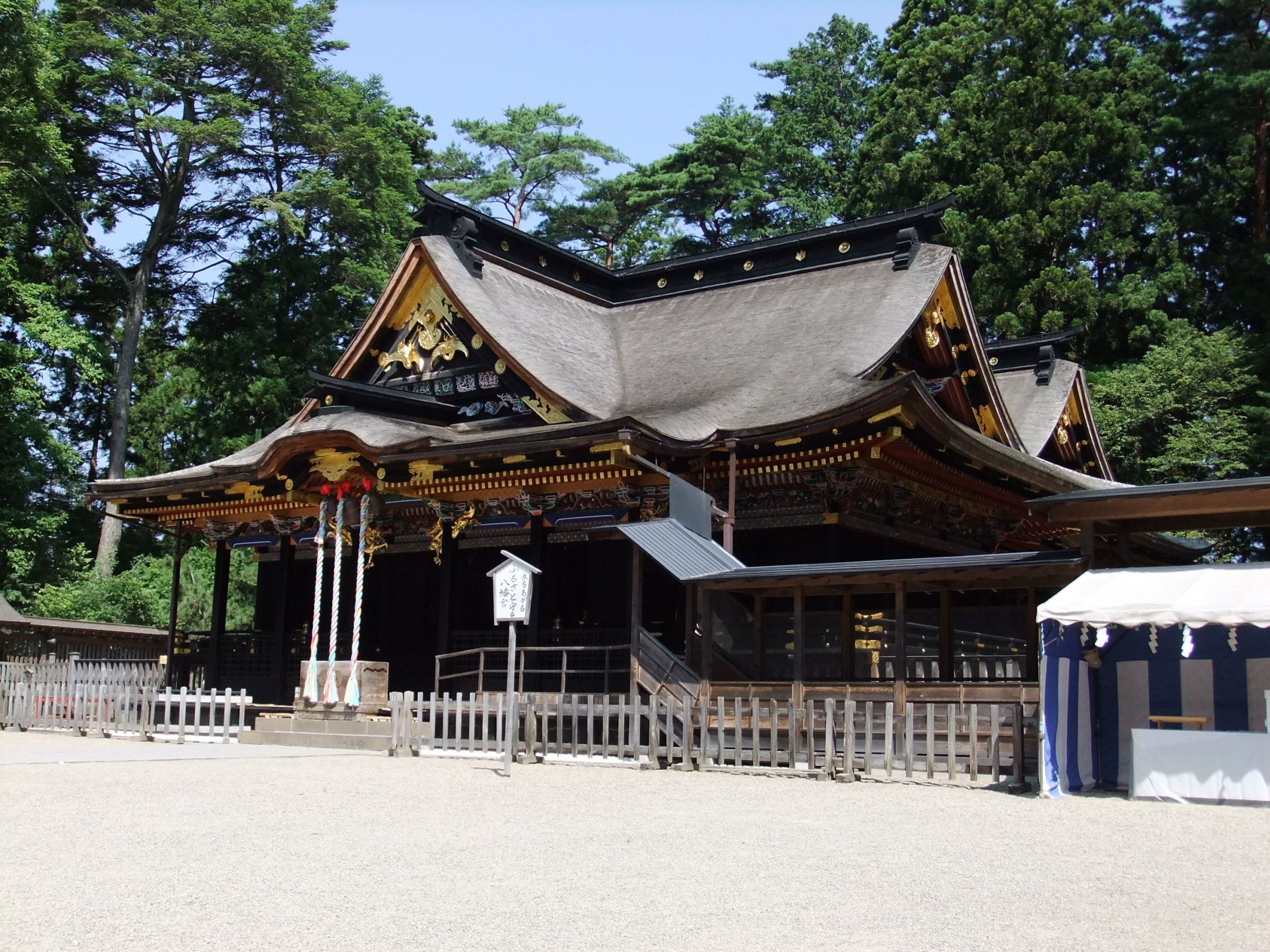
Osaki Hachimangu
Step through the stone torii and the plain approach gives nothing away. Then the main hall appears, and four centuries of lacquer, gilt, and carved wood hit all at once. Osaki Hachimangu in Sendai is a building designed to ambush the senses -- austere from a distance, overwhelming up close. Completed in 1607 on the orders of Date Masamune, the powerful lord who founded Sendai as his castle town, the shrine is one of the oldest surviving examples of gongen-zukuri architecture and has been designated a National Treasure of Japan. It stands today as proof of Masamune's ambition to transplant the cultural splendor of Kyoto to the northern frontier.
A Shrine on the Move
The origins of Osaki Hachimangu stretch far beyond Sendai. According to shrine legend, the great general Sakanoue no Tamuramaro first enshrined a divided spirit from Usa Shrine -- the head Hachiman shrine on the island of Kyushu -- at Isawa Castle in what is now Iwate Prefecture. During the Muromachi period, the Osaki clan, who served as military governors of the region, relocated the shrine to their own territory in present-day Osaki, Miyagi, and the name stuck. When the Osaki clan fell from power, Date Masamune claimed their guardian deity along with their lands. In 1604, he began construction of a grand new shrine at the northwest corner of his castle town, positioning it as the spiritual protector of Sendai itself.
Kyoto Craftsmen in the North
Masamune spared no expense. He recruited carpenters, painters, and metalworkers from Kyoto and central Japan, some of whom had previously served the Toyotomi family. Over three years, from 1604 to 1607, they created a shrine that consciously emulated the most lavish recent works of central Japan, particularly the Toyokuni shrine in Kyoto. The result is a masterwork of Azuchi-Momoyama period aesthetics: wood carvings of extraordinary intricacy, vivid polychrome painting, gleaming metal fittings, and lacquerwork that has survived over four centuries. The main hall, connecting passage, and worship hall sit under a single roof of thin Japanese cypress shake shingles, joined together in the gongen-zukuri style -- a sanctuary, a stone-floored passage called the ishi-no-ma, and a worship hall unified as one structure.
Where Gods Overlap
Osaki Hachimangu embodies the long Japanese tradition of shinbutsu-shugo -- the blending of Shinto and Buddhism. During the Edo period, the Buddhist deity Amida Nyorai was regarded as an avatar of Hachiman, the Shinto god of war, and the shrine was believed to offer protection against drought. People born in the years of the dog and boar in the Chinese zodiac still revere the shrine today. The yabusame horseback archery ritual, once performed by former vassals of the Osaki clan who traveled to Sendai at the domain's expense on festival day, connected the shrine to its martial roots. Each September 14, a Noh-like kagura dance -- originally performed by ten priests, now carried on by parishioners -- unfolds on the nagatoko platform before the worship hall. Of the original 17 dances, only eight survive, each a quiet link to vanishing traditions.
Treasure and Transformation
The Meiji government's 1868 separation of Shinto and Buddhism stripped the shrine of its Buddhist associations, and it reverted to the name Osaki Hachiman Jinja. The modern ranking system of 1871 categorized it modestly. But the architecture spoke for itself. The main hall's designation as a National Treasure in 1952 recognized it as one of the finest surviving examples of early 17th-century shrine construction in Japan. The surrounding buildings -- a Taisho-period shrine office, the former priest's residence, and a traditional stable -- are all National Registered Tangible Cultural Properties. In 1997, a decade before the shrine's 400th anniversary, the name was elevated to Osaki Hachimangu, the grander suffix reflecting both historical depth and living devotion.
From the Air
Located at 38.2722N, 140.8450E in Sendai's Aoba ward, on a wooded hillside northwest of Sendai Castle. The shrine sits amid dense urban Sendai, identifiable by its forested compound. Sendai Airport (RJSS) is approximately 18 km to the south-southeast. JGSDF Kasuminome Airfield (RJSU) lies about 10 km to the southeast. JASDF Matsushima Air Base (RJST) is roughly 25 km to the northeast. From 3,000 feet, Sendai Castle's Aobayama hill to the southeast and the Hirose River curving through the city provide reliable visual landmarks.