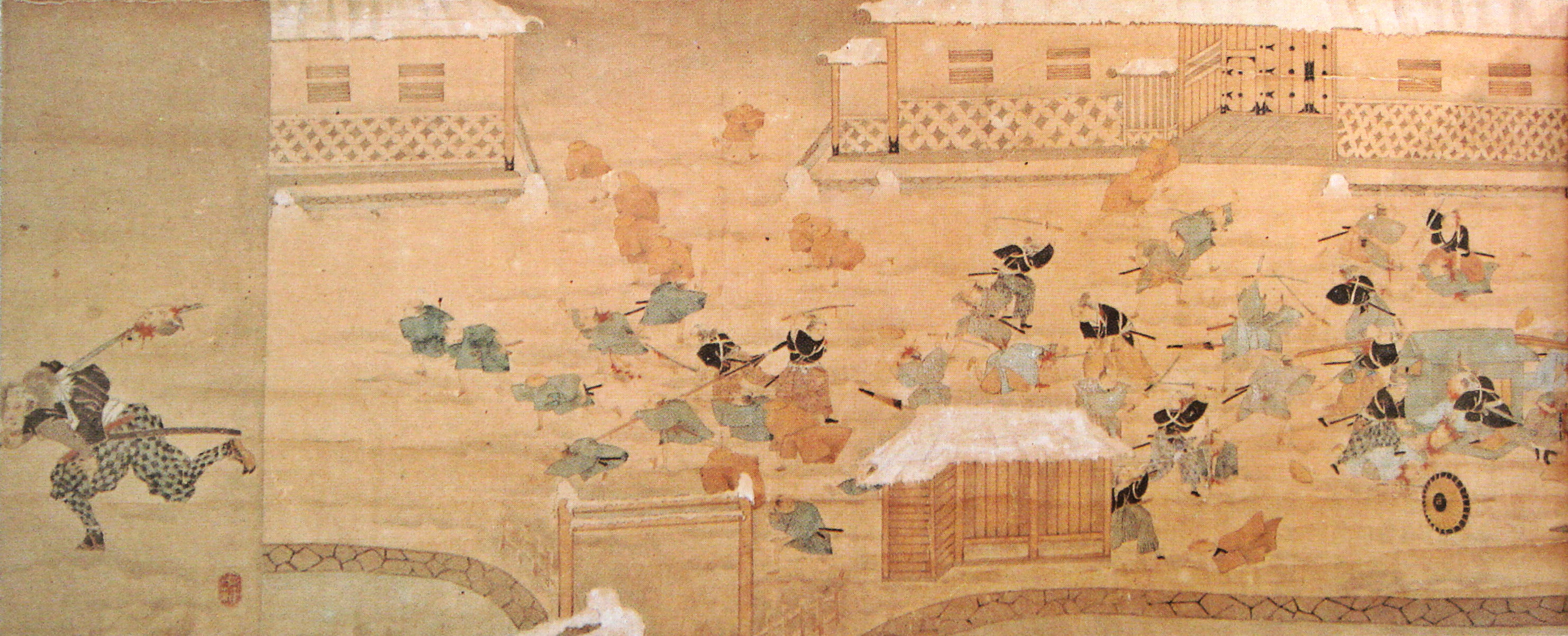
Sakuradamon Incident (1860)
The weapon that killed him was a gift. On March 24, 1860, a group of ronin samurai ambushed Ii Naosuke, the most powerful man in Japan, as his palanquin approached the Sakurada Gate of Edo Castle. While a diversionary attack drew his guards forward, a lone assassin fired a single shot into the enclosed litter with a Japanese-made copy of a Colt 1851 Navy Revolver -- copied from the very firearms that Commodore Matthew Perry had presented to the shogunate as diplomatic gifts just years earlier. The bullet struck Ii, likely paralyzing him. Then the assassins dragged him out and took his head. The irony was perfect: the man who had opened Japan to the West was killed by a Western weapon his own government had received as a token of friendship.
The Man Who Opened the Door
Ii Naosuke held the title of Tairo, Chief Minister of the Tokugawa shogunate, making him the most influential political figure in a country that had been sealed from the outside world for more than 200 years under the sakoku policy of national seclusion. In 1858, Ii signed the Treaty of Amity and Commerce with the United States, negotiated by American consul Townsend Harris, and soon followed with similar treaties with other Western powers. The decision was explosive. Emperor Komei had explicitly instructed the shogunate not to sign, and by defying the imperial court, Ii branded the Tokugawa government as traitors to the throne. From 1859, the ports of Nagasaki, Hakodate, and Yokohama opened to foreign traders, who were granted extraterritoriality -- the right to be judged under their own laws on Japanese soil. Ii further enraged his opponents through the Ansei Purge, a crackdown that imprisoned, exiled, or executed political rivals across the country.
Blood in the Snow
The assassination was timed for the Double Third Festival, when all daimyo lords stationed in Edo were required to enter the castle for ceremonial meetings. The conspirators, ronin from the Mito and Satsuma domains, knew Ii's palanquin would pass the Sakurada Gate. They struck in a coordinated assault: a frontal attack to scatter the bodyguards, then the fatal shot from the side. The assassin who beheaded Ii was Arimura Jisaemon, a samurai from Satsuma Domain, who immediately performed seppuku at the scene. The conspirators carried a written manifesto explaining their act, framing it as loyalty to the emperor against a government that had betrayed the nation. The shogunate was so shaken that officials refused to acknowledge Ii's death for a full month, claiming publicly that he was merely injured and recovering.
News Carried by Pony Express
Word of the assassination traveled by ship across the Pacific to San Francisco, then raced eastward across the American frontier by Pony Express. On June 12, 1860, The New York Times reported that Japan's first diplomatic mission to the West had received the news while abroad. The killing sent shockwaves far beyond Tokyo. For the samurai class, it was a resurrection: prior to the attack, warriors had been widely dismissed as weak and irrelevant, having lost their martial purpose during centuries of peace. The Sakuradamon Incident revived the culture of warrior rule and bushido spirit almost overnight. For the shogunate, it was a wound that never healed. In the words of British diplomat Sir Ernest Satow: "A bloody revenge was taken on the individual, but the hostility to the system only increased with time, and in the end brought about its complete ruin."
The Gate Still Stands
The Sakurada Gate survives today as part of the Imperial Palace grounds in central Tokyo, a massive wooden structure that looks almost peaceful beneath its stone walls and surrounding moat. For the eight years following the assassination, the streets of Edo remained dangerous for shogunate officials and foreigners alike, as the sonno joi movement -- "revere the emperor, expel the barbarians" -- spread across Japan. The violence culminated in the Boshin War and the fall of the Tokugawa shogunate in 1868, replaced by the Meiji Restoration. In a final irony, the new government adopted a policy of trade and diplomacy with Western powers that looked far more like the vision of the murdered Ii Naosuke than that of his assassins. The man they killed for opening Japan was proven right by the very revolution his death helped ignite.
From the Air
The Sakurada Gate sits at 35.678N, 139.753E on the southwestern edge of the Imperial Palace grounds in central Tokyo. From altitude, the Palace complex is the vast green rectangle at the heart of the city, surrounded by moats and stone walls. The Sakurada Gate is on the southwest corner. Nearest major airport is Tokyo Haneda (RJTT), about 14 km south. Tokyo Narita (RJAA) is 60 km east-northeast. Best viewed at 2,000-4,000 feet to appreciate the Palace grounds in context with the surrounding modern city.