Salaga: The Timbuktu of the South
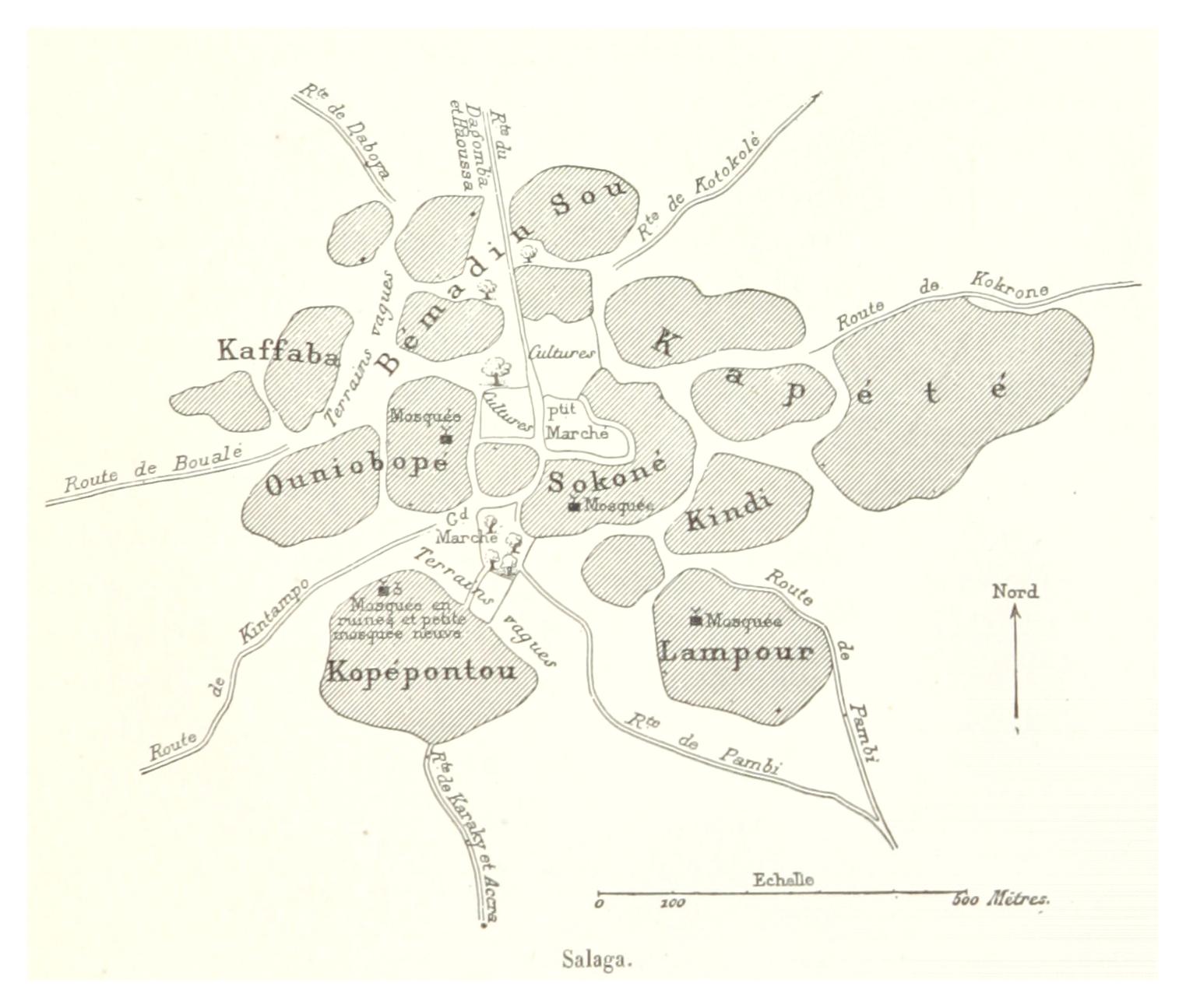
In the Dagomba language, 'salgi' means 'to get used to a place of abode.' It is a fitting name for a town that drew people from across West Africa and convinced them to stay. By the eighteenth century, Salaga was one of the most important trading centers on the continent -- a market town in the Gonja kingdom where Hausa merchants from the east, Wangara traders from the west, Dagomba cattle herders from the north, and Ashanti kola brokers from the south all converged in a commercial crossroads that earned it the title 'the Timbuktu of the south.' But Salaga was also a place where human beings were bought, sold, bathed, and shipped to the coast. Its history is inseparable from the slave trade, and the town's remaining wells and ponds testify to that reality with a directness that no monument could match.
Crossroads of the Sahel
Salaga's location made it a natural hub. Sitting at the southern edge of the Sahel, the town occupied the narrow zone where the savanna meets the forest -- the ecological boundary that also marked an economic one. Goods that thrived in one zone were scarce in the other, and Salaga sat at the point of exchange. Kola nuts, prized as a stimulant across the Muslim world, were carried north through Salaga from the forests of what is now southern Ghana to markets in Kano, Katsina, and beyond in northern Nigeria. Cattle and groundnuts came south through the Dagomba towns of Kpabia and Yendi. Salt arrived from Saharan deposits. The Gonja kingdom, a powerful warrior state, controlled Salaga and taxed this commerce, but the town's character was shaped less by its rulers than by its traders -- Hausas, Wangaras, Dagombas, Gurmas, and others who made it one of the most cosmopolitan places in precolonial West Africa.
The Hundred Wells
Along a stream in the northeastern part of Salaga, enslaved people dug more than one hundred wells. The wells served a grim practical purpose: they provided drinking water during the dry season, when the captives might wait weeks or months before being sold. But the wells were also spaces of survival -- places where enslaved people exercised the small agency available to them, digging for water that kept them alive in conditions designed to break them. Nearby, a pond called 'Wonkan bawa' -- a Hausa phrase meaning 'the bathing spot of slaves' -- marks the place where enslaved people were forced to wash before being presented at market. The bathing was not kindness; it was commerce, an effort to make human merchandise look healthy enough to command a good price. A young baobab tree now grows where the slave market once stood, its roots reaching into soil that absorbed the footsteps of people whose names history did not record.
Warriors and Scholars
Salaga was not only a marketplace. It was central to the emergence of the Zabarima emirate as a military power in the 1860s, when the scholar Alfa Hano and the warrior Gazari migrated from their homes southeast of Niamey in present-day Niger and made Salaga their base. The combination of Islamic learning and martial prowess was characteristic of the town: Salaga housed mosques and Quranic schools alongside weapons traders and military recruiters. When civil war erupted in 1892, the resulting sack destroyed Salaga's commercial infrastructure and triggered a mass exodus of the Zongo communities -- the Muslim trading populations -- southward into the forest belt. This scattering carried Islam deep into regions of Ghana where it had previously had little presence, establishing Zongo quarters in Kumasi, Accra, and dozens of smaller towns that persist to this day.
Memory and Market
Modern Salaga is the quiet capital of Ghana's East Gonja District, home to roughly 25,000 people. The town is served by Salaga Senior High School, established in 1976, and the daily rhythms of a Savannah Region market town have long replaced the continental commerce that once defined it. But the past has not been erased. The slave wells remain, some still holding water. The Wonkan bawa pond is still identifiable. And in Accra's Jamestown neighborhood, a market still carries the name 'Salaga Market' -- a reminder that enslaved people shipped from this inland town were sold at the coast, linking Salaga to the Atlantic slave trade in a chain that stretched from the Sahel to the sea. Ayesha Harruna Attah's novel 'The Hundred Wells of Salaga' has brought the town's story to a wider audience, reminding readers that trade towns have always been places of both opportunity and exploitation, and that the line between the two was drawn across human lives.
From the Air
Salaga is located at approximately 8.55N, 0.52W in the Savannah Region of northern Ghana, capital of the East Gonja District. The town sits in flat Guinea savanna terrain. From altitude, it appears as a modest settlement surrounded by open grassland with scattered trees. The slave market heritage site and wells are in the northeastern part of town near a stream. Tamale Airport (DGLE) is the nearest commercial airport, approximately 120 km to the north. Visibility is generally excellent during the dry season but Harmattan dust can reduce it significantly from December to February. The town lies east of the Volta River system and west of the Oti River.