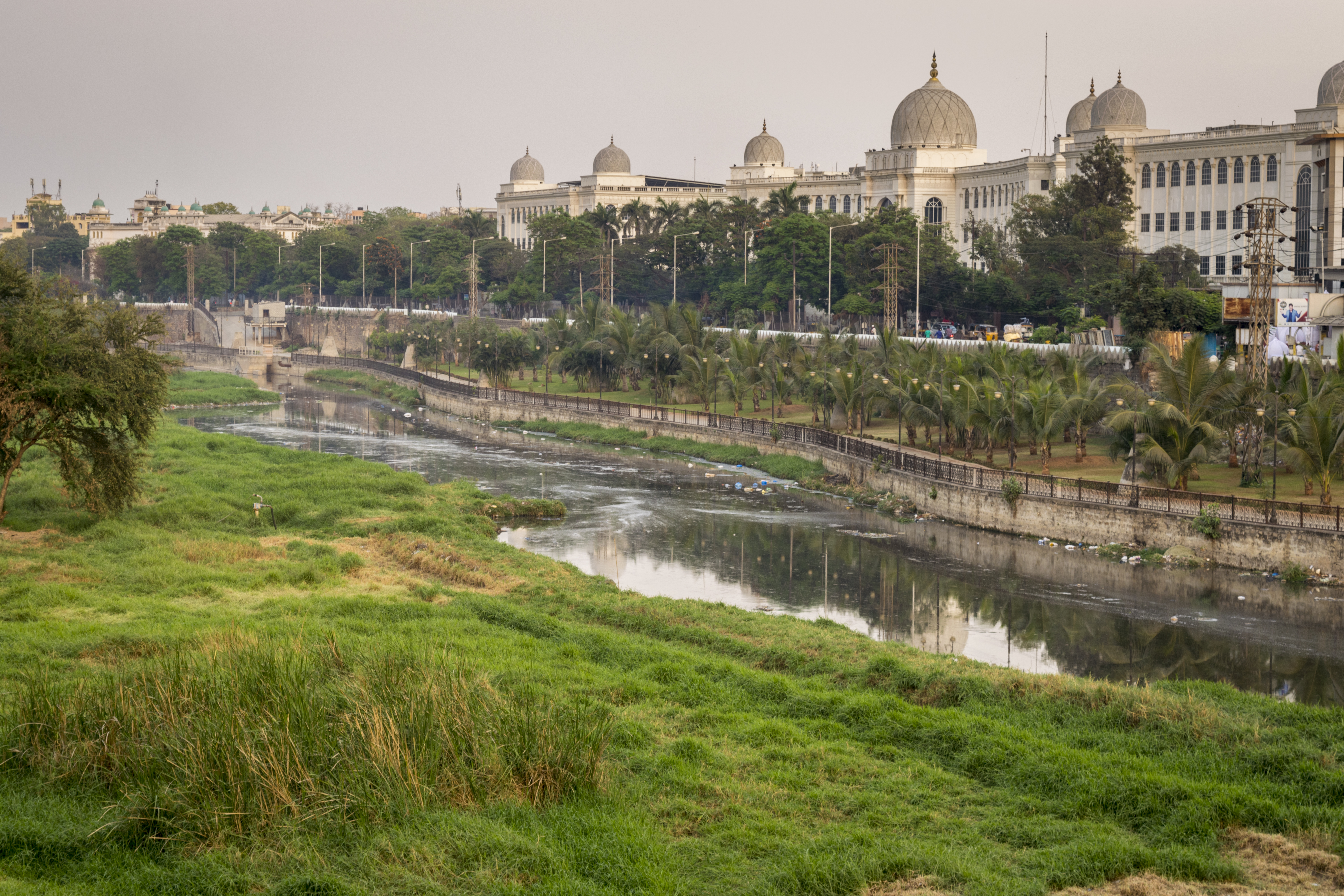
Salar Jung Museum
Old-timers in Hyderabad believe the Salar Jung Museum holds only half of what Nawab Mir Yousuf Ali Khan actually collected. His staff, entrusted with safeguarding the collection, reportedly siphoned off pieces while the Nawab spent thirty-five years and a substantial portion of his income acquiring art from Japan, China, Burma, Nepal, India, Persia, Egypt, Europe, and North America. What survived fills 38 galleries across two floors of a semicircular building on the southern bank of the Musi River. Even at half strength -- if the stories are true -- the Salar Jung Museum is one of the largest one-person art collections ever assembled, and the Indian Parliament has declared it an Institution of National Importance.
The Collector and His Obsession
Mir Yousuf Ali Khan, Salar Jung III, was born in 1889 into Hyderabad's Salar Jung family, a dynasty of statesmen who served as prime ministers under the Nizams. He held the same office during the Nizam's rule over Hyderabad State, but his true vocation was collecting. Over three and a half decades, he acquired sculptures, paintings, carvings, textiles, manuscripts, ceramics, metalwork, carpets, clocks, furniture, and weapons from across the world. The collection was not just broad -- it was deep, spanning centuries and civilizations within each category. When the Nawab died in 1949, the treasures remained in his ancestral palace, Diwan Devdi. Jawaharlal Nehru inaugurated them as a public museum on 16 December 1951, giving India access to a private obsession that most museums would need committees and centuries to match.
Mephistopheles, Rebecca, and a Two-Faced Statue
The museum's most celebrated pieces reveal a family's taste for the dramatic. In 1876, Salar Jung I traveled to France and acquired Mephistopheles and Margaretta, a double sculpture that shows two different figures depending on which side you view it from -- a technical feat that still startles visitors who walk around it. On the same European trip, he purchased the Veiled Rebecca in Rome, a marble statue by Giovanni Maria Benzoni where the stone renders fabric so convincingly that the veil seems to ripple. Works by Canaletto, William-Adolphe Bouguereau, and Francesco Hayez hang in the European galleries. The collection spans three generations of the Salar Jung family, each adding to what the previous generation had gathered, creating a museum that is simultaneously a personal statement and a survey of world art.
Clocks, Coins, and the Weight of Time
An entire room is dedicated to clocks -- ancient sundials shaped as obelisks stand alongside twentieth-century timepieces, with miniature clocks requiring magnifying glasses displayed near stately grandfather clocks from France, Germany, Italy, Switzerland, and Britain. The musical clock purchased from Cook and Kelvey of England remains a centerpiece. Elsewhere, roughly 600 coins trace Indian monetary history from the Vijayanagara dynasty through the Bahmani and Mughal empires to modern India, with some punch-mark coins from the Kushan dynasty dating back 2,300 years. The jade collection, numbering 984 objects largely from the Mughal Empire and the Asaf Jah dynasty, ranks among the largest publicly displayed jade collections in India. Weapons belonging to Aurangzeb, Tipu Sultan, and Abul Hasan Qutb Shah rest in the arms and armour gallery.
A Building That Almost Wasn't
The museum's journey to its current home was neither smooth nor entirely honest. After the Nawab's death, the collection at Diwan Devdi became a museum, but the state soon decided it needed a purpose-built structure. Nehru laid the foundation stone for a new building in 1963, and architect Mohammed Fayazuddin won the design competition. The museum moved to its present location at Dar-ul-Shifa in 1968 -- and more pieces vanished during the transfer, lost or stolen in the logistics of shifting a world-class collection across the city. A fire broke out in an auditorium on the premises in 2006, though it was extinguished before any artifacts were damaged. Through theft, neglect, fire, and bureaucratic indifference, the collection endured. The ground floor holds 20 galleries and the first floor 18, but even this only displays a portion of what the museum possesses. Plans for a new Islamic Gallery promise to bring more of the Salar Jung legacy into public view.
From the Air
The Salar Jung Museum sits at 17.37N, 78.48E on the southern bank of the Musi River in central Hyderabad. The semicircular museum building is visible from low altitude near the river. Nearest airport is Rajiv Gandhi International (VOHS/HYD), approximately 20 km to the south. The museum is close to the Charminar and other Old City landmarks. Elevation roughly 490 meters on the Deccan Plateau.