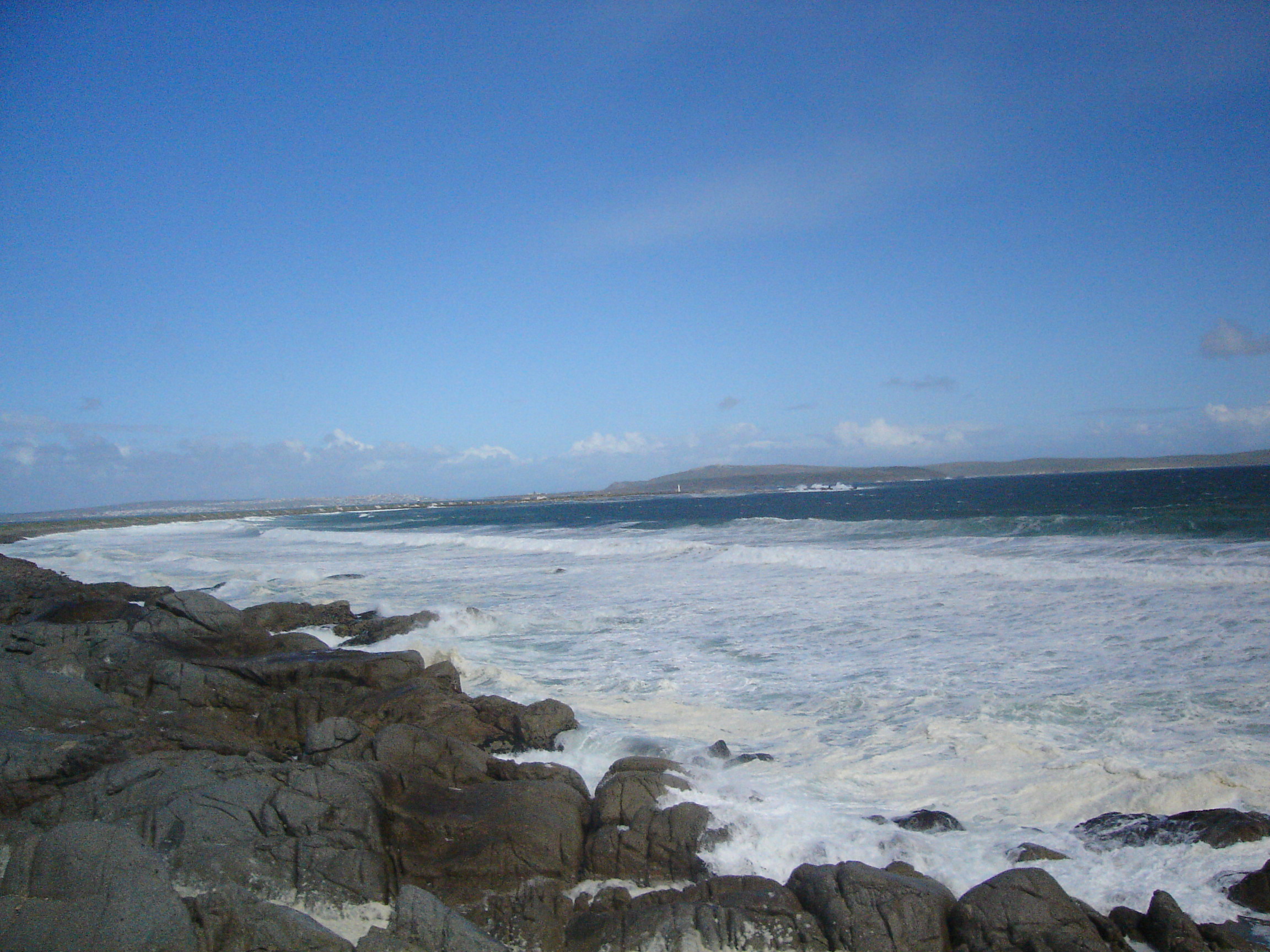
Saldanha Bay
The name is borrowed. In 1503, Portuguese captain Antonio de Saldanha sailed into a bay on the southwestern coast of Africa and dropped anchor. That bay was Table Bay, near what would become Cape Town. When Table Bay received its current name in 1601, the old name was transferred northward to the larger bay 105 kilometers up the coast -- a bay Saldanha himself had never seen. It is a fitting origin for a place that has spent five centuries being shaped by the plans, mistakes, and ambitions of people passing through. John Locke mentioned it in the first edition of Two Treatises of Government as an example of the state of nature. Today, Saldanha Bay is a modern port where Capesize ore carriers load iron bound for steel mills on the other side of the world.
Borrowed Names, Deep Water
Saldanha Bay faces southwest, 11 kilometers long and 12 kilometers wide, with the Langebaan Lagoon extending 14 kilometers southeastward from its inner corner like a turquoise tail. The bay is one of the finest natural harbors on the African coast -- deep, sheltered, and large enough to accommodate the massive vessels that modern bulk shipping demands. For centuries, that shelter attracted ships seeking refuge from storms, from enemies, or from the long emptiness of the South Atlantic. The municipality of Saldanha, incorporated with five neighboring towns in 2000, has a population of roughly 72,000. The area has a Mediterranean climate, though with rainfall low enough that it verges on the desert conditions of Namaqualand to the north. Southern right whales visit the bay's waters during winter and spring, their presence a reminder that this harbor belongs to the ocean before it belongs to anyone else.
Centuries of Passing Through
The bay's history reads like a ledger of colonial interests. In 1781, during the Fourth Anglo-Dutch War, a British squadron under Commodore George Johnstone sailed in flying false French colors and captured five Dutch East Indiamen that had sought shelter from a feared British attack on Cape Town. The Dutch crews beached and torched their own ships rather than surrender them, and the British scrambled to save what they could from the flames. It was the only notable military action of an expedition originally sent to seize Cape Town, and it remains one of the more colorful naval episodes in South African history. The Saldanha Bay Canning Company, founded by James Kasner and Ellis Silverman in 1905, marked a different kind of arrival -- the beginning of the fishing and seafood processing industry that still anchors the local economy alongside mussels and crayfish.
Iron and Anchors
The modern port exists because of iron ore. When South Africa needed to export ore from the mines at Sishen in the Northern Cape, the solution required building more than 800 kilometers of railway -- the Sishen-Saldanha line -- and constructing a deepwater jetty capable of handling Capesize bulk carriers, among the largest ships in commercial service. The port transformed Saldanha from a sleepy fishing town into an industrial hub where the steel industry, Saldanha Steel, and the harbor infrastructure dominate the waterfront. The naval connection persists too: SAS Saldanha, a South African Navy training base, and the South African Military Academy both operate in the area. The SAS Saldanha Nature Reserve, part of the naval base, offers wildflower displays in late winter and spring, an unexpected grace note amid the military and industrial infrastructure.
Water Sports and Whales
Despite the iron ore terminal and the naval base, Saldanha Bay remains a paradise for anyone drawn to the water. The sheltered bay offers ideal conditions for sailing, kayaking, and kitesurfing, and the local watersport community has grown steadily. The fishing boats that work the bay's waters are a constant presence, heading out at dawn and returning in the afternoon, their movements as regular as the tides. The West Coast National Park wraps around the southern and eastern edges of the bay, and the Langebaan Lagoon -- a Ramsar wetland site -- is one of the most important bird habitats in southern Africa. From the air, the contrast is stark: the industrial bulk of the ore terminal to the north, the turquoise calm of the lagoon to the south, and between them a bay that has been absorbing human ambition for half a millennium.
From the Air
Located at 33.03S, 18.01E on the southwestern coast of South Africa, approximately 105 km northwest of Cape Town. The bay is 11 km long and 12 km wide, facing southwest. The iron ore jetty extending into the bay is a prominent visual landmark, as is the Langebaan Lagoon extending southeast. Best viewed at 3,000-6,000 ft AGL. Nearest airports: Cape Town International (FACT) 105 km southeast; Langebaan airfield (FALA) nearby. Saldanha Bay is one of the deepest natural harbors on the African coast.