Salem Witch Trials
Dorothy Good was four years old when the magistrates questioned her. Her answers -- confused, childish, misunderstood -- were taken as a confession that implicated her own mother, Sarah, who would hang on July 19, 1692. Between February of that year and May of the next, the village of Salem and its surrounding communities spiraled into a prosecutorial frenzy that saw more than 200 people accused of witchcraft, 30 found guilty, and 20 killed. It was the deadliest witch hunt in the history of colonial North America, and it began with the strange behavior of four girls in a minister's household.
A Village Already Burning
Salem Village -- present-day Danvers, Massachusetts -- was not a peaceful place before the accusations started. Neighbors fought over property lines, grazing rights, and church privileges. The settlement had burned through three ministers in quick succession; the first two left after the congregation refused to pay their full salary, and the third departed when the church in Salem Town declined to ordain him. The fourth minister, Samuel Parris, arrived in 1689 and promptly deepened the divisions. He sought out sin in his congregation, subjected church members in good standing to public penance for trivial infractions, and could not settle his parishioners' disputes. Meanwhile, the broader colony was reeling from the revocation of its charter, a failed attack on French Quebec, and ongoing raids by Wabanaki warriors along the Maine coast that sent refugees flooding into Essex County. Into this cauldron of anxiety, in the winter of 1692, four girls began to scream.
The Afflicted and the Accused
Betty Parris, age nine. Abigail Williams, eleven. Ann Putnam Jr., twelve. Elizabeth Hubbard, seventeen. They contorted their bodies, crawled under furniture, complained of being pinched and pricked with invisible pins. A doctor -- likely William Griggs -- could find no physical cause. The first three women accused fit a pattern that made them easy targets: Sarah Good was destitute, Sarah Osborne rarely attended church, and Tituba, an enslaved woman described in contemporary records as Indian, whose exact origins remain disputed, was an outsider by every measure the Puritans counted. But the accusations quickly outgrew these convenient scapegoats. When Martha Corey and Rebecca Nurse -- both full covenanted church members -- were charged, the village confronted a terrifying logic: if upstanding women of faith could be witches, then no one was safe. Church membership offered no shield. By the end of May 1692, 62 people sat in jail awaiting trial.
The Court of Oyer and Terminer
On June 2, 1692, the newly created Court of Oyer and Terminer convened in Salem Town under Chief Magistrate William Stoughton, the colony's lieutenant governor. Bridget Bishop was the first to face the grand jury. She wore black clothing and 'odd costumes,' which violated the Puritan code, and her coat had been 'cut or torn in two ways.' She was convicted and hanged on June 10. The court adjourned for 20 days to seek guidance from the colony's leading ministers, whose response -- drafted by Cotton Mather -- cautioned against relying too heavily on spectral evidence but ultimately endorsed continued prosecution. Judge Nathaniel Saltonstall resigned from the court in protest, the only public official with the courage to condemn the proceedings from the start. Five more women hanged on July 19. In August, George Burroughs -- a former Salem Village minister -- was convicted and executed alongside four others. Giles Corey, pressed to death under heavy stones for refusing to enter a plea, died on September 19.
When the Wheel Turned
The trials collapsed under their own momentum. As accusations reached into the ranks of prominent citizens, leading clergymen began questioning the validity of spectral evidence -- testimony claiming the accused's spirit had appeared to torment the accuser. Governor William Phips, whose own wife had been named, dissolved the Court of Oyer and Terminer in October 1692 and established a Superior Court of Judicature that barred spectral evidence. The remaining trials produced mostly acquittals. By May 1693, the last prisoners were released. In the years that followed, several of the accusers -- mostly teenage girls -- admitted they had fabricated their charges. In 1711, the colonial legislature annulled the convictions. Historian George Lincoln Burr later wrote that 'the Salem witchcraft was the rock on which the theocracy shattered.' Massachusetts absolved six victims by legislative act in 1957, five more in 2001, and in 2022, Elizabeth Johnson Jr. became the last convicted Salem 'witch' to be officially exonerated -- 329 years after her guilty verdict.
The Ground Remembers
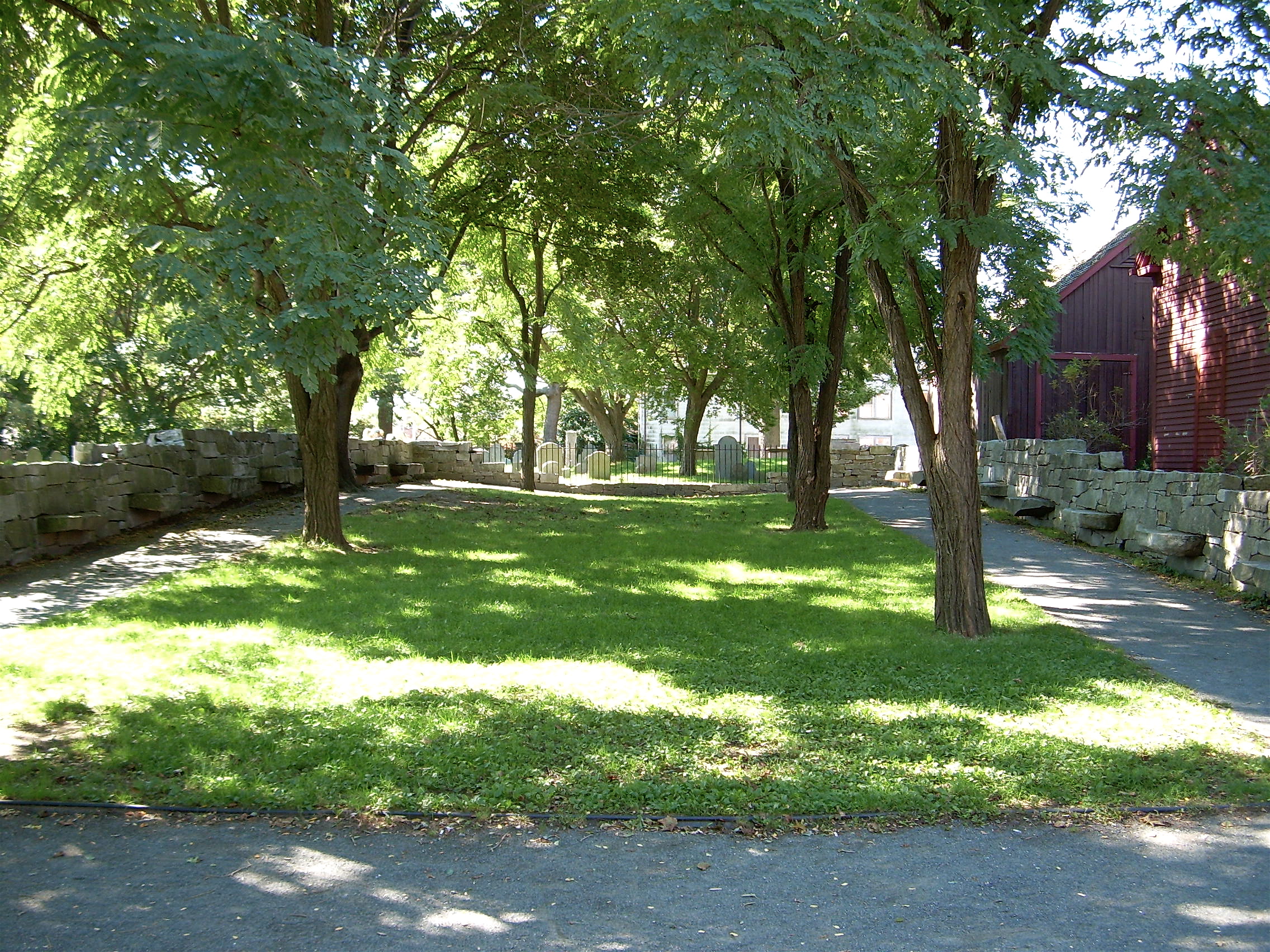
Salem today wears its history openly, sometimes solemnly and sometimes commercially. A memorial park dedicated in 1992 on the 300th anniversary of the trials bears stone benches inscribed with the victims' names and their protests of innocence. In Danvers, a separate memorial honors the accused from the original Salem Village. Proctor's Ledge, the actual execution site identified by researchers from the University of Virginia in 2016, received its own memorial in 2017. The geography of the trials is remarkably compact -- Salem Village and Salem Town sit just a few miles apart, and the meetinghouses, jails, and execution grounds all occupied a landscape you can still walk in an afternoon. From above, the area looks unremarkable: New England suburbia layered over colonial foundations. But the ground holds the weight of what happened here, a cautionary story about fear, authority, and what communities can do to their own when suspicion replaces evidence.
From the Air
The Salem witch trials centered on Salem Village (now Danvers, 42.57N, 70.95W) and Salem Town (now Salem, 42.52N, 70.90W), located on the North Shore of Massachusetts about 15nm northeast of Boston. The towns are visible at 3,000-5,000 feet, situated along the coastline with Salem Harbor as a landmark. Nearby airports: KBVY (Beverly Municipal, 3nm north), KBOS (Boston Logan International, 13nm south). The compact geography of the trials -- spanning just a few miles between Danvers and Salem -- is striking from altitude. Clear weather provides views of Salem Harbor, the Danvers River, and the suburban landscape that now covers the colonial village sites.