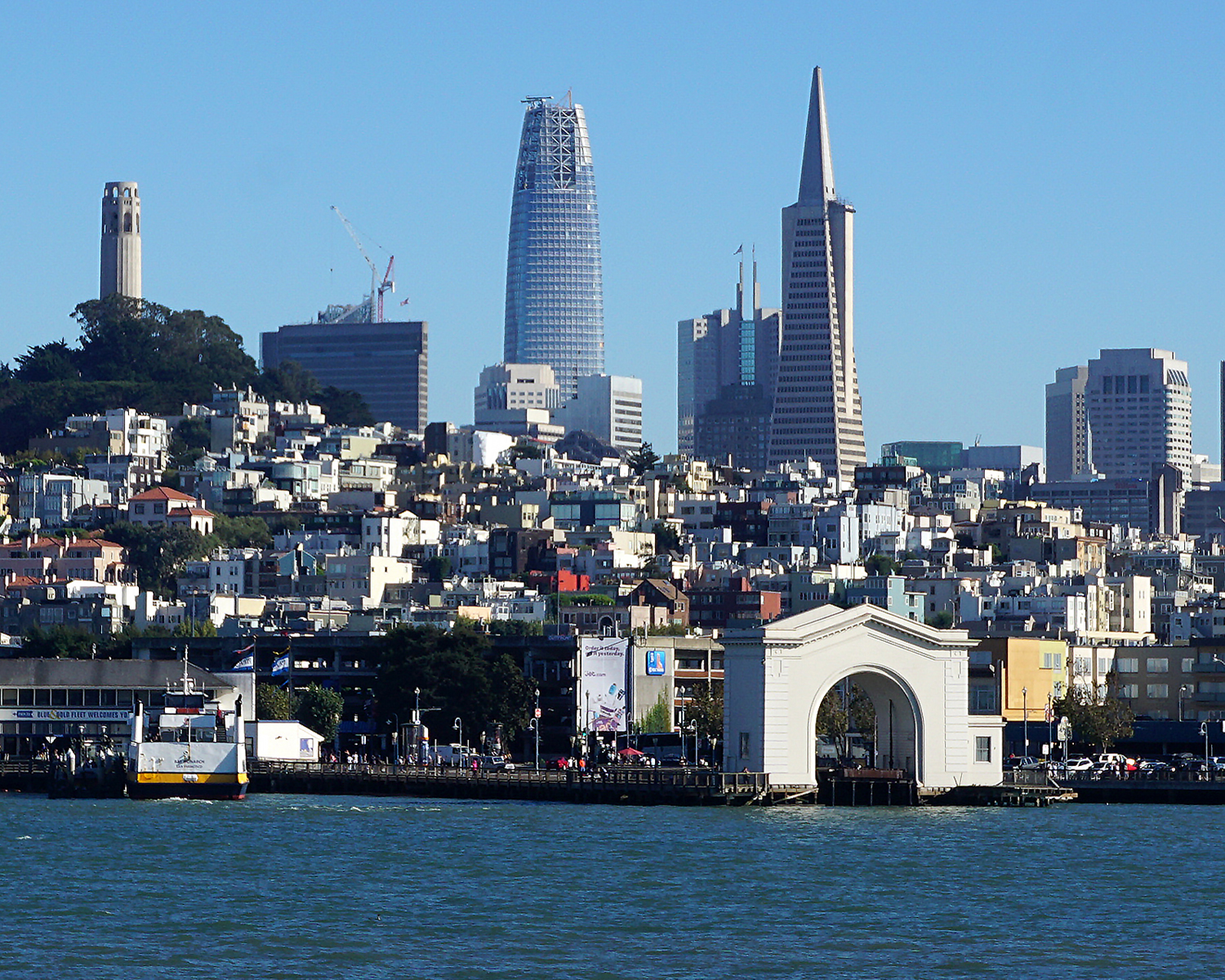
Salesforce Tower
Every night after dark, the top nine floors of San Francisco's tallest building become a screen. The LED installation on Salesforce Tower displays shifting patterns of light, abstract animations, and data-driven art visible from across the city and the bay. It is an appropriate crown for a building that changed San Francisco's skyline more dramatically than any structure since the Transamerica Pyramid. At 1,070 feet and 61 stories, Salesforce Tower surpassed the Pyramid in 2018 to become the tallest building in San Francisco and the tallest in California until the Wilshire Grand Center in Los Angeles — completed the prior year at 1,100 feet — claimed that title.
Reshaping the Skyline
Located at 415 Mission Street in the South of Market district, Salesforce Tower was designed by Pelli Clarke Pelli Architects and completed in 2018. The building's tapering form rises from a broad base to a narrow crown, its glass curtain wall reflecting different qualities of light throughout the day. The tower was originally known as the Transbay Tower during planning and construction. Salesforce, the cloud computing company founded in San Francisco in 1999, secured naming rights and leased the majority of the building's office space. The tower's construction was part of the larger Transbay redevelopment project that also produced the Salesforce Transit Center at its base.
The Art at the Top
The LED installation occupying the tower's crown was created by artist Jim Campbell. Composed of 11,000 LED discs mounted on the building's exterior, the display is visible from miles away and can be programmed with different artworks and animations. Campbell designed the initial installation to display abstract patterns derived from video footage of natural and urban scenes, processed into flowing fields of light that shift and morph throughout the night. The installation was intended to make the tower a civic gesture rather than just a corporate headquarters, returning something to the city's visual landscape in exchange for dominating it. Whether it succeeds is a matter of taste, but no one disputes its visibility.
Controversy and Context
Not everyone welcomed the tower. Critics argued that it was too tall, too corporate, and too disruptive to a skyline that had traditionally been defined by hills rather than skyscrapers. The building's approval came during a period of intense debate about growth, development, and the tech industry's impact on San Francisco's character and affordability. Supporters countered that the tower consolidated office space in the downtown core, reducing pressure on neighborhoods, and that its transit center connection encouraged public transportation over car commutes. The building includes ground-floor public spaces and connects to the rooftop park atop the adjacent transit center. Love it or resent it, Salesforce Tower is now the fixed point from which San Francisco's skyline is measured.
From the Air
Located at 37.79°N, 122.40°W in San Francisco's South of Market district. At 1,070 feet, it is the tallest structure in San Francisco and unmistakable from any altitude or approach direction. The LED crown is visible at night from miles away. Nearest airports: SFO (KSFO, 10 nm south), Oakland (KOAK, 9 nm east). The tower stands adjacent to the Salesforce Transit Center.