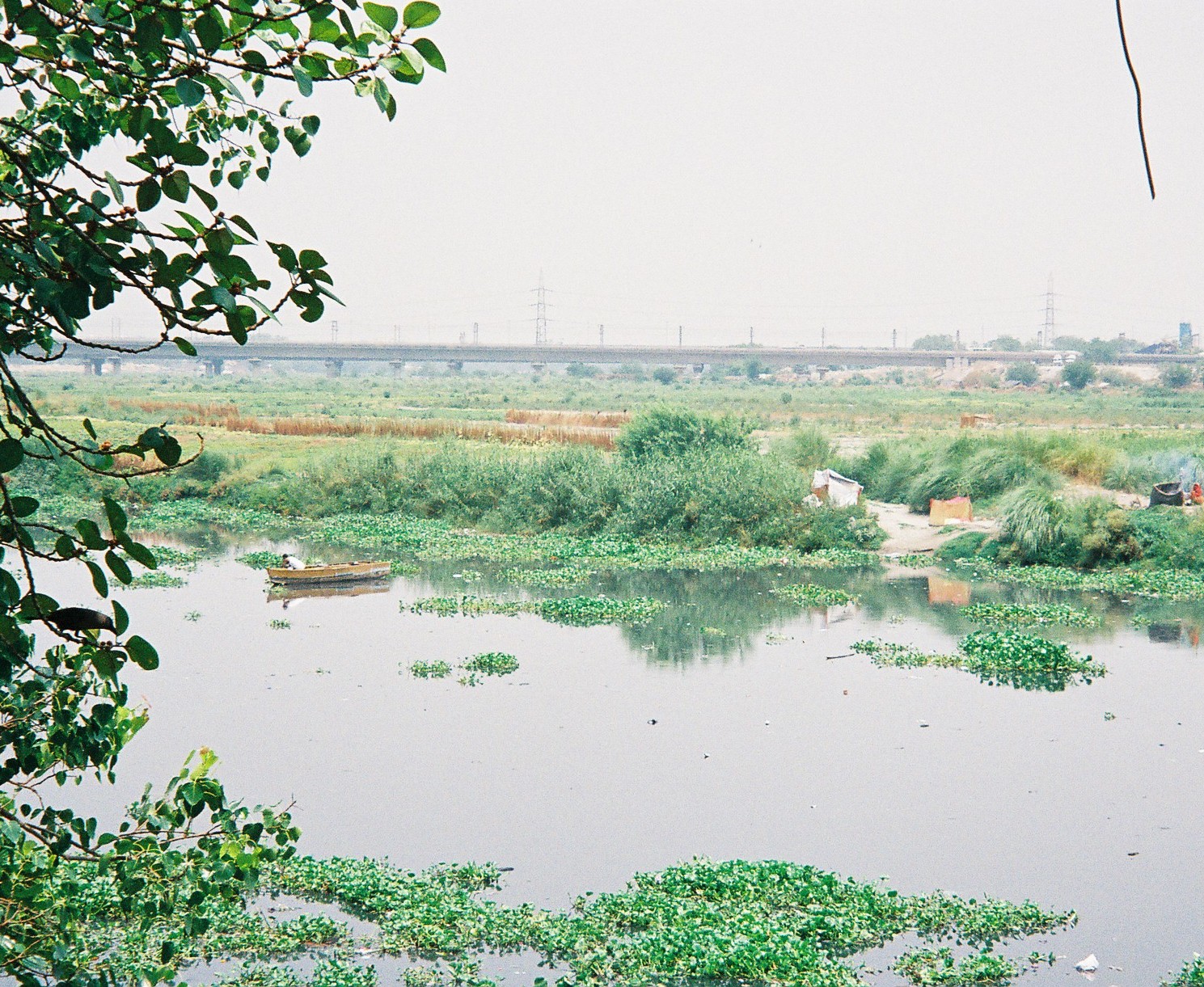
Salimgarh Fort
Locals say that on moonlit nights, the ghost of Zebunnisa -- Mughal princess, poet, prisoner -- sings from behind the walls of Salimgarh Fort. Whether or not you believe in spirits, the image captures something true about this place: it has always been more prison than palace, more burden than glory. Built in 1546 on a Yamuna River island by Salim Shah Suri during the brief Afghan interruption of Mughal rule, Salimgarh was a fort born of political instability. It would spend the next five centuries absorbing the consequences of power struggles it did not start.
An Island Between Empires
The Sur dynasty's hold on Delhi was a historical interruption. In 1540, the Afghan warlord Sher Shah Suri defeated the Mughal emperor Humayun and seized control of northern India. His son, Salim Shah Suri, chose a Yamuna island for a new fortification -- a site with natural defensive advantages, bordered by the river on one side and the Aravalli ridge's northern spur on the other. Any attacking army would be forced to follow the river course, channeling into a kill zone. The fort was completed in 1546, but the dynasty that built it did not last much longer. By 1555, Humayun had returned from exile and defeated the last Sur ruler, Sikandar Suri. The Mughals reclaimed Delhi, and Salimgarh -- barely a decade old -- changed hands for the first time. It would not be the last.
The Emperor Who Refused to Run
Salimgarh's most dramatic chapter came during the Indian Rebellion of 1857. Bahadur Shah Zafar II, the last Mughal emperor -- by then an elderly figurehead with little real power -- used the fort as a command post. He convened meetings in August and September to discuss war strategy against the British, and reportedly watched artillery exchanges from the ramparts. When officers came requesting their wages, he offered to pawn the imperial crown jewels. They refused, moved by the gesture. Proclamations issued from the fort called on people of all castes and creeds to join the resistance. But by mid-September, British forces were closing in. Bahadur Shah's aide, Bakht Khan, urged him to flee and wage guerrilla war in the countryside. The emperor refused. He allowed his forces to evacuate, then walked to Humayun's Tomb -- the burial place of his ancestor -- where the British captured him. He was exiled to Rangoon, where he died in 1862, the last of a dynasty that had ruled India for over three centuries.
From Dungeon to Freedom Fighters' Memorial
Imprisonment had always been part of Salimgarh's identity. The Mughal emperor Aurangzeb converted it into a prison, and the British continued the practice after 1857, initially using it as a military camp with artillery units. The fort's darkest modern chapter came between 1945 and 1947, when the British held prisoners of the Indian National Army here -- soldiers who had fought alongside the Japanese against British rule during World War II. INA prisoners were detained, and some reportedly tortured, within these walls. Local legend claims their moans can still be heard at night. After Indian independence in August 1947, the fort was renamed Swatantrata Senani Smarak -- Freedom Fighters' Memorial -- honoring those who suffered and died in captivity. The comparison to the Tower of London was made frequently during the colonial era, and not without reason: both fortresses served as prisons for political enemies of the state, places where inconvenient people were made to disappear.
A Long Road to World Heritage
Salimgarh Fort was continuously occupied by military forces from 1857 until 2003 -- first the British Army, then after independence, the Indian Army. This unbroken military presence created a bureaucratic tangle that stymied conservation for decades. When the Archaeological Survey of India approached UNESCO in 1992 to propose World Heritage status for the Red Fort Complex, which includes Salimgarh, it had to withdraw the application because it lacked full administrative control of the site. The ASI told the courts bluntly: restoration was impossible while the military remained. In December 2003, the Indian Army finally handed over the fort. A fresh UNESCO proposal followed in 2006, and in June 2007, the World Heritage Committee approved it during a session in Christchurch, New Zealand. The Red Fort Complex -- encompassing both the Red Fort and Salimgarh Fort across a 50-hectare core zone -- became Delhi's third World Heritage Site.
The Bridge Between Eras
An arched bridge once connected Salimgarh Fort to the Red Fort across a Yamuna spill channel -- a physical link between the Sur and Mughal periods of Delhi's history. The channel has since been filled in and converted into a road, but the bridge remains, and the ASI's conservation plan specifically calls for its restoration as a symbol connecting two eras. In the fort's early years, the only access was by boat. Emperor Jahangir is believed to have built the bridge, though some sources credit Farid Khan, who held the fort as a land grant. The East India Railway later drove a rail line directly through the fort's structure, connecting it to the Rajputana Railway -- a characteristically colonial act of infrastructure that treated historical monuments as obstacles to be punched through rather than preserved. Today, Salimgarh sits quietly beside its famous neighbor, overlooked by most visitors who come only for the Red Fort. But the smaller, older fortress carries the weightier story -- one of dispossession, defiance, captivity, and the long, bureaucratic struggle to preserve what power has repeatedly tried to discard.
From the Air
Salimgarh Fort is located at 28.661N, 77.240E on the northern side of the Red Fort complex in Old Delhi, adjacent to the Yamuna River. From the air, look for the Red Fort's massive red sandstone walls and the railway bridge that passes near/through the Salimgarh Fort structure. The fort's circular bastions are visible from lower altitudes. The Yamuna River runs along the eastern side. Nearest major airport is Indira Gandhi International (VIDP/DEL), approximately 17 km to the southwest. Best viewed below 2,500 feet. The Old Delhi Railway Station and the distinctive dome of Jama Masjid provide useful visual reference points to the south and west.