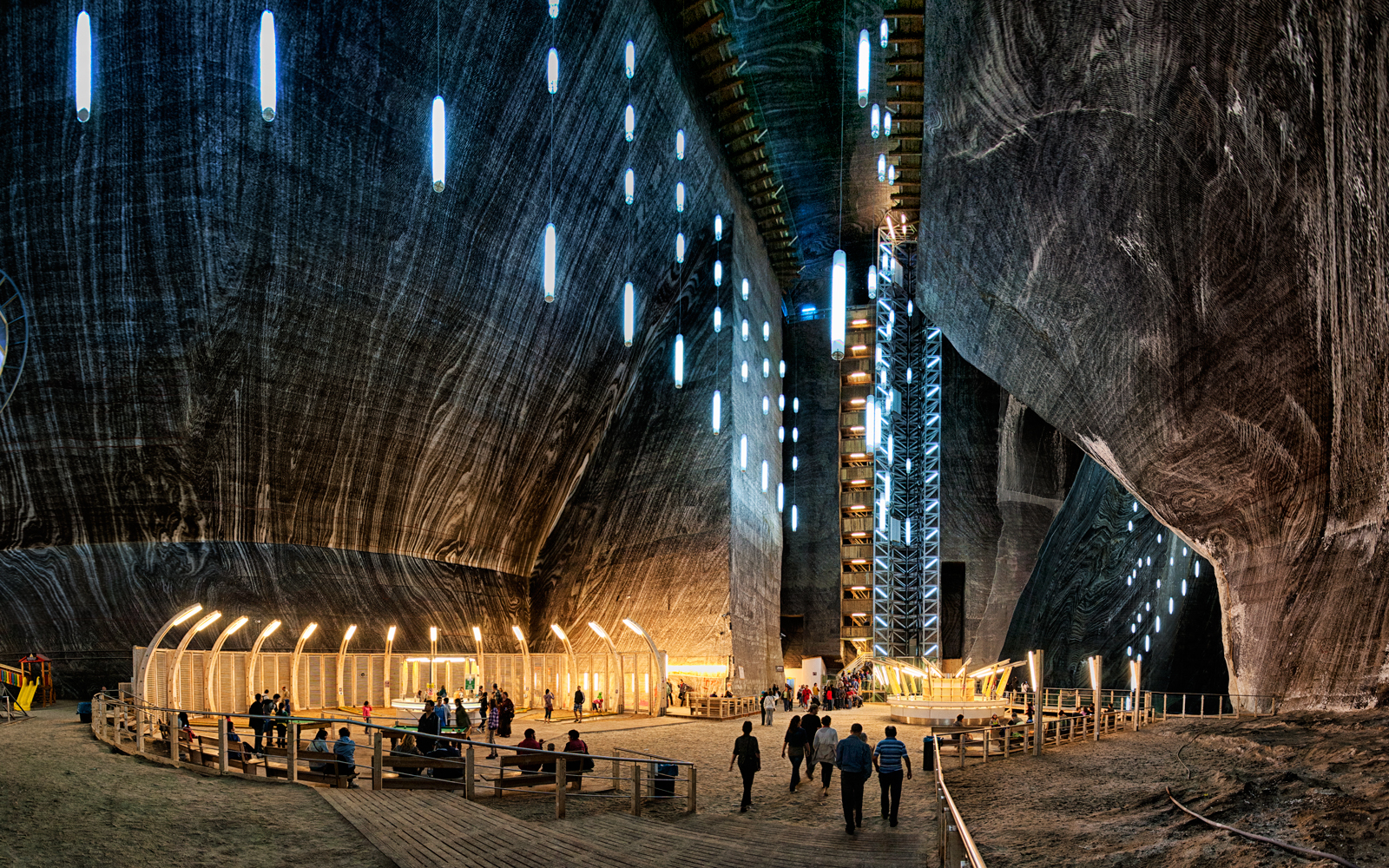
Salina Turda
One hundred and twelve meters below the surface of a Transylvanian hillside, there is a Ferris wheel. It turns slowly in air that has not seen sunlight since the Jurassic, inside a bell-shaped cavern so vast it generates its own echo. Salina Turda is not what most people expect from a salt mine. First mentioned in a Hungarian chancellery document dated 1 May 1271, this mine produced table salt continuously from the Middle Ages until 1932. What it produces now is astonishment.
Seven Centuries of Salt
Salt extraction at Turda dates to antiquity, but the written record begins in the 13th century, when documents from the Hungarian chancellery described salines arranged in the Baile Sarate microdepression and along the slopes of the Valea Sarata. Mining progressed steadily through the centuries. By the 17th century, operations had expanded to the northwestern slope, opening shafts that would eventually become the Terezia chamber. The Sfantul Anton mine followed, operating until it was finally closed in 1932. During World War II, the abandoned galleries found a grimmer purpose as bomb shelters. After the war, in one of the more improbable second acts in Romanian industrial history, the caverns were briefly repurposed as a cheese storage facility. The salt-saturated air, it turned out, was excellent for aging dairy.
The Bell Mines
The miners who worked Salina Turda carved their chambers in a conical shape, wider at the top and tapering toward the base, a technique that created the bell-shaped caverns that give the mine its otherworldly character. The Terezia mine is the most dramatic: 90 meters high, 87 meters in diameter, with a depth of 112 meters from shaft mouth to floor. An underground lake covers roughly 80 percent of its base, and in the center of that lake sits an island formed from low-grade salt deposits left after mining ceased in 1880. The Iosif mine, 112 meters deep and 67 meters wide, is known as the Echoes Room because its sealed, conical shape produces a reverberating acoustic effect. Then there is Rudolf, the last chamber to be mined, where 172 steps descend through 13 marked levels, each wall inscribed with the year that floor was opened.
Machinery Frozen in Time
In the octagonal Crivac room, a massive wooden winch stands exactly where it was installed in 1881. Called a crivac or gepel, this rudimentary machine was used to haul blocks of salt to the surface on ropes. It replaced an even earlier version from 1864. What makes it remarkable is not just its age but its position: this is the only salt-lifting machine in Romania, and possibly in all of Europe, that remains in its original operating location within a mine. The gepel is frozen mid-function, its wooden arms and gears still arranged as though waiting for the next load. Around it, the octagonal walls of salt catch whatever light reaches this depth, and the air carries the faint mineral tang that permeates every corner of the mine.
Reinvention Underground
In 1992, sixty years after the last block of salt was lifted, Salina Turda reopened as a halotherapy center and tourist attraction. The salt-laden air, consistently cool and nearly free of allergens, drew visitors seeking respiratory relief. But the mine's ambitions grew. A major renovation in 2008, funded by a 5.9-million-euro EU grant, transformed the subterranean chambers into something between a theme park and a geological museum. A panoramic elevator now glides through the Rudolf mine, offering views of salt stalactites up to three meters long that have formed on the northwestern ceiling over decades. By 2017, the mine was drawing roughly 618,000 visitors a year. Business Insider named it one of the 25 hidden gems around the world worth the trek. The Gizela mine, the smallest of the main chambers, serves as a spa treatment room where visitors breathe naturally aerosolized salt air, while its sealed gallery, the Crystal Hall, protects a geological reserve of salt crystals and efflorescences too fragile for public access.
Salt and Memory
Salt preserves. That is its oldest and most fundamental property, and Salina Turda embodies the principle in ways its medieval miners could not have imagined. The mine has preserved its own history with an almost geological patience. Each of the 13 levels in the Rudolf mine carries a date, an annual ring in salt rather than wood. The crivac winch has survived because the salt air inhibits the decay that would have destroyed its timbers in any surface building. Even the underground lake in the Terezia chamber preserves its chemistry, its waters so saline that little can live in them but nothing truly disappears either. Walking through the mine is walking through layered time, from the ancient extraction pits to the 18th-century shafts to the modern elevator that carries you back to daylight. Turda's salt sustained a regional economy for seven centuries. Now the mine itself is what is sustained, transformed from a place of extraction into a place of wonder.
From the Air
Located at 46.59N, 23.79E, in the Durgau-Valea Sarata area on the outskirts of Turda. The mine entrance is not visible from altitude, but the city of Turda is clearly identifiable along the Aries River valley, roughly 30 km southeast of Cluj-Napoca. Nearest major airport is Cluj-Napoca International (LRCL), about 25 km northwest. The surrounding terrain is gently rolling Transylvanian hills.