Salisbury Cathedral
Most medieval cathedrals are architectural palimpsests, centuries of additions and alterations layered upon each other. Salisbury is different. Built in just 38 years between 1220 and 1258, with the tower and spire completed by 1330, it possesses a unity of design that is exceptional among English cathedrals. That coherence makes it the definitive example of Early English Gothic architecture, and its spire, rising 404 feet above the Wiltshire plain, remains the tallest in the country. It was not always so. The spires at Lincoln Cathedral and Old St Paul's Cathedral once stood taller, but both collapsed in the sixteenth century, leaving Salisbury's to claim the record by default, and by endurance.
A Cathedral Relocated
The original cathedral stood two miles north at Old Sarum, a windswept hilltop fortress where clergy and soldiers shared cramped quarters in mutual irritation. Bishop Herbert Poore proposed moving in 1197, but it was his brother Richard who drove the project forward. Foundation stones were laid on 28 April 1220 by the Earl and Countess of Salisbury, and the speed of construction was remarkable by medieval standards. Nave, transepts, and choir were complete by 1258. Cloisters followed in 1240, the chapter house in 1263, and the tower and spire by 1330. The chosen site, beside the River Avon in a broad meadow, gave the new cathedral something Old Sarum never had: space. The resulting close is the largest in Britain, and Nikolaus Pevsner called it "the most beautiful of England's closes."
The Weight of the Spire
The tower and spire were not part of the original plan, and the foundations were never designed to bear their 6,500-ton weight. The stress shows. The four main pillars of the crossing visibly bow inward under the load, and the spire leans 27.5 inches from true vertical. Medieval masons recognized the problem and added buttresses and internal bracing struts, some still visible inside the cathedral. Christopher Wren surveyed the building in 1668 and recommended iron tie rods, which were installed. The spire has been under continuous monitoring and repair for centuries, a delicate negotiation between ambition and gravity that shows no sign of ending. From inside the cathedral, visitors can climb the tower and see both the medieval timber scaffolding and the modern steel reinforcements that keep it standing.
Magna Carta and the Clock
Salisbury holds treasures that extend well beyond architecture. In the chapter house, one of only four surviving copies of the original 1215 Magna Carta is displayed. This copy is considered the best preserved of the four. The cathedral also houses a clock dating to about 1386, one of the oldest working mechanical clocks in the world. It has no face; it was designed only to strike the hours. The mechanism was discovered in the cathedral's tower in 1928, restored, and placed on display. Beyond these headlining artifacts, the cathedral close contains buildings spanning nearly a thousand years of English history, including the medieval Bishop's Palace and Mompesson House, now a National Trust property known for its Queen Anne architecture and collection of eighteenth-century glassware.
Constable's Cathedral
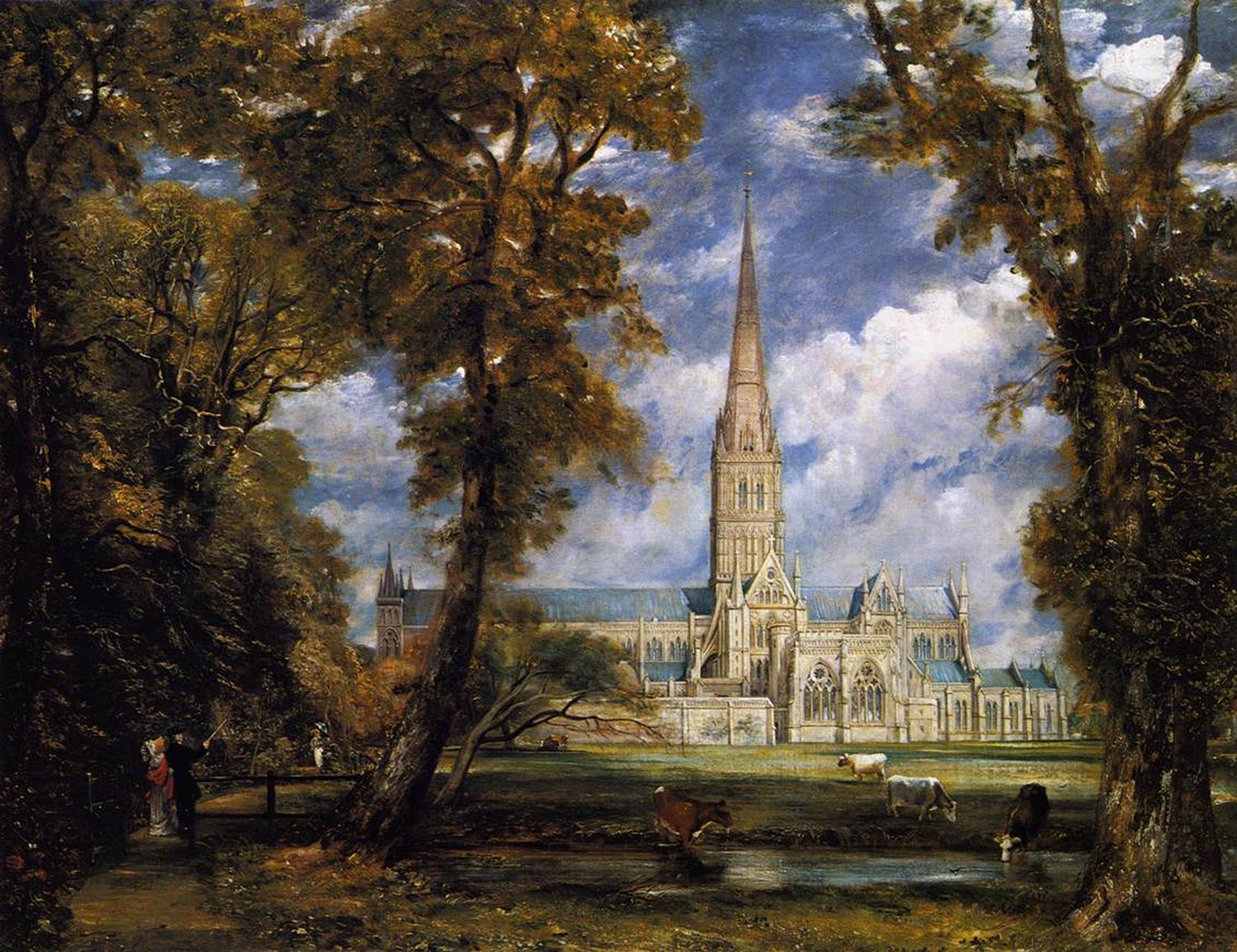
John Constable painted Salisbury Cathedral from the close several times, most famously in 1823, capturing the spire framed by elms against a cloud-streaked sky. The painting became one of the defining images of English Romantic art and helped establish the cathedral as a national icon. The relationship between the building and its setting is central to its impact. Unlike cathedrals hemmed in by urban development, Salisbury's spire rises from an open green that gives it room to breathe, the full height of its silhouette visible from miles away. From the air, the cathedral and its close form a distinct precinct within the small city, the spire's shadow sweeping across the close as the day progresses, a sundial writ large across the landscape.
From the Air
Located at 51.065N, 1.797W in Salisbury, Wiltshire. The 404-foot spire is the tallest in England and an unmistakable visual landmark from any altitude or direction. Nearest airports: EGLS (Old Sarum, 2 nm north), EGHI (Southampton, 20 nm southeast). The cathedral close, Britain's largest, is clearly visible as a green precinct around the cathedral. Recommended viewing altitude 2,000-5,000 ft. The spire is visible from considerable distance across the Wiltshire plain.