Salk Institute for Biological Studies
Jonas Salk had already changed the world once. His inactivated poliovirus vaccine, announced on April 12, 1955, ended one of the most feared childhood diseases of the twentieth century with a speed and decisiveness that bordered on the miraculous. Salk's next ambition was an institution — a place where scientists of exceptional quality could pursue fundamental biological research without the constraints of university departments or commercial pressures. In 1960, the city of San Diego granted him land on the Torrey Pines Mesa after a public referendum, and Salk began the process of building what he wanted. He brought in Louis Kahn to design the campus. The building Kahn created is often described as arguably the defining work of his career.
What Kahn Built
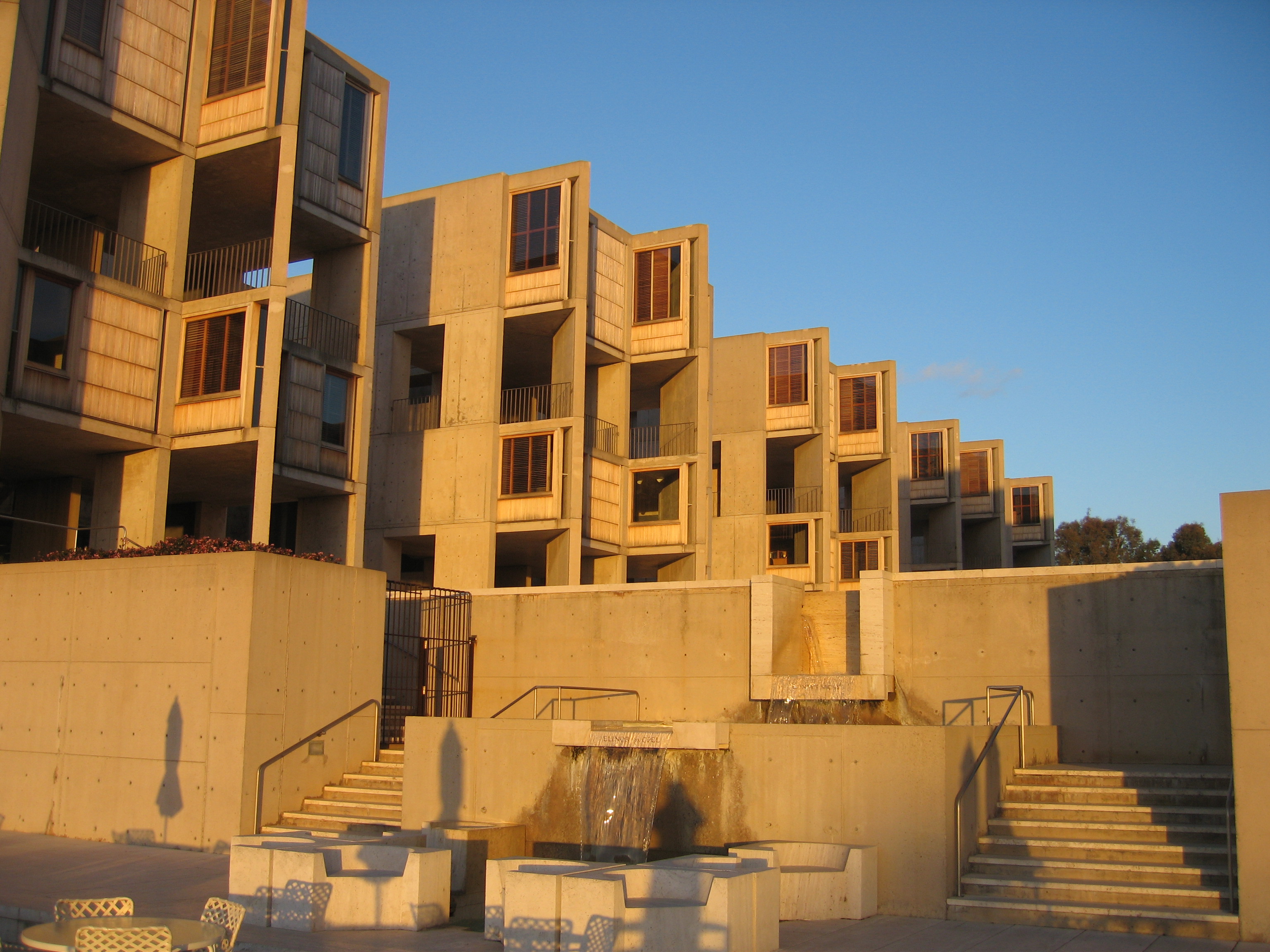
Louis Kahn began designing the Salk Institute in 1959 and completed the first buildings in 1965. The commission gave Kahn — who was fifty-eight years old when he started and who had spent most of his career working in relative obscurity before a late flowering of recognition — the opportunity to build a significant institutional complex from scratch, on a mesa above the Pacific, for a client who understood both scientific and cultural ambition.
The design is organized around a central travertine marble plaza that runs between two parallel blocks of laboratory buildings. A thin channel of water bisects the plaza and extends to its western edge, where it meets the sky at the exact point where the sun sets over the Pacific on the summer and winter solstices. The effect, when you are standing in the plaza looking west, is of a horizon line composed of water and sky — the ocean apparently reachable at the end of the channel. Kahn intended the plaza as a gathering place for scientists between experiments, a space that balanced the enclosed intensity of the laboratories with open sky and the view of the sea.
The laboratory blocks themselves are engineering achievements as well as architectural ones. Kahn designed them to allow complete flexibility in interior arrangement — no load-bearing walls within the laboratory floors — so that the configuration of research spaces could be changed as scientific needs evolved. Hollow spaces for mechanical systems run between every occupied floor, accessible for maintenance and modification. The buildings were designated a cultural landmark in 1991, recognized as significant architectural works worth preserving.
Jonas Salk is said to have told Kahn that he wanted the kind of building that Picasso might visit. Kahn delivered something more demanding: a building that makes the people inside it aware of their relationship to time, light, and the geological patience of the cliff above the Pacific.
The Scientists Inside
Salk assembled his founding consultants carefully. Jacob Bronowski, the mathematician and humanist who would later write 'The Ascent of Man,' helped shape the intellectual culture of the institute in its early years. Francis Crick, who had shared the Nobel Prize in 1962 for co-discovering the structure of DNA, joined the Salk Institute faculty and worked there for the rest of his career — spending his later years studying consciousness rather than molecular biology, a shift that reflected the institute's culture of allowing scientists to follow their curiosity.
The Salk Institute has been home to five Nobel laureates over its history. Elizabeth Blackburn, who shared the 2009 Nobel Prize in Physiology or Medicine for discovering how chromosomes are protected by telomeres and the enzyme telomerase, has been associated with the institute. The work done at the Salk has contributed to understanding of cellular signaling, gene expression, developmental biology, and neuroscience — the fundamental mechanisms by which living things develop, function, and go wrong.
The institute's faculty of fifty-three scientists works across these areas in the laboratories that Kahn designed to accommodate whatever biology demands. The flexibility he built into the structure has allowed the buildings to host research that Salk and Kahn could not have anticipated in 1959: genetic sequencing, molecular imaging, computational biology, and the study of cellular processes at resolution and speed unavailable in any earlier era.
The View From the Plaza
The Salk Institute sits at the edge of the Torrey Pines State Natural Reserve, on bluffs that drop into the Pacific. The view west from the travertine plaza encompasses ocean and sky in proportions that change with the light — gray and close in fog, immense and layered in clarity, dramatic in the long horizontal light of late afternoon. Scientists walking between the laboratory blocks pass through a space designed to remind them, at least briefly, that the universe extends beyond the experiment in progress.
Salk's vision for the institute was that biology and the humanities could coexist productively in a single institution — that scientists who engaged with art, philosophy, and the broader human context of their work would do better science than those who retreated entirely into specialization. The founding invitation to Bronowski and Crick, the commissioning of Kahn, and the design of the plaza as a space for thinking as well as transit all reflect this vision.
The institute bears one man's name, but it has become something larger than any single person: a model for how to organize fundamental research, a landmark in architectural history, and a reminder that beauty and scientific ambition are not incompatible. Sixty-five years after Jonas Salk received this land from the people of San Diego, the water still runs to the edge of the plaza, and the sun still sets over the channel on the solstice.
From the Air
The Salk Institute sits at approximately 32.89°N, 117.24°W on the Torrey Pines Mesa, near the cliffs above the Pacific. The campus is visible from the air as a distinctive pair of parallel concrete buildings flanking a central open plaza, set within the preserved scrubland of the mesa. Flying north along the coast at 3,000–5,000 feet MSL, look for the Torrey Pines State Reserve bluffs and the Salk campus at their northern edge. Nearest airports: KMYF (Montgomery-Gibbs Executive, 8 miles east) and KSAN (San Diego International, 12 miles south). The Scripps Institution of Oceanography pier is visible to the south.