Salmon Ruins
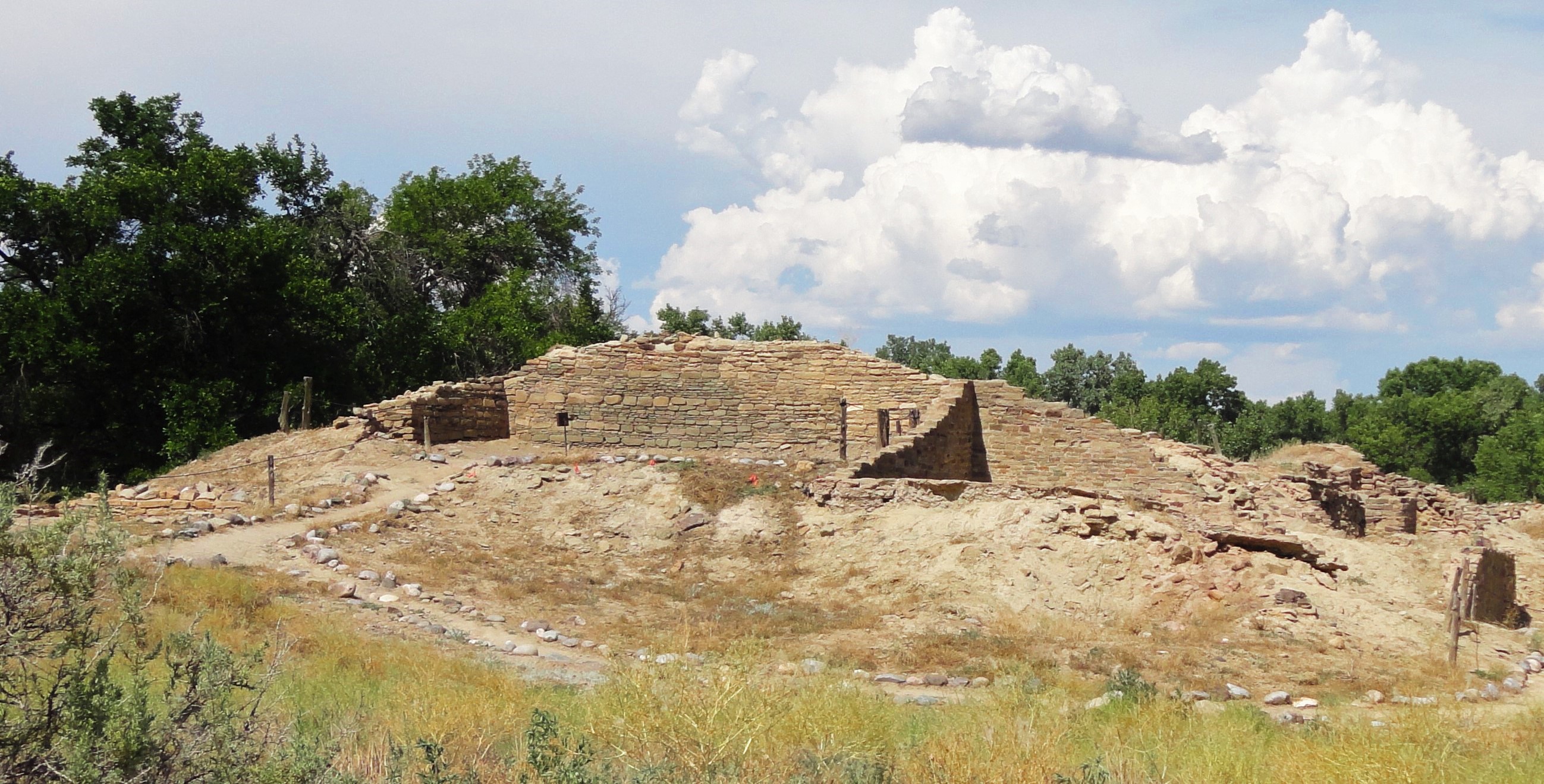
Tree rings never lie. Hundreds of them, counted from the wooden beams of Salmon Pueblo, pinpoint a burst of construction between 1090 and 1095 CE, when Chacoan builders raised a three-story great house of 275 to 300 rooms on the north bank of the San Juan River. They carried ponderosa pine, Douglas fir, and spruce logs from distant mountain forests to roof their creation. The pueblo sat on the first alluvial terrace above the floodplain, just west of what is now Bloomfield, New Mexico, and roughly north of Pueblo Bonito in Chaco Canyon. It was, from the start, a statement of purpose: a Chacoan outpost planted firmly in the Middle San Juan region.
The Chacoan Blueprint
Salmon's ground plan mirrors that of Hungo Pavi in Chaco Canyon and the nearby Aztec Ruins, which rose slightly later between 1100 and 1125. Thin sandstone slabs laid in classic Chaco veneer form the walls. The rectangular structure stretches along an east-west axis, its long north wall anchoring a layout of 150 ground-floor rooms arranged into 25 four-room suites, each interpreted as a family dwelling unit. Two roomblocks extend southward from the rear section, enclosing a large plaza that holds a great kiva. At the heart of the main roomblock stands an elevated tower kiva, a ceremonial space that would later figure in one of the pueblo's most haunting episodes. Unlike many Chacoan great houses used primarily for ceremony or storage, Salmon shows strong evidence of continuous residential occupation during the Chacoan period.
Two Peoples, One Pueblo
By 1125, the original Chacoan residents had departed, but Salmon did not fall silent. Local Middle San Juan Puebloans moved in and made the place their own, subdividing the large Chacoan rooms into smaller living spaces and installing more than 20 small kivas throughout the building and plaza. After 1200, activity increased as trade networks expanded across the greater San Juan area. Although Salmon's residents exchanged goods with people from the Mesa Verde region to the north, archaeological evidence shows that few Mesa Verdeans actually relocated here. The pueblo was not a colony of another culture but a community shaped by two successive peoples who adapted the same walls to different lives.
Fire and Farewell
Sometime in the 1280s, Salmon Pueblo burned. The fire was no accident. On the western side of the building, bushels of stored corn were consumed by flames. On the charred roof of the tower kiva, archaeologists found the partially cremated remains of nearly 20 children and several adults. Early interpretations cast this as evidence of warfare, a violent end to a besieged community. But later analysis by Nancy Akins and others revealed a more complex picture: the cremation appeared deliberate, a final ritual act at the moment of abandonment, with little or no evidence of conflict. Whatever drove the people of Salmon away, they chose to mark their departure with fire, sealing centuries of occupation beneath ash and silence.
Unearthed and Unfinished
Peter Milton Salmon homesteaded the property in the late nineteenth century, and his family lent the ruins their modern name. The Salmon family and later owner Charles Dustin protected the site until the nonprofit San Juan County Museum Association acquired the land in 1969. Between 1970 and 1979, archaeologist Cynthia Irwin-Williams directed excavations that uncovered more than a third of the ground-floor rooms and recovered over 1.5 million artifacts. Her untimely death in 1990 left the final report unfinished. A decade later, Archaeology Southwest partnered with the museum to complete the work. Archaeologist Paul Reed led the effort, producing a three-volume technical report in 2006 and a synthesis volume, Chaco's Northern Prodigies, in 2008. The site was listed on the National Register of Historic Places in 1970, and the Salmon Ruins Museum opened to the public in 1973.
Rooms with a View
Salmon's special-function rooms hint at the complexity of daily life here. Four milling rooms processed corn and grain. Two rooms contain archaeo-astronomical features, alignments that tracked the movement of the sun or stars. Two more served as workshops where residents crafted and repaired metates and stone tools. The great kiva, its roof once held aloft by four massive columns of alternating stone and wood, anchored community gatherings in the plaza. Today the Salmon Ruins Museum and Heritage Park preserve both the ancient pueblo and the Salmon family homestead, offering visitors a walk through nearly a thousand years of human presence on the banks of the San Juan.
From the Air
Salmon Ruins sits at 36.70N, 108.03W on the north bank of the San Juan River, just west of Bloomfield, New Mexico. From the air, look for the rectangular pueblo footprint on the first terrace above the river floodplain. The nearest airport is Four Corners Regional Airport (KFMN) in Farmington, approximately 10 miles to the west. Best viewed at altitudes of 2,000-4,000 feet AGL in clear conditions. The San Juan River corridor provides a strong visual reference for navigation.