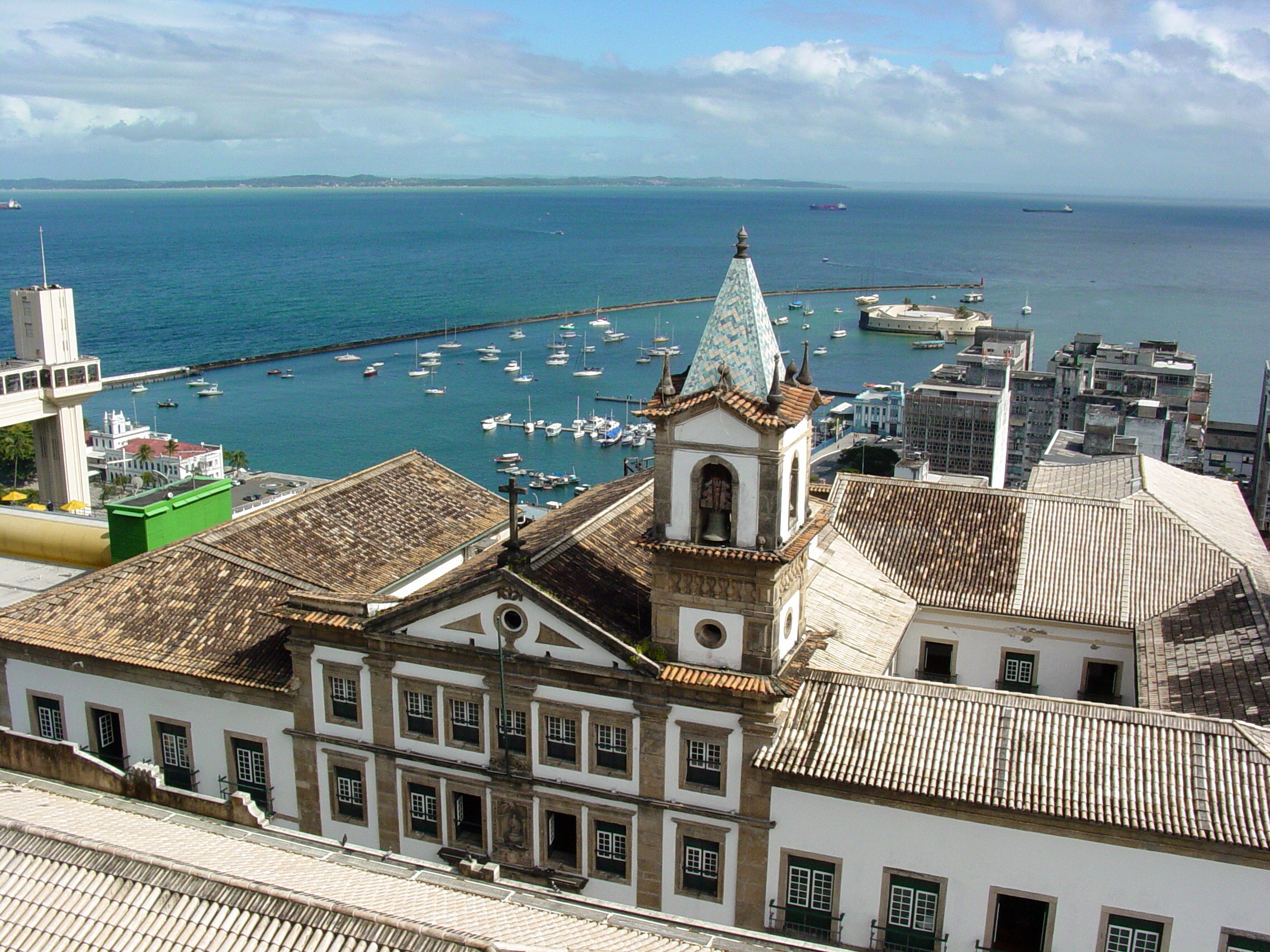
Salvador, Bahia
Before Rio, before São Paulo, before Brasília, there was Salvador. The Portuguese founded it in 1549 on a cliff above the Bay of All Saints, and for more than two centuries it was the capital of their largest colony - the commercial heart of an empire that stretched from Angola to Macau. More enslaved Africans were disembarked here than at any other single port in the Atlantic world. That history did not end when slavery did. It became the city: in the Yoruba deities still honored in terreiros tucked into side streets, in the berimbau's iron twang drifting up from a capoeira circle, in the smoke of dendê palm oil rising from a baiana's acarajé stand on the Terreiro de Jesus.
Capital of an Empire
Tomé de Souza arrived in 1549 with a charter, a fleet, and a Jesuit named Manuel da Nóbrega. Within a decade Salvador had a bishop, a cathedral, and the beginnings of the sugar economy that would define northeastern Brazil. The city perched above a natural harbor so vast the Portuguese called it Bahia de Todos os Santos - All Saints Bay - a sheltered anchorage where the sugar fleets loaded and the slave ships docked. For 214 years Salvador governed colonial Brazil. Then in 1763, the crown moved the capital south to Rio de Janeiro, closer to the gold of Minas Gerais. Salvador did not decline so much as settle into itself. The convents and merchant houses built during the sugar boom are still there - the Cathedral Basilica completed in 1679, the Church and Convent of São Francisco with its interior so encrusted in gold leaf that visitors sometimes stop at the door, as though they had stepped into a reliquary instead of a room.
Pelourinho and What It Was Named For
Pelourinho means pillory - the whipping post. The neighborhood took its name from the colonial post that once stood in the upper city, where the enslaved were punished in public view. UNESCO designated the historic center a World Heritage Site in 1985, and a major restoration beginning in 1992 reclaimed the cobblestones, the pastel facades, the baroque churches stacked up the hillside. The restoration also displaced most of the Afro-Brazilian families who had been living there, a legacy that residents of Salvador still argue about. Walking Pelourinho today you hear the conflict: the drums of Olodum echoing off façades restored for tourists, the Church of Nossa Senhora do Rosário dos Pretos - Our Lady of the Rosary of Black People - where enslaved Brazilians once built their own parish because they were not welcome at the white churches. The upper city and the lower city remain connected by the Lacerda Elevator, opened in 1873, which drops 72 meters between the Praça Thomé de Souza and the commercial waterfront in 22 seconds.
The Sound of Bahia
Salvador's contribution to world music is hard to overstate. Capoeira - part dance, part martial art, part Yoruba ritual - was codified here in the first half of the twentieth century by Mestre Bimba and Mestre Pastinha, who took a practice once criminalized as a slave revolt and turned it into a tradition taught in academies from Tokyo to Berlin. The blocos afros - Ilê Aiyê, Olodum, Filhos de Gandhi, Timbalada - emerged in Salvador in the 1970s and 1980s, using Carnival to assert Black identity when Brazilian Carnival was mostly white. Out of those drum circles came samba-reggae and axé. The Bahian Carnival now lasts a full week and draws nearly four million people to 25 kilometers of streets, avenues, and squares - the largest street party on earth, according to the Guinness Book of Records. Dorival Caymmi, Gilberto Gil, Caetano Veloso, Gal Costa, Daniela Mercury, Carlinhos Brown - the list of Bahian musicians reshaping Brazilian sound since the 1950s reads like an index of MPB itself.
Two Cities on One Cliff
A hundred-meter escarpment divides Salvador into Cidade Alta on top and Cidade Baixa below. This geography is not cosmetic. The upper city holds the old capital - the administrative squares, the churches, the civic buildings - while the lower city grew around the docks and warehouses. The division has persisted into the modern city, shaped now by a different kind of cliff: wealth. Vitória and Barra along the Atlantic coast hold high-rises and consulates. Liberdade, in the lower city along the bay, has one of the largest Afro-Brazilian populations in Brazil. The 2022 census counted 2.4 million people in Salvador, and 83 percent identified as Black or pardo - making Salvador one of the most African cities outside Africa. Eighty kilometers of beaches curl around the peninsula, from the sheltered coves of Porto da Barra to the Atlantic surf at Farol de Itapoã. The Farol da Barra lighthouse, built into a fort completed in 1702, still marks the point where the bay meets the ocean.
From the Air
Salvador sits at 12.98°S, 38.49°W, on a peninsula shielding the 1,000-square-kilometer Bay of All Saints from the Atlantic. Salvador Bahia International Airport (SBSV), 28 km north of the historic center, is the primary gateway; Salvador Air Force Base (BASV) is co-located. VFR arrivals benefit from the dramatic cliff line dividing upper and lower city - a 100-meter escarpment visible for miles - with the Farol da Barra lighthouse marking the peninsula's southern tip. Typical viewing altitude 3,000-6,000 feet. Tropical climate year-round, temperatures 21-30°C, with a rainy season April-June; watch for afternoon convective buildups and coastal sea breeze fronts in summer.