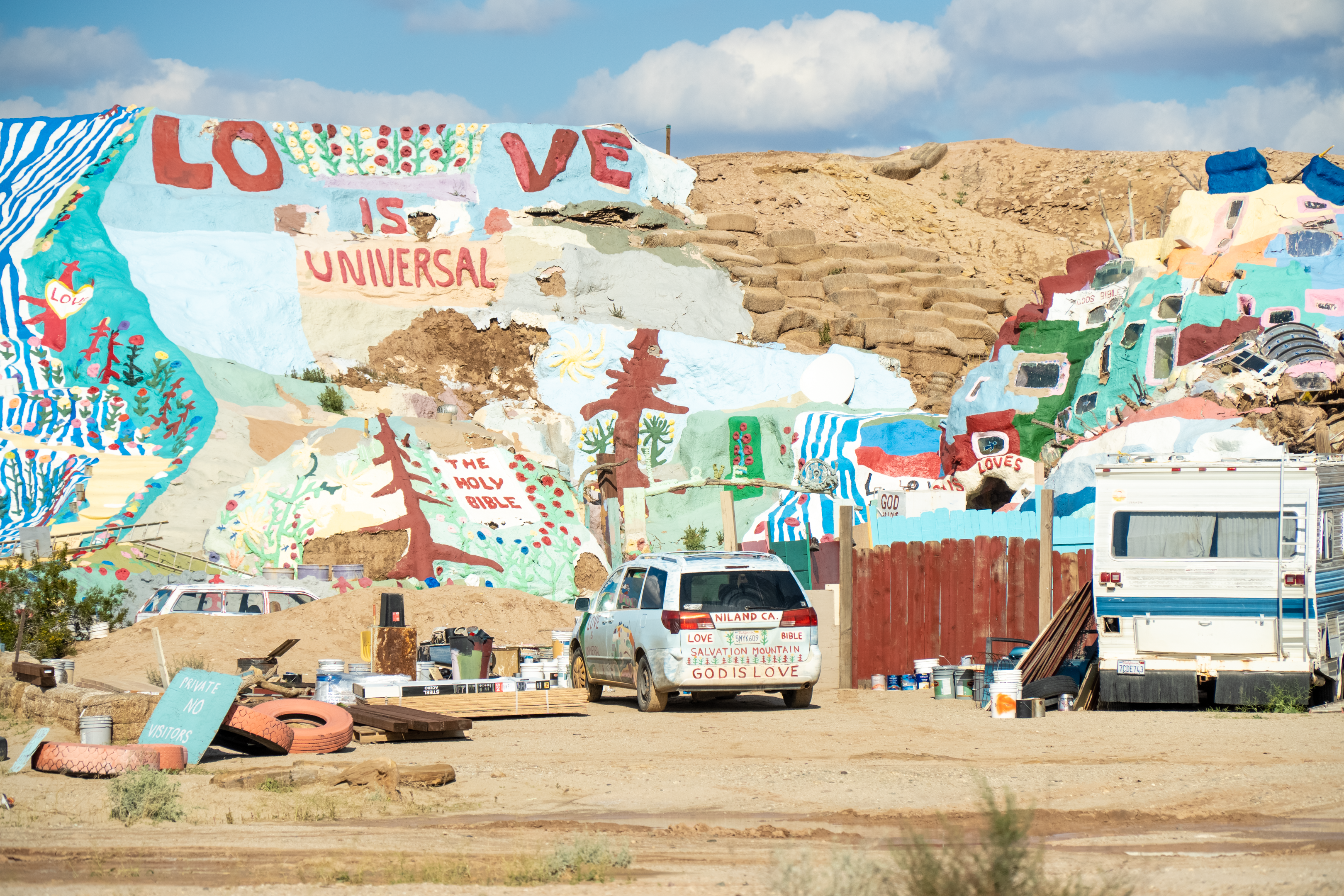
Salvation Mountain
At the edge of the Salton Sea, where California's desert heat reaches its most punishing, a man named Leonard Knight spent 28 years building a mountain. Using adobe, straw, and over 100,000 gallons of donated paint, Knight transformed a natural hill into a 50-foot folk art monument covered in flowers, waterfalls, Bible verses, and one repeated message: 'God Is Love.' Salvation Mountain is outsider art at its most extreme - one man's decades-long labor of religious devotion, painted in colors that shouldn't exist in the beige desert landscape. The U.S. government once condemned the mountain as toxic waste, threatening to bulldoze it. Supporters rallied; the site was eventually designated a 'national treasure' by congressional resolution. Knight died in 2014, but volunteers maintain his mountain, repainting it constantly against the desert sun that fades everything. Salvation Mountain persists, impossibly bright, impossible to ignore.
The Builder
Leonard Knight was a Vermont native who drifted through various jobs before experiencing a religious awakening in 1967. He spent years trying to build a hot air balloon that would carry his message - 'God Is Love' - across the sky. When the balloon project failed, he settled in the desert near Niland, California, in 1984 and began painting a small hill. He had no art training, no construction experience, no plan beyond spreading his message. He worked every day for 28 years, accepting paint donations, sleeping in his truck, greeting the thousands of visitors who came to see his creation. Knight was unfailingly cheerful, welcoming everyone regardless of their beliefs. 'I just want people to know God loves them,' he explained.
The Mountain
Salvation Mountain covers approximately half an acre and rises about 50 feet from the desert floor. The structure is adobe and straw over a natural hill, covered in layer upon layer of paint. The main face features a massive heart, a 'God Is Love' banner, a painted stream with a cross, flowers, and birds. A pathway leads through the 'Yellow Brick Road' and into the 'Hogan,' a cave-like structure decorated with painted tree trunks. Every surface is covered with paint, Bible verses, and Knight's simple message. The colors are vivid - reds, blues, yellows, greens - maintained by constant repainting. In the desert light, the mountain seems to glow. It's simultaneously folk art, religious monument, and fever dream.
The Controversy
In 1994, Imperial County officials declared Salvation Mountain a 'toxic nightmare' and proposed bulldozing it. They claimed the lead paint was contaminating the soil. Supporters rallied - artists, religious groups, and free-speech advocates argued the mountain was art, not pollution. Testing found no significant contamination; Knight had been using donated latex paint, which is lead-free. The bulldozing was cancelled. In 2002, Senator Barbara Boxer introduced a resolution designating Salvation Mountain a 'national treasure.' It passed. The mountain now falls under the protection of the Imperial County, which permits visitors but doesn't maintain the site. Volunteers do that, repainting sections that fade in the brutal sun.
The Legacy
Leonard Knight left the mountain in 2011 as his health declined; he died in 2014 at age 82. The site is now maintained by a group of volunteers who camp nearby and repaint constantly. Without maintenance, the desert would reclaim the mountain within years - paint peels, adobe crumbles, colors fade. The volunteers keep Knight's vision alive, repainting sections, welcoming visitors, accepting paint donations. Salvation Mountain has appeared in films, music videos, and art publications. It's become a pilgrimage site for both the religious and the aesthetically curious. The message remains what Knight intended: 'God Is Love,' painted in colors visible from miles away.
Visiting Salvation Mountain
Salvation Mountain is located just east of Niland, California, at the northeastern edge of the Salton Sea. The site is free and open to visitors; donations of paint and money are welcomed. There are no facilities - bring water, food, and shade. The desert is extremely hot in summer; visit in winter or early morning. The adjacent community of Slab City, a squatter settlement on abandoned military land, is interesting but separate from Salvation Mountain. Palm Springs is 80 miles northwest; San Diego is 120 miles southwest. The nearest commercial airports are in Palm Springs or San Diego. The drive through the Salton Sea basin is desolate but memorable - appropriate preparation for the explosion of color at journey's end.
From the Air
Located at 33.25°N, 115.47°W in the desert of southeastern California, near the Salton Sea. From altitude, Salvation Mountain appears as an improbable splash of color in the beige desert - visible from surprising distance due to its brightness. The Salton Sea spreads to the west, its shoreline visible as irregular white salt deposits. Slab City is immediately adjacent. Niland is the nearest town. The desert is flat and desolate, interrupted by irrigated farmland to the north. Palm Springs is 80 miles northwest across desert terrain. The terrain is below sea level, part of the Salton Trough.