Salvation Mountain: One Man's Painted Sermon in the Desert
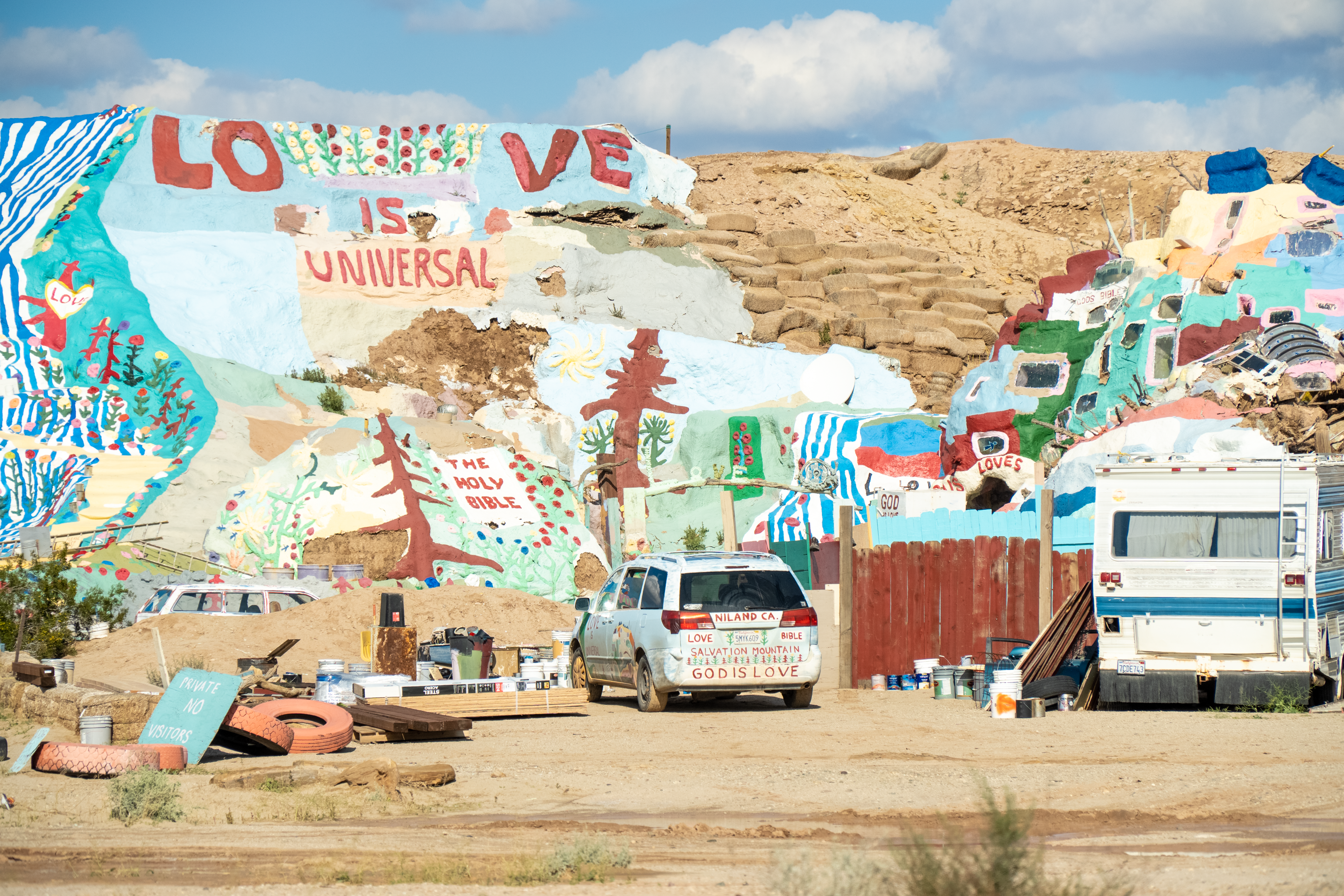
Leonard Knight had a simple message: God is love. He spent 28 years painting it on a mountain. Salvation Mountain rises from the California desert near the Salton Sea like a fever dream made solid - a 50-foot hill covered in 100,000 gallons of latex paint, adobe, straw, and obsession. Knight started building in 1984 with a hot air balloon message that failed, so he just kept going, transforming a bare hill into a Technicolor testament of flowers, waterfalls, Bible verses, and the words 'GOD IS LOVE' visible from miles away. He lived in his truck, accepted donated paint, and worked until he was 80. The state of California tried to condemn it as toxic waste. Folk art experts declared it a national treasure. Knight just kept painting. He died in 2014, but the mountain endures - weird, beautiful, and utterly sincere in a world that rarely is.
The Vision
Leonard Knight came to the desert in 1984 with a plan to fly a hot air balloon painted with 'GOD IS LOVE' over America. The balloon never flew properly; after years of failed attempts, Knight started building a mountain instead. He wasn't an artist. He wasn't trained in construction. He was a Vermont-born Korean War veteran who'd found Jesus at 35 and never stopped talking about it. The first version of Salvation Mountain collapsed after four years of work. Knight rebuilt it, this time using adobe and straw mixed with donated paint. He didn't ask for money, just paint. People brought it by the truckload. The mountain grew.
The Construction
Salvation Mountain is held together by faith and latex paint. Knight developed his own construction technique: mixing adobe, straw, and paint into a cement-like substance that hardens in the desert heat. He worked alone, mostly, painting from dawn until the heat drove him into shade. The mountain features a yellow brick road leading to the summit, painted trees, a painted waterfall, Biblical verses covering every surface, and caves decorated with found objects. There's no plan, no blueprint - Knight built what he felt like building, painted what he felt like painting. The result is chaos that somehow coheres, a monument to one man's unwavering certainty.
The Controversy
In 1994, Imperial County declared Salvation Mountain a toxic nightmare. The lead-based paint Knight had used for years contaminated the site, officials claimed, and the mountain should be demolished. Folk art scholars rushed to its defense. The Folk Art Society of America declared it a 'national treasure.' Senator Barbara Boxer entered its defense into the Congressional Record. Tests showed the lead levels were actually safe. The mountain survived. Knight kept painting, switching to donated latex paint, transforming criticism into vindication. The county that tried to destroy his life's work eventually listed it as a tourist attraction.
The Legacy
Leonard Knight painted until he couldn't anymore. In 2011, at 80, dementia and physical decline forced him to leave the desert. He died in 2014. But Salvation Mountain didn't die with him. Volunteers now maintain the site, applying fresh paint, repairing weather damage, preserving Knight's vision. The mountain appears in films, music videos, and countless Instagram feeds - its weird beauty perfectly suited to an age of shareable images. Some visitors come for the art. Some come for the message. Some come for the photos. Knight would have welcomed all of them. God is love, after all.
Visiting Salvation Mountain
Salvation Mountain is located near Niland, California, just east of the Salton Sea and adjacent to Slab City. There's no admission fee - Knight never charged, and the volunteers who maintain it don't either. The site is open 24 hours, though visiting during daylight is recommended. Bring water; this is harsh desert with no services nearby. The mountain is fragile - don't climb on areas marked as off-limits. Photography is encouraged; the colors are most vivid in morning or late afternoon light. Slab City, the off-grid community next door, offers its own surreal experience. The nearest services are in Niland (basic) or El Centro (full services, 30 miles south). Visit in winter or early spring; summer temperatures exceed 110°F.
From the Air
Located at 33.25°N, 115.47°W in Imperial County, California. From altitude, Salvation Mountain is visible as an improbable splash of color against the beige desert - reds, yellows, blues, and greens forming a small hill that looks nothing like its surroundings. Slab City spreads to the north, a grid of trailers and improvised structures. The Salton Sea shimmers to the west. The Chocolate Mountains rise to the east. The site sits at the edge of agricultural land, where irrigation ends and desert begins. The mountain is small from altitude but unmistakable - nothing else in the desert looks painted.