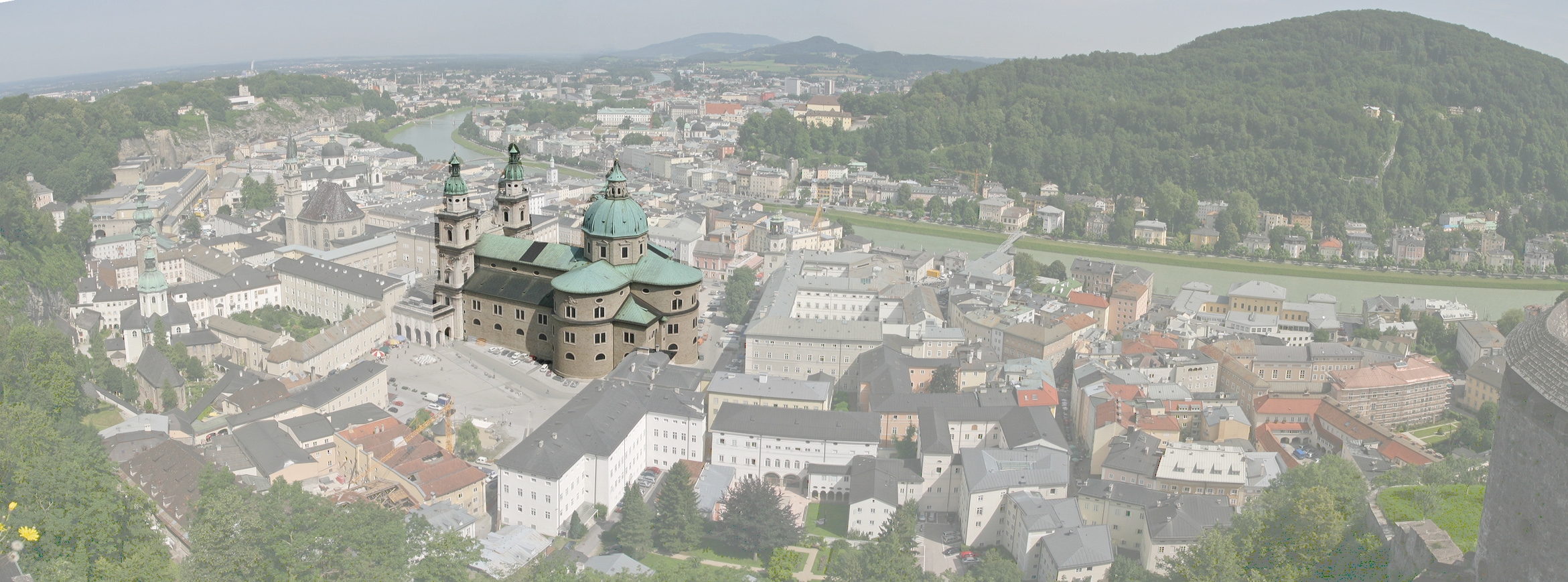
Salzburg Cathedral: The Church That Burned, Collapsed, and Rose Again in Marble
On January 28, 1756, a one-day-old infant was carried through the doors of Salzburg Cathedral and baptized at a 14th-century Gothic font. The baby was Wolfgang Amadeus Mozart. The font had survived from a much older church - one that had already been built, burned, rebuilt, expanded, demolished, and reconstructed in its current Baroque form over the course of a thousand years. That capacity for reinvention defines this cathedral. It stands today at 142 meters long and 33 meters high, its facade of bright Untersberg marble framed by twin towers, looking as confident and permanent as if it had always been this way. It has not.
A Millennium of Construction and Catastrophe
The story begins around 774, when Saint Vergilius of Salzburg built the first cathedral, possibly on foundations laid by Saint Rupert himself. That structure, 66 meters long and 33 meters wide, lasted less than 70 years before Archbishop Arno ordered renovations. In 842, lightning struck and the building burned. Rebuilding began three years later. Between 1000 and 1080, Archbishop Hartwig added a westward choir and crypt. Archbishop Konrad I raised west towers between 1106 and 1147. By the late Middle Ages, the cathedral had become an ad hoc Romanesque basilica - the accumulated result of centuries of patching, extending, and improvising. Then in 1598, severe damage struck again. After multiple failed attempts at restoration, Prince-Bishop Wolf Dietrich von Raitenau made the bold decision: tear it down entirely and start fresh.
An Italian Vision on Austrian Soil
Wolf Dietrich had spent time in Italy and Rome, and he wanted Italian Baroque architecture for Salzburg. He hired the Venetian architect Vincenzo Scamozzi to draw up plans for a comprehensive new building. But Wolf Dietrich never saw his vision realized - he fell from power in 1612. His successor, Markus Sittich von Hohenems, laid the cornerstone in 1614, and architect Santino Solari dramatically reworked Scamozzi's original design. The cathedral that rose was completed in just 14 years, consecrated on September 24, 1628, with a ceremony that matched the building's ambitions: twelve choirs sang from the marble galleries, performing a Te Deum composed by Stefano Bernardi, the Kapellmeister to the Salzburg court. That score has been lost, but the galleries remain, and the acoustic architecture that made polychoral music possible is still embedded in the stone.
Stone, Marble, and Seven Bells
The cathedral's body is dark grey stone, but the facade blazes white - Untersberg marble, quarried from the mountain visible to the south. Two towers frame a richly decorated front topped by a curved gable. Three high round arches at the base lead through bronze doors into the nave. Above the center window, a golden crown aligns precisely with the Marian column in the Domplatz below, a piece of urban design as deliberate as any in Europe. The column itself, the Maria Immaculata, was commissioned by Archbishop Sigismund von Schrattenbach and sculpted by the brothers Wolfgang and Johann Baptist Hagenauer between 1766 and 1771. Seven bells hang in the two towers. The oldest, the Marienglocke, dates to 1628 - the year of consecration. The largest, the Salvatorglocke, weighs 14,256 kilograms and was cast in 1961. Its inscription reads: 'We praise Your name forever and ever.'
A Bomb Through the Dome
In 1944, a single bomb crashed through the central dome over the crossing. The damage was devastating but precise - a wound in the heart of the building that left the nave and towers standing. Restoration proved slow. The war's destruction across Austria meant resources were scarce and priorities many. It took until 1959 - fifteen years - before the dome was fully repaired. Beneath the cathedral, the Domgrabungen excavation site reveals layers of everything that came before: foundation stones of the Romanesque basilica, Roman-era mosaics, and artifacts from the ancient city of Juvavum, the Roman settlement that preceded Salzburg. Walking down into the dig is walking backward through twenty centuries of construction on a single site, each era building on - and burying - the last.
Where the Archbishops Shaped a City
Salzburg Cathedral does not stand alone. Three open arcade arches connect it to the Salzburg Residenz on one side and St. Peter's Abbey on the other, forming the enclosed Domplatz - 101 meters long, 69 meters wide, with walls rising 81 meters. This architectural embrace was deliberate, binding church, palace, and monastery into a single complex that expressed the prince-archbishops' unified spiritual and political authority. Wolf Dietrich, who ordered the old cathedral demolished, also built the Alte Residenz next door. The cathedral anchors an ensemble of buildings that together define Salzburg's old town, a UNESCO World Heritage Site. The Gothic baptismal font where Mozart was christened still stands inside, a survivor from the demolished Romanesque church - a reminder that even the most thorough reinventions leave traces of what came before.
From the Air
Located at 47.798N, 13.047E in the heart of Salzburg's old town, Austria. The cathedral's twin Baroque towers and large central dome are distinctive landmarks from the air, sitting immediately north of the Festungsberg and Hohensalzburg Fortress. The Domplatz forms a visible enclosed square connecting the cathedral to surrounding palatial buildings. The Salzach River flows just 200 meters to the north. Salzburg Airport (LOWS) is approximately 3.5 km to the west-southwest. Best viewed at 2,000-3,500 feet AGL. The bright Untersberg marble facade contrasts with the darker stone of the nave, making the cathedral easy to distinguish from surrounding structures.