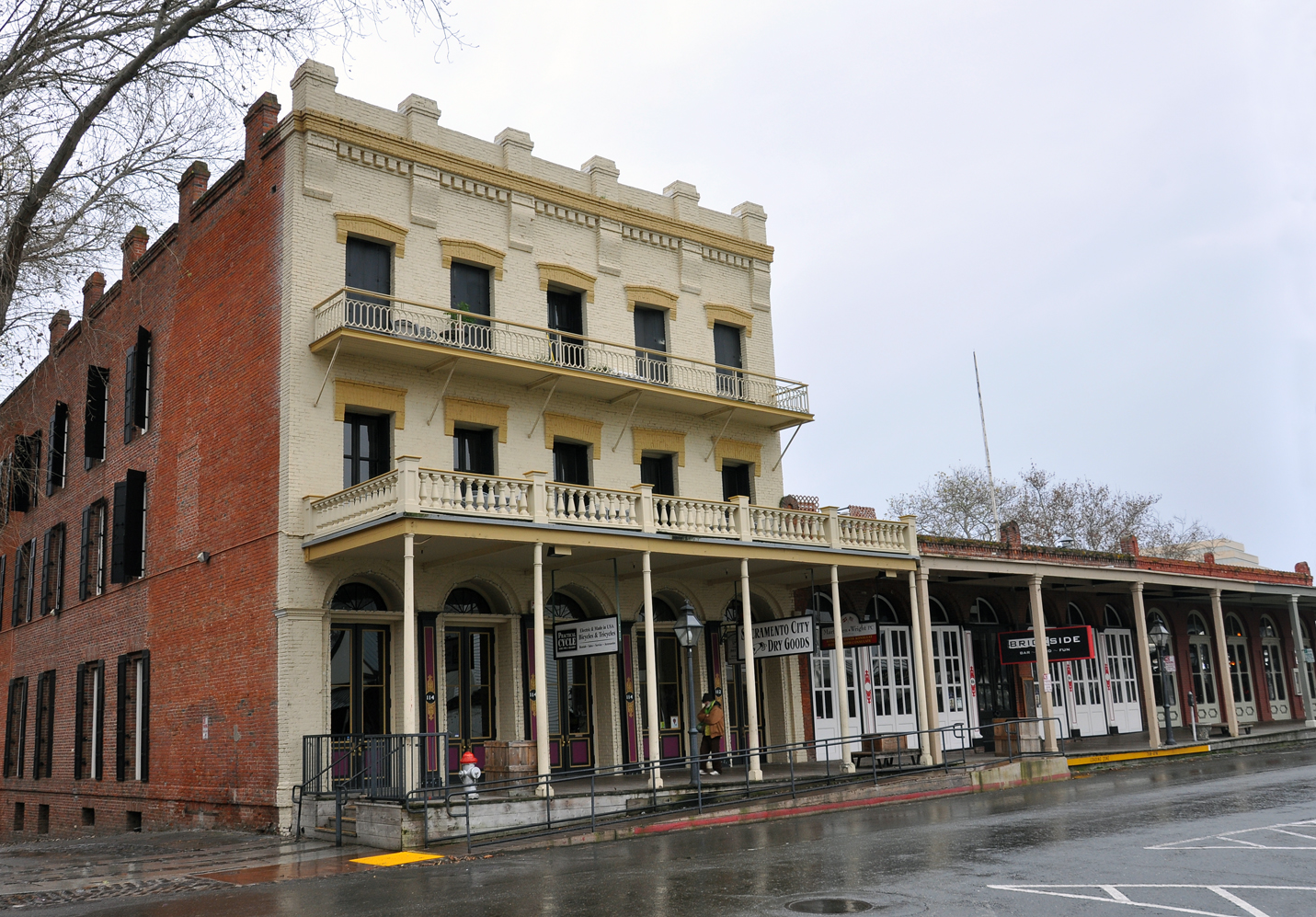
Sam Brannan House
On January 24, 1854, exactly five years after James Marshall spotted gold flakes in the tailrace at Sutter's Mill, seventy men gathered in the meeting room of the Jones Hotel at 112 J Street, Sacramento. They were not there to celebrate a strike. They were there because the Gold Rush was already slipping into the past, and they wanted to catch it before it disappeared entirely. That evening, the Sacramento Pioneer Association was born. The building where they met -- a three-story brick structure known by many names over the decades -- still stands in Old Sacramento State Historic Park, a California Historical Landmark that has outlasted fire, flood, and the city that tried to bury it.
Ashes, Bricks, and a Lot of Names
The lot at 112 J Street has been reinventing itself since 1849, when a wooden building went up and became Sacramento's first United States post office. That structure burned in an 1852 fire, one of the conflagrations that periodically leveled Sacramento's young downtown. Henry E. Robinson built the current three-story brick building on the site in 1853, on land owned by Samuel Brannan -- the Mormon elder turned entrepreneur who had famously run through San Francisco's streets waving a vial of gold dust and shouting the news of the discovery at Sutter's Mill. The building became the Jones Hotel, then the Vernon House under Miss O. J. Clark, who ran it as a boarding house after purchasing it in 1855. When Peter Bryding bought the property and converted it back to a hotel in 1865, he named it the Brannan House in honor of the land's original owner. The name stuck, even as Brannan himself spiraled from one of California's richest men to one of its most broke.
Lifting a City Above the Waterline
Sacramento in the 1860s had a flooding problem that bordered on the existential. The Great Flood of 1862 inundated the city, turning streets into rivers and the state capitol into an island. The city's response was ambitious and slightly mad: over a thirteen-year program spanning the 1860s and 1870s, Sacramento raised its buildings and streets, physically lifting the downtown above the reach of the Sacramento and American Rivers. The Brannan House was jacked up nine feet in 1865. Walking through Old Sacramento today, it is easy to forget that the ground-level storefronts were once second floors, that there is an entire buried layer of the city beneath the sidewalks. The raising of Sacramento was an act of collective stubbornness -- rather than relocate, the residents decided to pick up their city and set it down higher.
A Room Full of California's Founders
The founding membership of the Sacramento Pioneer Association reads like a who's who of mid-nineteenth-century California. John Sutter, on whose land gold was discovered, became the association's first honorary member. James W. Marshall, who actually found the gold, joined as well. Mark Hopkins and Collis Potter Huntington, two of the Big Four who would build the Central Pacific Railroad and amass enormous fortunes, were among the seventy founders. So were two future California governors, J. Neely Johnson and John Bigler, along with banker D. O. Mills and newspaper publisher James McClatchy, whose family would go on to build the McClatchy newspaper chain. Joseph W. Winans served as the first president. These men had arrived in California within its first chaotic decade of American governance, and they understood, even then, that their moment was exceptional.
Keeping the Record
The Pioneer Association did not fade away after its founders died. The organization incorporated the Sacramento Pioneer Foundation as a nonprofit in 1966 and continues to maintain Pioneer Hall on Seventh Street, built in 1868, which holds the distinction of being the oldest building in California under continuous ownership by a single entity. The association runs Pioneer Grove Cemetery within the Sacramento Historic City Cemetery, preserving the burial ground of many of the city's earliest settlers. From 1857 to 1859, the association's president was Dr. John F. Morse, who wrote the first history of Sacramento and built the Morse Building that still bears his name. The Brannan House itself has had a quieter later life, serving today as a Colderbank office in Old Sacramento -- a working building in a historic district, its brick walls holding the memory of a room where seventy men decided that the wildest years in California's history were worth remembering.
From the Air
Located at 38.58N, 121.51W in Old Sacramento State Historic Park, along the Sacramento River waterfront. The Old Sacramento district is visible from the air as a compact historic block between the river and downtown Sacramento's modern grid. Sacramento Executive Airport (KSAC) lies 3nm south; Sacramento International (KSMF) is 10nm northwest. The I-5 freeway and Tower Bridge provide good visual references. Best viewed at 1,500-2,500 feet AGL.