Samad al-Shan
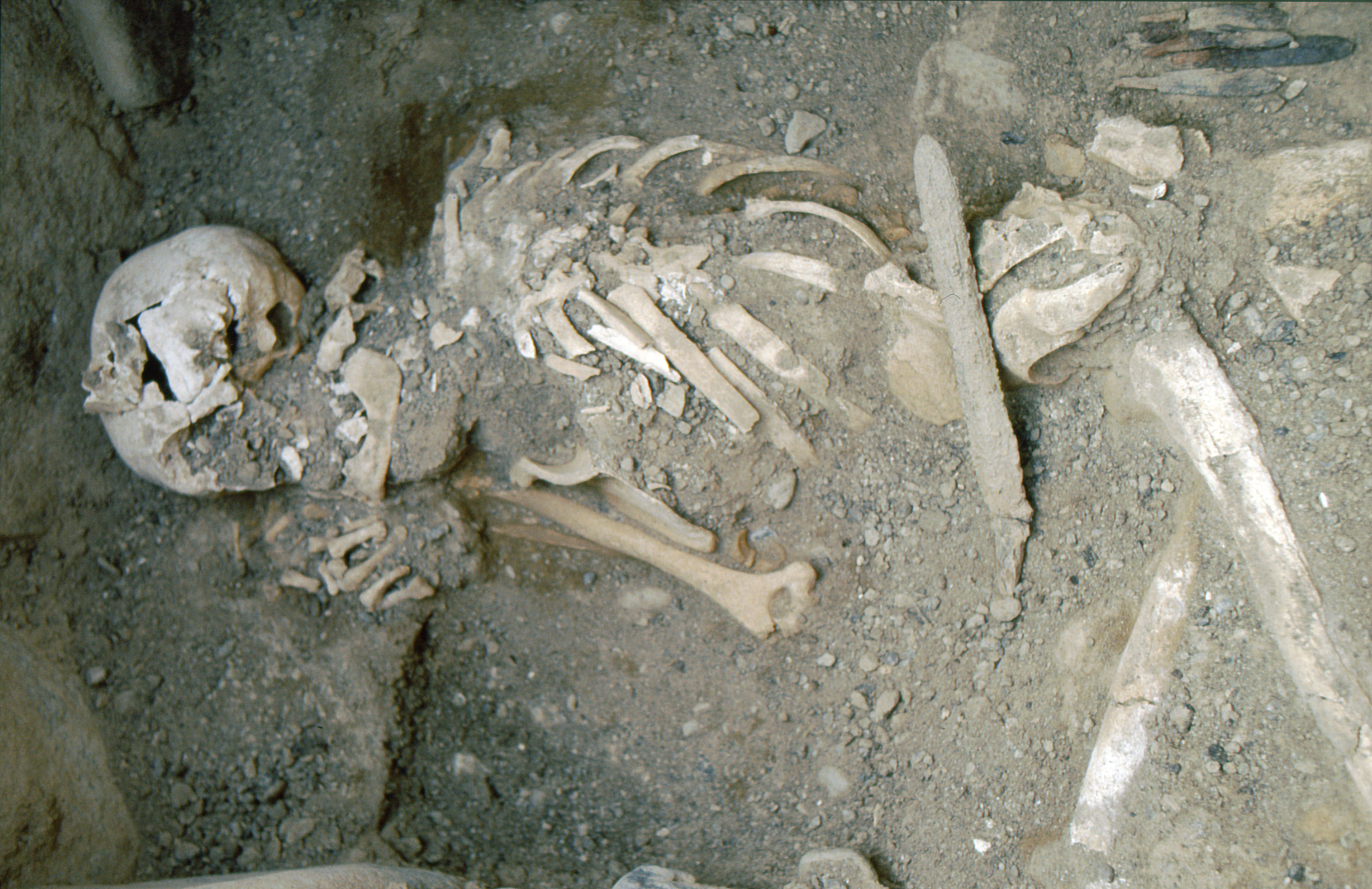
The dead at Samad al-Shan were buried with care and intention. Men were placed on their right side, women on their left. Men received weapons: arrow-heads, quiver remains, daggers. Women never did. Both sexes wore beads. The stronger the skeleton -- heavier bones, more pronounced muscle attachment marks -- the richer the grave goods. These details, painstakingly documented from over 260 excavated graves, form the foundation of what archaeologists call the Samad Period, a Late Iron Age cultural assemblage unique to Central Oman and one of the least understood chapters of Arabian prehistory.
The Type-Site
Samad al-Shan sits at about 565 meters altitude in Oman's Sharqiyah province, two kilometers east of the village of al-Maysar. British surveyors discovered part of the site in 1976. Systematic excavation began in 1981, when archaeologist Gerd Weisgerber started mapping the area. Over the following decades, teams from the German Mining Museum in Bochum and the University of Heidelberg, led by Burkhard Vogt, Weisgerber, and Paul Yule, documented graves spanning from the Bronze Age through the Late Iron Age. Samad became the type-site: the defining reference point for a non-literate Late Iron Age culture distributed across 126 known sites in Central Oman. These were not people who wrote things down. What we know about them comes almost entirely from what they left in their graves.
What the Graves Say
The subterranean stone graves at Samad range from simple chambers to elaborate constructions up to 9 meters long. Grave goods included hand-made local pottery, imported glazed perfume bottles, and lathe-turned soft stone bowls. Much has not survived: clothing, leather articles, arrow shafts, bows, and woven basketry have all decomposed. Precious metal objects are largely missing, probably looted in antiquity. What remains tells a story of social hierarchy. More than twice as many men have identifiable graves as women, and men's graves tend to be larger and better equipped. Children's graves are rare, though they may exist in unexcavated sections of the cemeteries. The population's teeth were catastrophically decayed, likely from a diet heavy in dates -- consistent with the theory that these were settled date farmers rather than nomadic herders.
Neither Persian Colony Nor Bedouin Camp
Who the Samad people were is a question that has resisted easy answers. European historians long declared interior Oman a colony of Persia during this period, but archaeological evidence contradicts this: over 80 Samad-period sites have been documented, while sites with Persian artifacts in southeastern Arabia are virtually nonexistent. The traditional Omani explanation, drawn from the Kashf al-Ghumma, holds that the population migrated from South Arabia. But the material culture at Samad does not match contemporary graves from southwestern Arabia. Linguistically, the Samad sites fall within areas where Modern South Arabian languages were historically spoken, not Arabic. The evidence dates the Samad Late Iron Age from roughly 300 BC to 300 CE, after which its cause of disappearance remains unclear; a series of megadroughts began around 500 AD, roughly two centuries after the Samad period's end.
Reading Bones in the Desert
At Samad al-Shan, archaeology approaches its limits. The desert preserves some things and destroys others according to its own logic. The stone graves survive because stone endures. The bodies inside tell their stories through bone density and dental wear. The weapons speak of conflict or status or both. But the questions that matter most -- what language these people spoke, what they believed, why they buried men and women differently, what happened to them in the end -- can only be approached indirectly, through inference and comparison. The Samad Late Iron Age remains little researched, resting primarily on Yule's excavation report of the type-site and subsequent reinterpretations. New discoveries could easily reshape the chronology, the geographic distribution, and the cultural identity of these people who farmed dates in an oasis 2,300 years ago and left their dead facing different directions depending on whether they were born male or female.
From the Air
Located at 22.81N, 58.15E in Oman's Sharqiyah province, at approximately 565 m altitude. The site is an oasis area in arid terrain. Nearest major airport is Muscat International (OOMS), approximately 200 km northwest. The landscape is flat desert punctuated by wadi channels from the Hajar Mountains.