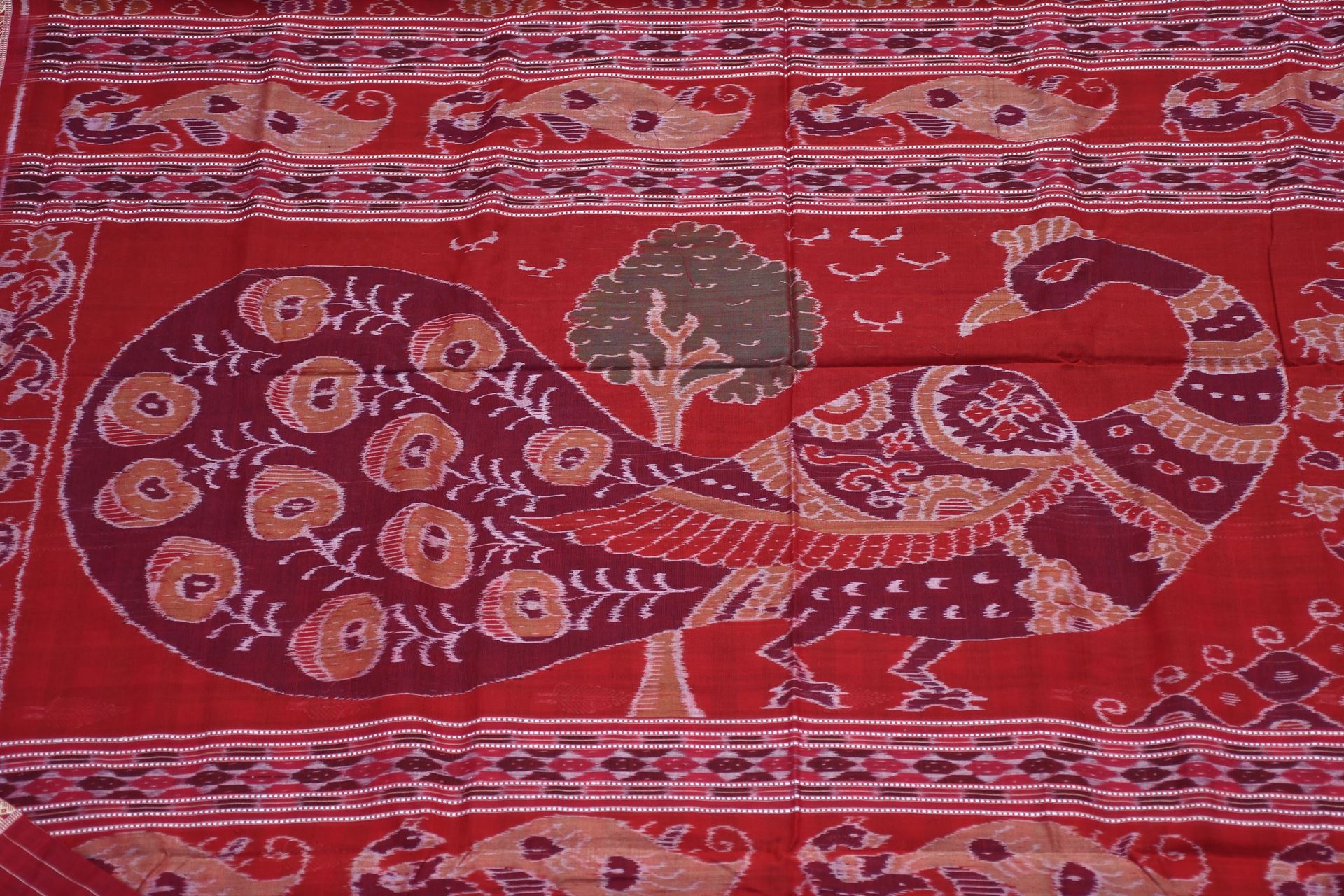
Sambalpuri Sari
The threads are dyed before they are woven. That single fact -- the reversal of what seems like the natural order of making cloth -- is what makes a Sambalpuri sari extraordinary. In the bandha technique, weavers tie off sections of the warp and weft yarns according to the desired pattern, dip them in dye, then untie and weave. The design does not sit on the surface of the fabric; it is embedded in its structure, reflected almost identically on both sides. Once dyed, the yarn can never be bleached into another color. The pattern is permanent, committed to the cloth before the loom even begins its work.
Refugees, Looms, and Eight Centuries of Thread
The craft's origin story begins with displacement. According to tradition, the Bhulia weaving community fled Northern India in 1192 AD after the fall of the Chauhan empire to the Mughals. They settled in western Odisha, bringing their tie-dye knowledge with them. For the next seven centuries, the art flourished in a limited palette of vegetable dyes, producing saris worn primarily by local women. The transformation came in the early twentieth century, when Sri Radhashyam Meher pioneered improvements in technique and quality that gave the craft a wider audience and a name: Sambalpuri, after the Sambalpur region where the tradition had taken deepest root. Other master craftsmen followed -- Padma Shri awardees Kailash Chandra Meher, Kunja Bihari Meher, Chatrubhuja Meher, and Krutharth Acharya among them -- each pushing the boundaries of what bandha weaving could achieve.
Sacred Geometry in Silk and Cotton
Every motif on a Sambalpuri sari carries meaning. The shankha, or conch shell, represents the sacred instrument of Hindu worship. The chakra, the wheel, echoes the iconography of Lord Jagannath, whose temple at Puri is the spiritual heart of Odisha. Flowers -- phula -- symbolize natural beauty and fertility. The colors themselves speak: red, black, and white represent the face of Lord Jagannath in his Kaalia form. These are not decorative choices arrived at by fashion; they are cultural statements woven into fiber. The Bandhakala -- the tie-dye art -- enables craftsmen to embed portraits, landscapes, and geometric patterns into fabric capable of inspiring a thought or conveying a message. The entire process, from tying to dyeing to weaving, takes many weeks for a single sari.
From Village Looms to a Prime Minister's Wardrobe
Sambalpuri saris might have remained a regional tradition had Indira Gandhi not started wearing them. The Prime Minister's endorsement in the latter half of the twentieth century launched the textile into national consciousness. Through the 1980s and 1990s, demand spread across India. Varieties multiplied -- Sonepuri, Pasapali, Bomkai, Barpali, and Bapta saris, each named after its place of origin and popularly known as Pata. The handloom silk saris manufactured in Sambalpur and Berhampur earned inclusion in the Government of India's Geographical Indications registry, a legal protection meant to safeguard both the craft and the livelihoods of those who practice it. Today, Sambalpuri textiles span furnishing materials, dress fabrics, and saris in silk, cotton, and mercerized cotton, produced across the Sambalpur, Bargarh, Balangir, Boudh, and Sonepur districts.
The Loom Against the Machine
The protection came none too soon. Factory production of Sambalpuri-style saris has devastated traditional handloom artisans. What takes a weaver weeks to create by hand -- tying each thread, dyeing, setting up the loom, weaving with the precision that makes both sides of the fabric mirror each other -- can be approximated by machines in a fraction of the time and at a fraction of the cost. The result looks similar to an untrained eye, but the difference is structural: a machine-printed fabric wears its pattern on the surface, while a true bandha sari carries its design through the cloth itself. For the Bhulia weavers and their fellow artisans, the question is whether a craft that survived the fall of an empire and eight centuries of quiet practice can survive the economics of industrial production.
From the Air
The Sambalpuri sari tradition is centered around Sambalpur at 21.52N, 83.92E in western Odisha. The weaving clusters span the Sambalpur, Bargarh, Balangir, Boudh, and Sonepur districts. From the air, the landscape is the agricultural heartland of the Mahanadi River basin. The nearest airport is Jharsuguda (VEJH/JRG), approximately 60 km north. Bhubaneswar (VEBS/BBI) is the nearest major international airport, about 300 km southeast. The terrain is gently undulating with scattered hills of the Eastern Ghats to the south.