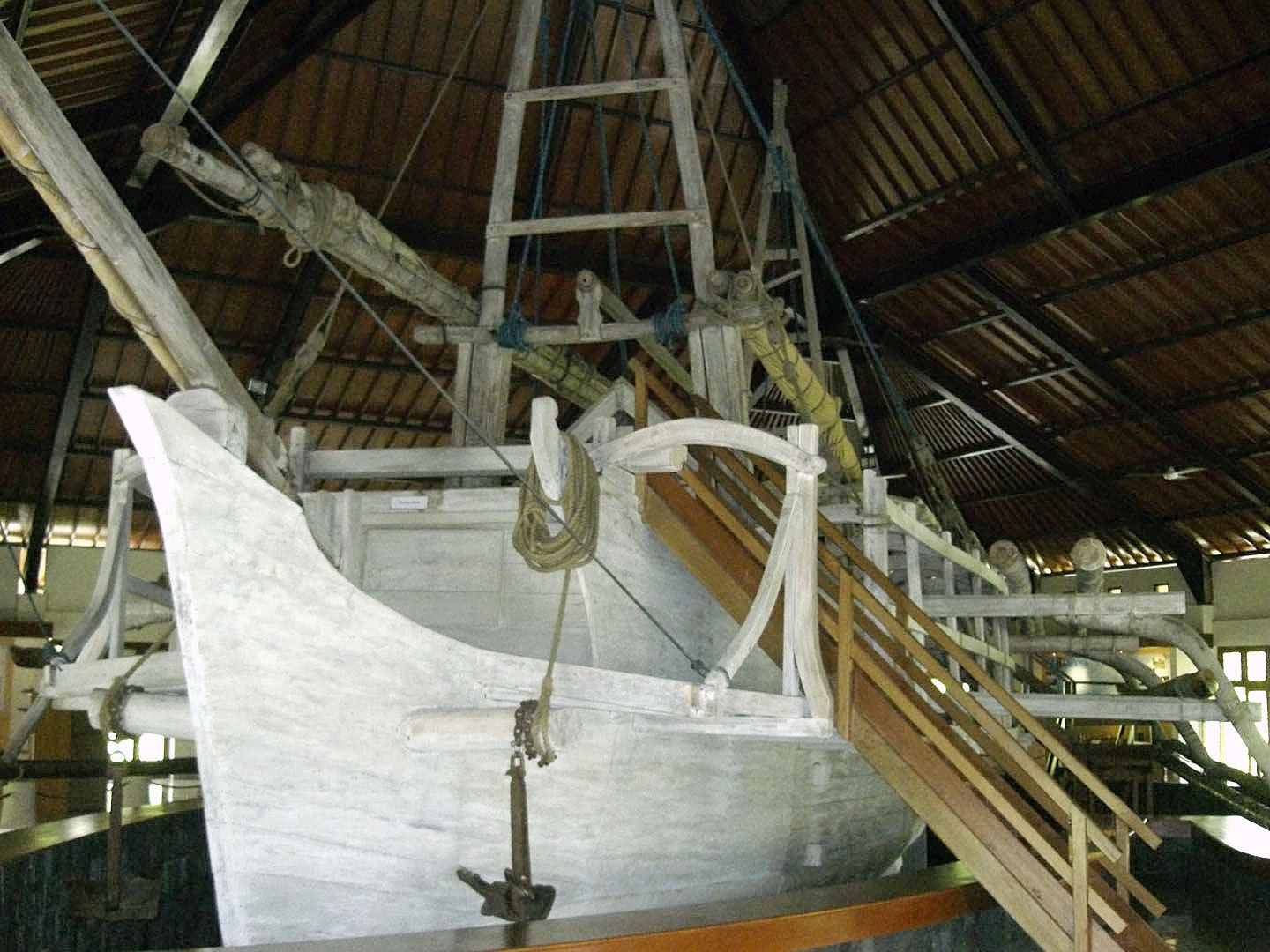
Samudra Raksa Museum: The Ship That Proved an Ancient Theory
Carved into the stone walls of the 8th-century Borobudur temple are images of ships. Not crude sketches, but detailed reliefs showing double-outrigger vessels with multiple sails, sturdy enough to cross open ocean. For decades, scholars debated whether these carvings depicted real seafaring technology or artistic imagination. In 2003, a team of Indonesian shipwrights answered the question by building one. They constructed a 25-meter wooden ship using only the temple reliefs as blueprints, launched it into the Indian Ocean, and sailed it from Indonesia to Madagascar and onward to Ghana. The vessel that proved the theory now rests in the Samudra Raksa Museum, just a few hundred meters from the temple walls that inspired it.
Stones That Tell of Open Water
The Borobudur temple complex in Magelang, Central Java, is best known as the world's largest Buddhist monument. But among its 2,672 relief panels are scenes of maritime life that tell a parallel story. Ships with outriggers and woven sails populate the lower galleries, carved with enough precision to show rigging details, hull construction, and cargo arrangements. These vessels were not riverboats. Their design suggests blue-water capability, ships built to handle the swells and currents of the Indian Ocean. Historians had long suspected that Javanese and Malay sailors of the Sailendra dynasty era traded across vast distances, carrying cinnamon, cloves, and other spices westward to Madagascar and the East African coast. The reliefs at Borobudur were the strongest visual evidence, but visual evidence alone could not settle the question of whether such voyages were technically possible.
Building a Ship from a Wall
The Borobudur Ship Expedition began as an act of experimental archaeology. Indonesian craftsmen, working with naval architects and historians, studied the temple reliefs to understand hull shape, mast placement, and outrigger geometry. They selected timber species that would have been available to 8th-century Javanese shipbuilders and used traditional woodworking techniques where possible. The result was a 25-meter double-outrigger sailing vessel, stitched together with plant fiber rather than nailed, just as the carvings suggested. When the ship was launched in August 2003, it represented more than craftsmanship. It was a hypothesis made physical: that the technology depicted on Borobudur's walls could actually carry people across thousands of kilometers of open sea.
The Cinnamon Route Retraced
The expedition departed Indonesia and sailed westward across the Indian Ocean, following the ancient trade corridor known as the Cinnamon Route. This was the path by which Southeast Asian spices, particularly cinnamon and cassia, are believed to have reached Madagascar, East Africa, and eventually the Mediterranean world. The crew navigated using traditional methods where they could, relying on wind patterns and ocean currents that ancient mariners would have understood. The voyage succeeded. The ship reached Madagascar, then continued along the African coast to Ghana, arriving in 2004. The journey proved that an 8th-century vessel of the type carved at Borobudur was seaworthy enough to complete the crossing. It also lent physical credibility to the linguistic and genetic evidence linking the Austronesian peoples of Indonesia to the settlement of Madagascar, which occurred roughly during the same era the temple was built.
A Museum Between Monuments
The Samudra Raksa Museum, whose name means "Guardian of the Ocean," opened on 31 August 2005. Coordinating Minister for Welfare Alwi Shihab presided over the ceremony, marking the museum as both a tribute to the expedition crew and a celebration of Indonesia's maritime heritage. The ship itself is the centerpiece, displayed in a hall just north of Borobudur within the archaeological park. Surrounding exhibits explain the Cinnamon Route trade network, the shipbuilding process, and the expedition's journey. Next door stands the Karmawibhangga Museum, which houses photographs of the hidden relief panels at Borobudur's base and other archaeological artifacts. Both museums are included in the park's entrance ticket, making them an easy complement to a visit to the great temple itself.
What the Ocean Remembers
The Samudra Raksa Museum occupies a peculiar position in the landscape of Indonesian heritage. It is not ancient, not grand, and not particularly large. Its value lies in the connection it draws between a stone carving and a living ocean. The Borobudur reliefs are more than a thousand years old. The ship in the museum is barely two decades old. Yet the ship validates the reliefs, and the reliefs give the ship its meaning. Together, they argue that Java's relationship with the sea is not incidental but foundational, stretching back to a time when Buddhist monks and spice traders shared the same coastline. For visitors who walk from the temple's upper terraces, where stone Buddhas gaze through perforated stupas, to the museum's interior, where a wooden hull still smells faintly of timber and salt air, the transition from the sacred to the practical feels seamless. The ancient Javanese, it turns out, were as skilled on water as they were in stone.
From the Air
Samudra Raksa Museum (7.60S, 110.20E) sits within the Borobudur Archaeological Park in Magelang, Central Java, Indonesia. Adisucipto International Airport (WARJ) in Yogyakarta is approximately 40km southeast. The museum is a few hundred meters north of the Borobudur temple, which is visible from the air as a stepped pyramid surrounded by green rice paddies. Mount Merapi volcano stands 28km to the east. Terrain is low-lying agricultural plain. Tropical climate with rainy season from November through March.