San Basilio de Palenque
The language gives it away. Walk through San Basilio de Palenque and you will hear something that sounds almost like Spanish but is not. Palenquero - the only Spanish-based creole language in Latin America - carries the grammar of Kikongo, a tongue spoken thousands of miles away in the Congo and Angola. It survives here, in a small village about 50 kilometers south of Cartagena, because the people who created it refused to let anyone take it from them. In 1599, roughly thirty enslaved Africans escaped into the forests near the Magdalena River under the leadership of a man named Benkos Bioho, and from that act of defiance grew the first free African settlement in the Americas.
King Benkos and the Palisade
Benkos Bioho was originally from the Bijago Islands of Guinea-Bissau in West Africa. Captured, shipped across the Atlantic, and sold into slavery at the port of Cartagena de Indias, he escaped in 1599 with about thirty others. The group fled into the swamps and forests between the Matuna marshlands and the Dique channel. When Spanish authorities sent twenty armed men to recapture them, the maroons fought back and killed the expedition's leader, Juan Gomez. Bioho established his settlement on defensible ground, surrounding it with palisades - palenques in Spanish - which gave the community its name. He declared himself King Benkos and founded a dynasty with his wife, Queen Wiwa. By the time the Spanish arrived at terms with Bioho, the settlement had grown into something they could no longer simply erase. They captured and hanged him in 1621, but the community he built survived.
Freedom Decreed, Freedom Defended
For decades, the Palenqueros waged an ongoing campaign to free enslaved Africans arriving at Cartagena's port. Raiding parties intercepted slave caravans, and word spread along the Magdalena River that freedom existed inland for those brave enough to reach it. In 1691, the Spanish Crown tried a different approach: a Royal Decree guaranteeing the Palenqueros their freedom, on the condition that they stop welcoming new escapees. The community accepted the decree's recognition of their liberty and ignored its restrictions. Runaways continued to arrive. In 1696, colonial authorities attempted to subdue another rebellion, and in 1713, after years of fierce resistance, Bishop Antonio Maria Casiani signed a formal agreement granting the community rights to its land - again with the stipulation that no new maroons be accepted. The Palenqueros again refused to honor that condition. Their freedom was not negotiable, and neither was their willingness to extend it to others.
A Language That Remembers
What makes Palenque extraordinary among the many maroon communities that once dotted the Caribbean coast is what it preserved. Palenquero, the village's creole language, draws its vocabulary primarily from colonial-era Spanish and Portuguese, but its grammatical structure comes from West African languages, particularly Kikongo. Fewer than half of the community's roughly 3,000 residents still speak it, but efforts to teach it to younger generations have intensified since UNESCO's recognition. The language is not a curiosity or a relic - it is living proof that the people who built this village carried their identity across the Atlantic and held onto it through centuries of pressure to assimilate. A New York Times article once described it as "a language, not quite Spanish, with African echoes," which captures its sound but not its significance. Palenquero is a declaration that enslavement could not erase the cultures it tried to destroy.
Drums, Death Rites, and New Rhythms
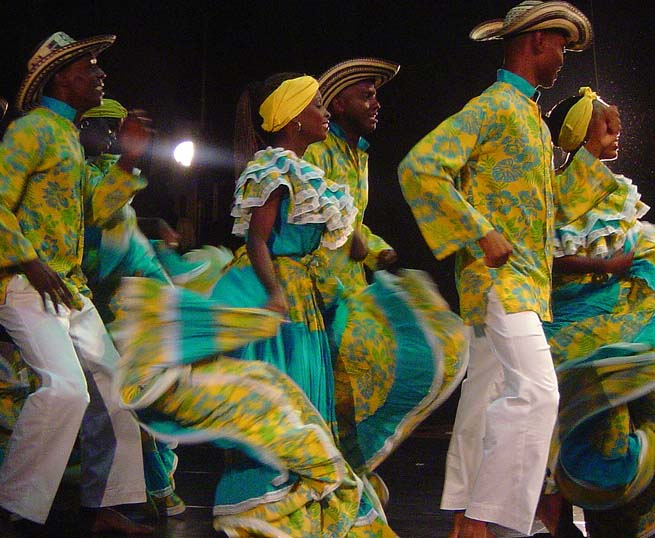
Music in Palenque runs deeper than entertainment. The lumbalu, a funeral ceremony with roots in West African burial traditions, involves singing and dancing around the deceased, followed by nine days of mourning. Traditional Palenquera music includes son Palenquero and bullerengue, performed with drums that connect directly to Central African rhythmic traditions. From this deep musical soil grew something unexpected: champeta, a modern genre that fuses African, Caribbean, and electronic elements and has become one of Colombia's most popular and controversial musical exports. Groups like Sexteto Tabala and Kombilesa Mi have brought Palenque's sound to international audiences. Every October, the Festival de Tambores transforms the village into a concert hall where children learn rhythms passed down through generations and musicians blend ancestral patterns with contemporary production.
The Palisade Still Stands
In 2005, UNESCO declared the cultural space of Palenque de San Basilio a Masterpiece of the Oral and Intangible Heritage of Humanity. The recognition was not for a monument or a building but for a living community and the traditions it has maintained for more than four centuries. A bronze statue of Benkos Bioho stands in the main plaza, his face set toward the horizon, the date 1603 inscribed on its base. Palenque remains small - a village, not a city - but its significance is outsized. It is the oldest and most intact maroon settlement in the Americas, a place where African identity survived not as a museum exhibit but as daily life: in the language spoken at breakfast, the drums played at funerals, and the stubborn insistence, generation after generation, that the freedom Benkos Bioho seized by force would never be surrendered.
From the Air
Located at 10.10N, 75.20W, approximately 50 km south of Cartagena in Colombia's Bolivar Department. The village sits inland amid rolling terrain between the Matuna wetlands and the foothills. Nearest major airport is Rafael Nunez International at Cartagena (SKCG/CTG), roughly 30 nm to the northwest. The landscape between Cartagena and Palenque shows the transition from coastal lowlands to the marshy interior where the original maroons found refuge. Best viewed at 3,000-5,000 ft.