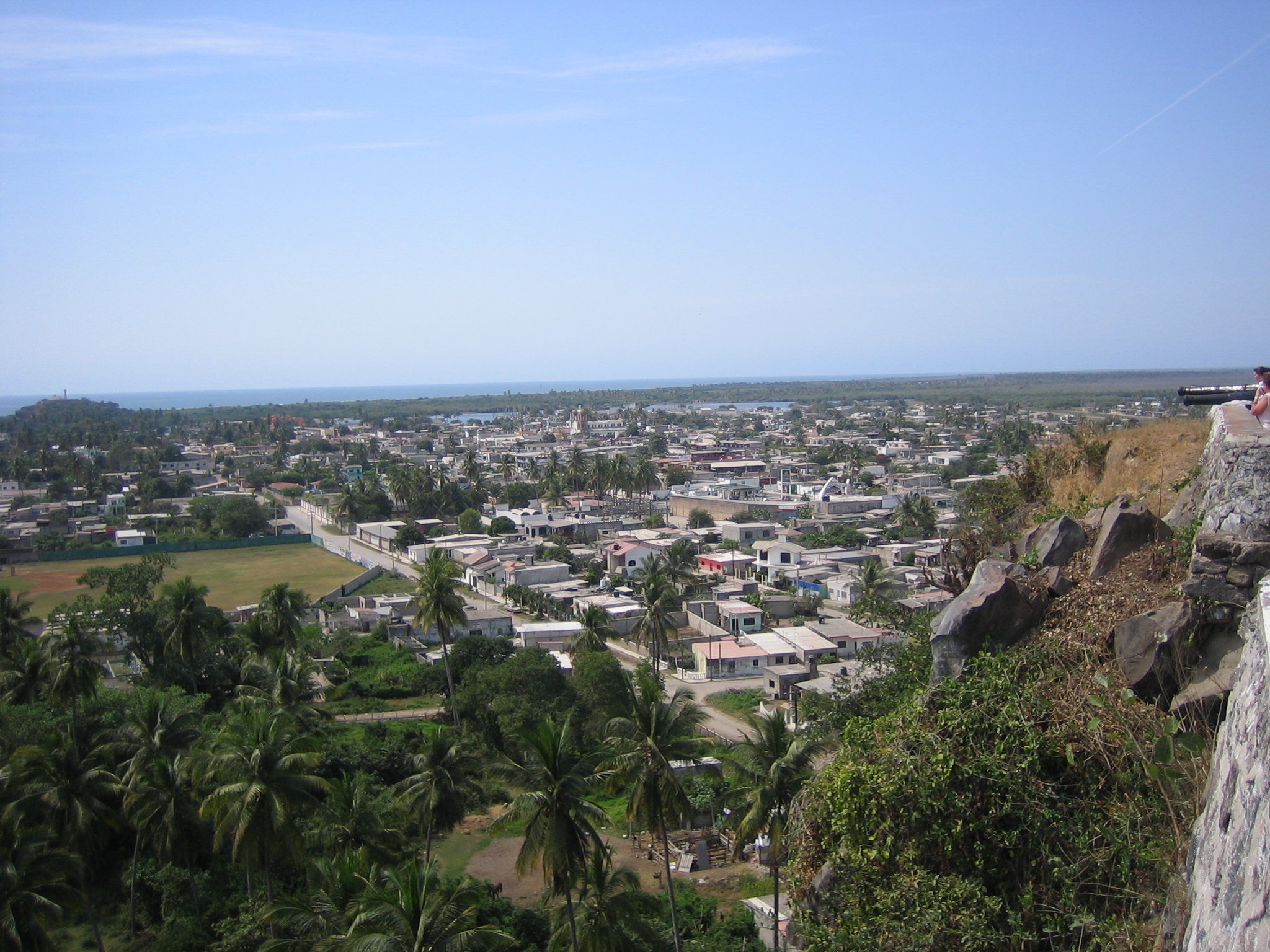
San Blas, Nayarit
The bronze bells that once hung in the Church of Our Lady of the Rosary on the hilltop above San Blas are said to have inspired Henry Wadsworth Longfellow's 1882 poem "The Bells of San Blas." The church is a ruin now, its stone walls open to the Nayarit sky, but the poem's final line -- "O Domine Deus!" -- captured something true about this place: it was already fading when Longfellow wrote about it. Two centuries earlier, San Blas had been one of the busiest ports on the Pacific coast of the Americas. Ships bound for California, Alaska, Manila, and the fur-rich waters of the Pacific Northwest were built and launched from its small harbor. That a town of fewer than nine thousand people was once the logistical backbone of Spain's Pacific ambitions says everything about how dramatically fortunes shift along this coast.
A Port Born for War, Not Commerce
San Blas owes its existence to a bureaucrat with strategic vision. In 1768, the Bourbon Visitador Jose de Galvez founded the port as a military staging ground for expeditions to Sinaloa, Sonora, and the Californias -- both Baja and Alta. This distinguished San Blas from Acapulco, which was fundamentally a commercial port. Galvez had a secondary motive too: curtailing the tax evasion that flourished in Acapulco's Asia trade, which Mexico City's merchant class controlled. He established a shipyard on the Santiago River, and from this unlikely harbor, Spain projected naval power up and down the Pacific. Only two ships were assigned initially -- the packet San Carlos under Juan Perez and El Principe under Vicente Vila -- but Galvez soon ordered four new vessels, including the schooner Sonora, which Juan Francisco de la Bodega y Quadra would sail all the way to Alaska in 1775.
The Road to California Ran Through San Blas
Spain's fragile colony in California depended on San Blas for survival. Two supply ships sailed from its harbor once a year, carrying provisions that the distant missions could not produce themselves. On March 12, 1768, Junipero Serra -- Father President of the California Missions -- departed San Blas aboard the locally built barque Purisima Concepcion, beginning the overland and maritime journey that would lead to the founding of missions from San Diego to San Francisco. In 1775, the San Carlos, a product of the Santiago River shipyard, set out from San Blas for San Francisco Bay with a crew of thirty aboard a vessel just fifty-eight feet long. For roughly twenty years in the late eighteenth century, this small town rivaled Acapulco itself, serving as the eastern anchor of trans-Pacific shipping routes that connected New Spain to Manila. Navy ships carried mail to the Philippines. By tradition, their crews could carry private merchandise, weaving a thread of commerce into every military voyage.
Mosquitoes, Silver, and Decline
San Blas was, in many ways, a terrible place for a port. The harbor was so cramped it could hold no more than four ships at a time. Silting from the Rio Grande de Santiago required constant dredging. Torrential rains from July to October, combined with extensive mangrove swamps, bred clouds of mosquitoes that were legendary even by tropical standards. Dysentery, typhoid fever, and malaria were endemic. Yet silver mined in Mexico's northwest needed an outlet to pay for imports, particularly goods from Panama -- which was flooded with British products funneled through Jamaica. So San Blas endured. A fort was built on the hilltop to defend the sea trade with the Philippines, its facade bearing stone carvings of the kings of Spain. When shipping eventually migrated to Manzanillo and then Acapulco, San Blas lost its reason for being. The jungle reclaimed what the empire had built, leaving the ruins that Longfellow immortalized.
Pueblo Magico on a Forgotten Shore
In 2023, the Mexican government designated San Blas a Pueblo Magico, recognizing its cultural and historical importance -- a status that brings tourism funding and national attention. The town sits about a hundred and sixty kilometers north of Puerto Vallarta and sixty-four kilometers west of the state capital Tepic, connected to the rest of Mexico by a three-hour drive from Guadalajara. Playa de Matanchen, just south of town, once held a Guinness World Record for the longest surfable wave, though a hurricane later filled part of the bay with sand and shortened the ride. Migratory birds fill the surrounding estuaries and lowland palm forests. The San Blas pier inspired the hit song "En el muelle de San Blas" by the Mexican rock band Mana, based on the story of a woman named Rebeca who waited at the dock for a sailor who never returned. It is a fitting anthem for a town that has spent two centuries waiting for its next chapter to begin.
From the Air
Located at 21.54°N, 105.29°W on the Pacific coast of Nayarit, Mexico. The town is at the mouth of a river system with extensive mangrove swamps visible from the air. A hilltop fort ruin is identifiable from low altitude. The harbor is very small. Nearest major airport is Tepic International Airport (ICAO: MMEP), approximately 64 km to the east. Puerto Vallarta's Gustavo Diaz Ordaz International Airport (ICAO: MMPR) is about 160 km to the south. Best viewed at 2,000-4,000 ft AGL for the contrast between mangroves, town, and coastline.