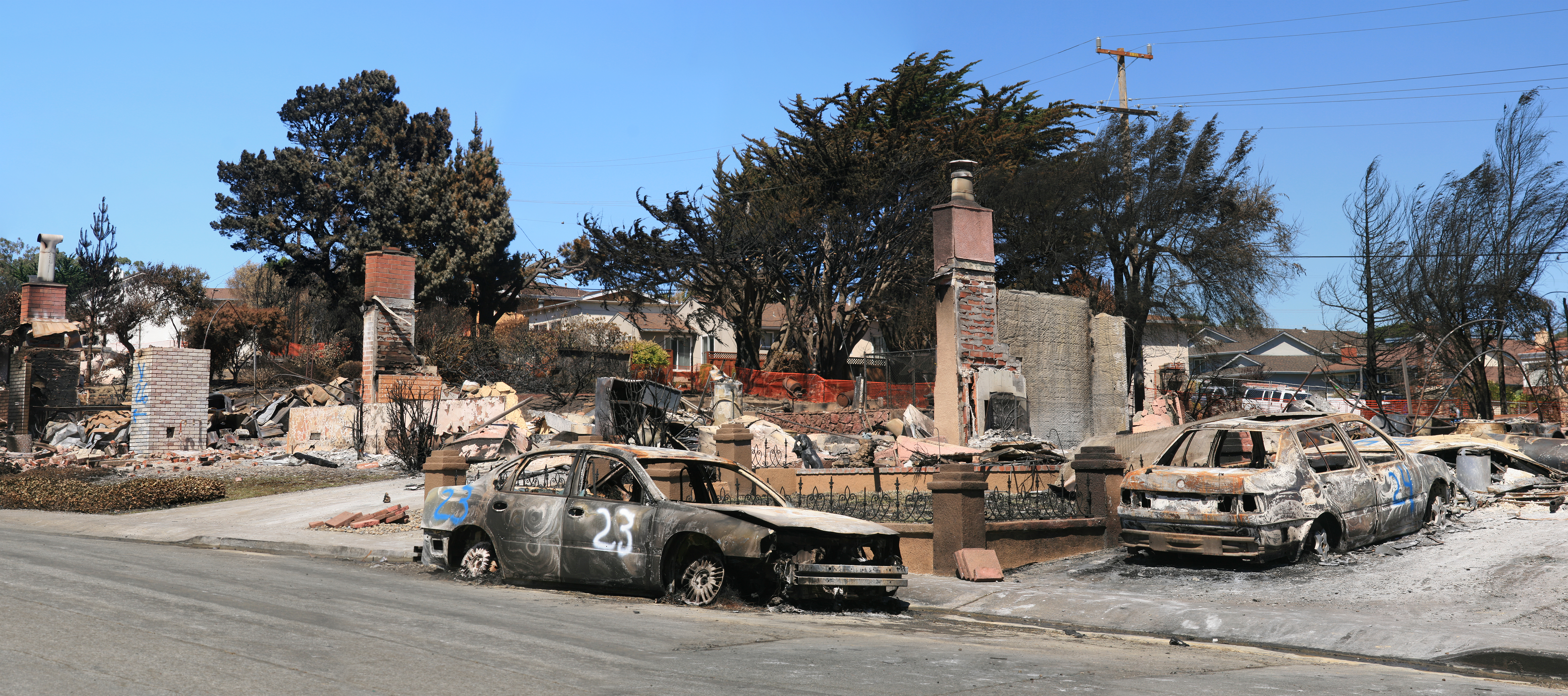
San Bruno Pipeline Explosion
Commercial pilots flying into San Francisco International Airport saw the fireball and assumed a plane had gone down. First responders racing toward the Crestmoor neighborhood thought the same thing. The roar and the shaking registered as a magnitude 1.1 earthquake on seismographs. It took crews nearly an hour to understand what had actually happened: a 30-inch steel natural gas pipeline, installed in 1956 beneath the sidewalks of a quiet residential street, had finally failed.
Six Minutes Past Six
At 6:11 PM PDT on September 9, 2010, the explosion tore through the Crestmoor residential neighborhood of San Bruno, near Skyline Boulevard and San Bruno Avenue. The blast excavated a crater 72 feet long, 26 feet wide, and created a geyser of burning natural gas. Eyewitnesses reported the initial fireball shot more than 1,000 feet into the air. It took 60 to 90 minutes to shut off the gas. By then, the fire had become an eight-alarm inferno requiring 200 firefighters and mutual aid from across the Bay Area, including 25 fire engines, four airtankers, two air attack planes, and a helicopter from California Department of Forestry and Fire Protection.
The Neighbors Became First Responders
The explosion compromised a water main, leaving firefighters without pressure. Residents dragged fire hoses nearly 1,000 feet to reach working hydrants. Ordinary citizens loaded injured neighbors and burn victims into their cars and drove them to hospitals. The fire was only fifty percent contained by 10 PM and continued burning until 11:40 AM the next day. Eight people died: Jessica Morales, Jacqueline Greig, Janessa Greig, Elizabeth Torres (81), Lavonne Bullis (82), Greg Bullis (50), Will Bullis (17), and one other victim. Thirty-eight homes were destroyed, many of them on Claremont Drive.
Welds That Never Should Have Held
Federal investigators found the pipeline riddled with defects. The thickness of the steel pipe varied. Some welds did not fully penetrate the metal. The segment that failed was made of several smaller sections welded together, with a seam running its length. The pipe had been installed in 1956, before modern X-ray testing could reveal such flaws. As PG&E increased pressure over the decades to meet growing energy demand, the defective welds weakened further. Ironically, PG&E had replaced sections of Line 132 along the San Andreas Fault to prevent earthquake damage, but the replacement stopped short of the segment that actually failed.
The Price of Neglect
Investigations revealed PG&E could not provide documentation proving many of its pipelines could withstand their rated operating pressures. An independent audit found the company had diverted over $100 million from safety operations to executive compensation and bonuses. In April 2015, the California Public Utilities Commission fined PG&E $1.6 billion. A federal grand jury indicted the company on 28 counts, including obstruction of justice for lying to the National Transportation Safety Board about pipeline testing policies. PG&E ultimately paid $565 million to settle victim claims and faced potential fines exceeding $3.8 billion.
What Remains
On September 9, 2012, exactly two years after the explosion, a memorial to the eight victims was unveiled in San Bruno City Park. The disaster forced a reckoning with America's aging pipeline infrastructure: thousands of miles of high-pressure fuel lines running beneath residential neighborhoods, installed decades ago, maintained by companies with inadequate records and perverse incentives to defer safety spending. Brigham McCown, former head of the federal Pipeline and Hazardous Materials Safety Administration, called for a national commission and suggested creating buffer zones around the most dangerous lines. The crater on Glenview Drive has been filled and rebuilt. The lessons remain half-learned.
From the Air
The San Bruno explosion site lies at 37.622N, 122.442W, approximately 2nm west of San Francisco International Airport (KSFO). The Crestmoor neighborhood sits between Skyline Boulevard (CA-35) and San Bruno Avenue, on hillside terrain. From altitude, look for the dense residential grid south of San Francisco proper. The memorial is located in San Bruno City Park. Due to proximity to SFO, this area sees heavy air traffic. Caution: SFO Class B airspace. Coordinate with SFO approach/departure if transiting below 4,000 feet.