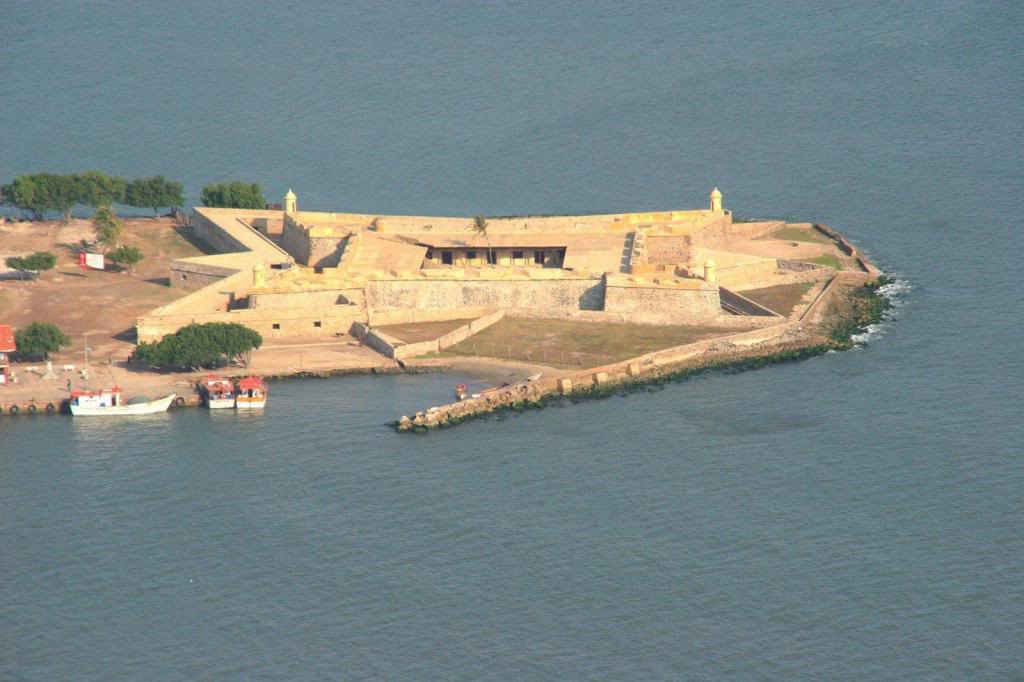
San Carlos de la Barra Fortress
Henry Morgan had a problem. It was March 1669, and the legendary Welsh privateer had sailed into Lake Maracaibo, sacked the city, and loaded his ships with plunder. Now he needed to get out. Standing between Morgan and the open Caribbean was a limestone fortress on a narrow peninsula, its 16 cannons trained on the only passage connecting the lake to the Gulf of Venezuela. The Spanish commander, Alonso de Espinosa, refused every offer -- gold, silver, cattle, hostages. Morgan's solution was pure theater: he faked a land assault at nightfall, sending empty boats ashore while his fleet slipped past the distracted garrison under cover of darkness. The fortress at San Carlos de la Barra had been built to keep people like Morgan out. It had been standing for barely 46 years, and already it was learning that determination alone does not stop a clever enemy.
Limestone Against Pirates
The Spanish built San Carlos de la Barra in 1623, using limestone quarried from the nearby Island of Toas. Its purpose was straightforward: control the narrow strait where Lake Maracaibo meets the Gulf of Venezuela. Before the fort existed, Maracaibo had been attacked and sacked repeatedly by pirates who sailed through the undefended passage and raided the settlements along the lake's shores. A star fort -- its angular bastions designed to eliminate blind spots for defensive fire -- was the answer. Positioned on the Peninsula of San Carlos in what is now Zulia state, the fortress became the gatekeeper of one of South America's most important waterways. Every ship entering or leaving the lake had to pass under its guns.
Pirates, Privateers, and Cunning
The fort's first major test came in 1666, when the French pirate Francois l'Olonnais -- known in Spanish as Jean David Nau El Olones -- arrived with a fleet of eight ships and 650 men. The garrison fought back with its 16 guns, but l'Olonnais captured the fortress in less than three hours. Three years later, Morgan's raid demonstrated that even a fort the pirates could not take by force could still be outwitted. The town's refugees had sheltered inside San Carlos during Morgan's sacking of Maracaibo, and Espinosa's garrison held firm in refusing to let the privateer escape. But Morgan understood that a fortress is only as strong as the people defending it, and when the Spanish rushed to repel what they believed was a ground assault, Morgan's ships ghosted past in the dark. He returned to Jamaica on May 14, 1669, his reputation cemented.
The Key to Independence
For two centuries, San Carlos de la Barra served Spain. Then, in 1823, it served Venezuela. Admiral Jose Prudencio Padilla led a Venezuelan naval squadron against the fort in an action known as the Forcing of the Barra de Maracaibo. By seizing the fortress, Padilla's ships gained access to the lake itself, where they engaged and defeated a Spanish fleet in the Battle of Lake Maracaibo -- the final naval engagement of the Venezuelan War of Independence. The fort that had been built to protect Spanish colonial interests became the hinge on which Venezuelan sovereignty turned. After independence, the fortress remained part of the national defense system, and in 1902 it faced its most modern adversary when warships of the Imperial German Navy bombarded it during the Venezuelan crisis of 1902-03, a debt dispute that drew in Britain, Germany, and Italy.
Walls That Remember
Not all the fortress's inhabitants were soldiers. San Carlos de la Barra also served as a prison, and among its inmates was the Venezuelan writer Eduardo Lopez Bustamante, who composed poetry within its limestone walls. There is something fitting about a place designed for war producing literature instead. The fort stands today on the same peninsula where it was raised four centuries ago, overlooking the same narrow passage. The limestone has weathered, the cannons are silent, and the pirates are long gone. But the strait it guards remains the only way into Lake Maracaibo, and the fort remains a monument to every force -- Spanish, French, English, Venezuelan, German -- that tried to control it.
From the Air
Coordinates: 10.986N, 71.608W, on the Peninsula of San Carlos at the narrow entrance connecting Lake Maracaibo to the Gulf of Venezuela, Zulia state. The star fort is visible from low altitude as a geometric shape on the tip of the peninsula. Lake Maracaibo stretches to the south; the Gulf of Venezuela opens to the north. The strait the fort guards is the lake's only outlet to the Caribbean. Nearest airport: La Chinita International Airport (SVMC/MAR) in Maracaibo, approximately 30 km south. Recommended altitude: 2,000-4,000 feet to appreciate the fort's position controlling the narrow channel.