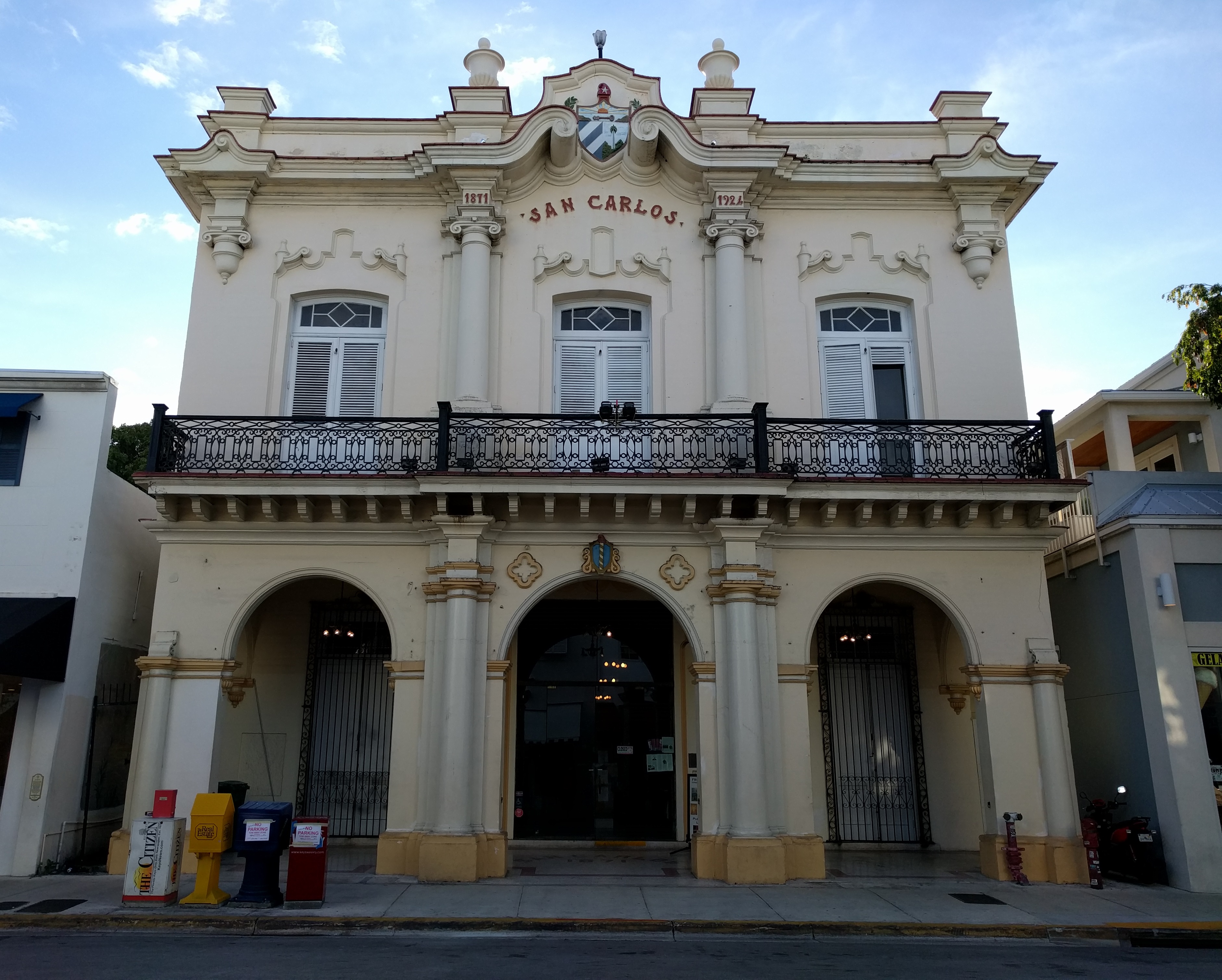
San Carlos Institute
On January 3, 1892, Jose Marti stood before a massive gathering at the San Carlos Institute on Duval Street in Key West and announced what the divided Cuban exile community had thought impossible: unity. The tobacco workers, the intellectuals, the old revolutionaries and the young firebrands were at last aligned behind a single cause -- Cuban independence from Spain. Marti called the institute "La Casa Cuba," and the name stuck. The building at 516 Duval Street has been destroyed by fire, flattened by hurricane, rebuilt with Cuban government funds, abandoned after a communist revolution, and finally resurrected through the sheer stubbornness of preservationists. Through it all, it has remained what it was founded to be in 1871: the cultural soul of the Cuban community in the Florida Keys.
Exile and Tobacco Smoke
Key West in the 1870s was as much a Cuban city as an American one. Thousands of Cuban exiles had settled on the island, many of them cigar workers who rolled tobacco in the factories that drove the local economy. In 1871, community leaders Jose Dolores Poyo and Juan Maria Reyes founded the San Carlos Institute in a small wooden building on Anne Street, naming it after Cuba's Seminario San Carlos and in honor of Carlos Manuel de Cespedes, the father of Cuban independence. The institute was a school, a meeting hall, a library, and a declaration of identity -- a place where exiles could preserve their language and culture while plotting their homeland's liberation. By 1884, the growing institute had moved to larger quarters on Fleming Street. Two years later, the great fire of 1886 devastated much of Key West and destroyed the building. Civic leader Martin Herrera oversaw its reconstruction on Duval Street, where it reopened in 1890.
Marti's Revolution Begins Here
Jose Marti arrived in Key West in January 1892 with a mission that went beyond speeches. He needed to unite a fractured exile community -- cigar factory owners and workers, idealists and pragmatists -- behind a single revolutionary organization. He went door to door, visited the factories, negotiated with community leaders, and finally called his assembly at the San Carlos. The result was the Cuban Revolutionary Party, the Partido Revolucionario Cubano, which would become the organizational engine of the Cuban War of Independence. Marti's deep affection for the institute and the Key West community was genuine; he returned repeatedly, fundraising and building support among the tobacco workers who donated portions of their wages to the cause. The San Carlos was simultaneously operating one of the first bilingual and racially integrated schools in the United States, teaching children of all backgrounds in both English and Spanish -- a radical proposition in the segregated South of the 1890s.
Destroyed and Reborn
The 1919 hurricane struck Key West with devastating force, damaging the San Carlos beyond repair. The institute's president, Jose M. Renedo, secured $80,000 from the Cuban government to rebuild. Architect Francisco Centurion designed a new building in the Cuban architectural tradition: spacious rooms with high ceilings, graceful curves and arches, marble stairways that caught the tropical light. The new San Carlos opened on October 10, 1924, and for the next thirty-five years it thrived as school, cultural center, and gathering place. Then came Fidel Castro's revolution in 1959. Cuban government funding vanished overnight. The school, directed for twenty-five years by Mrs. Benildes Remond Sanchez, struggled on until 1973, when the building was condemned as structurally unsound. For nearly two decades, the San Carlos sat empty on Duval Street, deteriorating while developers eyed the prime real estate.
La Casa Cuba Lives On
The rescue came through Rafael A. Penalver Jr., a South Florida civic leader who organized a campaign to save the institute from demolition. Architects Jorge and Margarita Khuly oversaw a painstaking restoration funded by $2.8 million in state grants and private donations exceeding $3 million. Key West artisans recreated the building's missing decorative tiles by hand. Sculptor Manuel Carbonell carved a statue of Jose Marti from Carrara marble for the entrance. On January 4, 1992 -- almost exactly a century after Marti's historic address -- the San Carlos reopened with a three-day celebration that drew over 5,000 people, with Senator Bob Graham delivering remarks. Today the institute functions as museum, library, theater, art gallery, and conference center. Its permanent exhibits trace the life of Marti, Cuba's postal history through a joint venture with the Smithsonian's National Postal Museum, and portraits of Cuba's constitutional presidents from 1902 to 1952. On Duval Street, surrounded by tourist bars and souvenir shops, La Casa Cuba endures.
From the Air
The San Carlos Institute sits at 24.56°N, 81.80°W on Duval Street in the heart of Old Town Key West. From the air, Duval Street runs roughly north-south through the densest part of the island, connecting the Gulf of Mexico to the Atlantic Ocean side. The institute is not individually distinguishable at altitude, but the Old Town grid of Victorian-era buildings is clearly visible. Key West International Airport (KEYW) is 3nm to the east. NAS Key West (KNQX) on Boca Chica Key is 5nm east. Recommended viewing altitude: 1,500-2,000 ft for the best view of Old Town's architecture and the narrow streets where Cuban exiles once rolled cigars and plotted revolution.