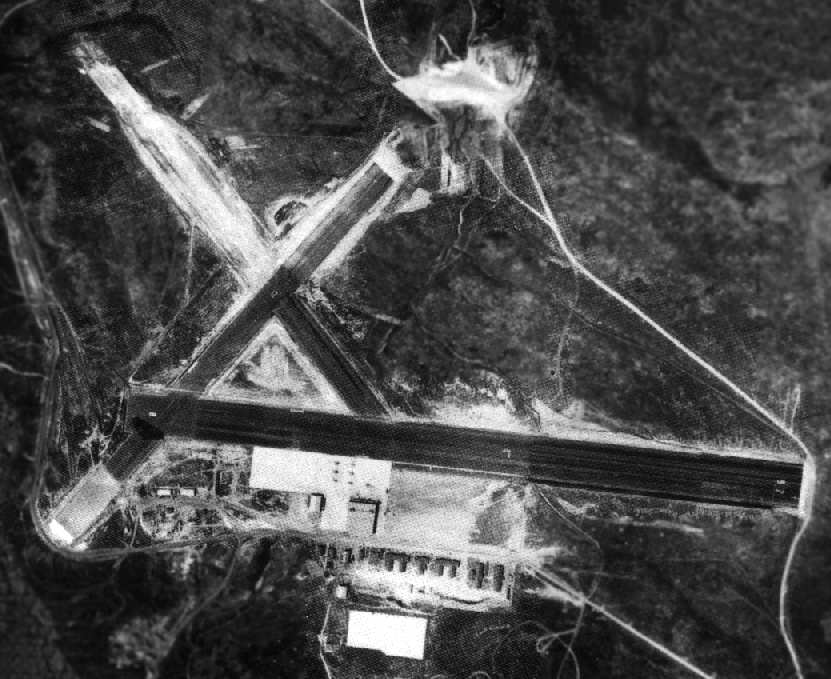
San Clemente Naval Auxiliary Air Station
In 1934, workers carved two 1,600-foot dirt runways into the volcanic terrain of San Clemente Island, creating an airfield that would play a small but vital role in preparing America for war. The Works Progress Administration improved and expanded the facility in 1938, paving the runways and building a hangar. When World War II came, Marines trained here in Vought SB2U Vindicator aircraft and Grumman J2F Duck seaplanes, learning the skills they would need to fight across the Pacific. San Clemente Naval Auxiliary Air Station never achieved fame, but it served its purpose, and its ghost remains in the helipads that now occupy the old runway.
New Deal Airfield
The Navy acquired San Clemente Island on November 7, 1934, and immediately set about building an airfield near the island's center. The original construction was modest: two dirt runways, each 1,600 feet long, scratched from the arid landscape. Four years later, the Works Progress Administration, the New Deal agency that employed millions during the Depression, sent workers to improve the facility. They paved and extended the runways to 3,000 and 2,000 feet respectively and constructed a new hangar. The WPA built infrastructure across America during this period, from post offices to bridges, but their work on this remote military island would prove particularly important.
Training for the Pacific War
With the outbreak of World War II, San Clemente Airfield became a Marine Corps training base. A Marine squadron was stationed at the airfield by 1942, conducting air scouting training with 19 Vought SB2U Vindicator aircraft and a single Grumman J2F Duck seaplane. The Vindicator, though obsolete by then for front-line combat, served well as a trainer. Meanwhile, the U.S. Army installed two radar stations nearby, part of the defensive network protecting the California coast from potential Japanese attack. The 3,000-foot runway was extended to 5,000 feet in 1941. In 1943, the facility was renamed Naval Auxiliary Air Facility San Clemente Island, and it supported bomb testing, radar training, naval fighter gunnery training, and electronic countermeasures for the remainder of the war.
Decline and Transformation
After the war, the airfield's importance gradually diminished. By 1977, the 2,000-foot runway had been removed entirely, and the east-west 5,000-foot runway sat unused for long periods, sometimes closed altogether. The reduced airfield found occasional use for amphibious and air assault training, as well as UAV operations, but it never regained its wartime significance. Today, two helipads occupy the old runway, serving the ongoing military operations that continue across San Clemente Island. Naval Auxiliary Landing Field San Clemente Island, located elsewhere on the island, has become the main active airfield, and the old auxiliary station exists primarily in historical records and aerial photographs.
From the Air
The former San Clemente Naval Auxiliary Air Station site is located at approximately 32.95N, 118.53W, near the center of San Clemente Island. The old runways are no longer active; current military aviation uses Naval Auxiliary Landing Field San Clemente Island (KNUC) to the south. The entire island is restricted military airspace. Contact San Diego Approach for routing information.