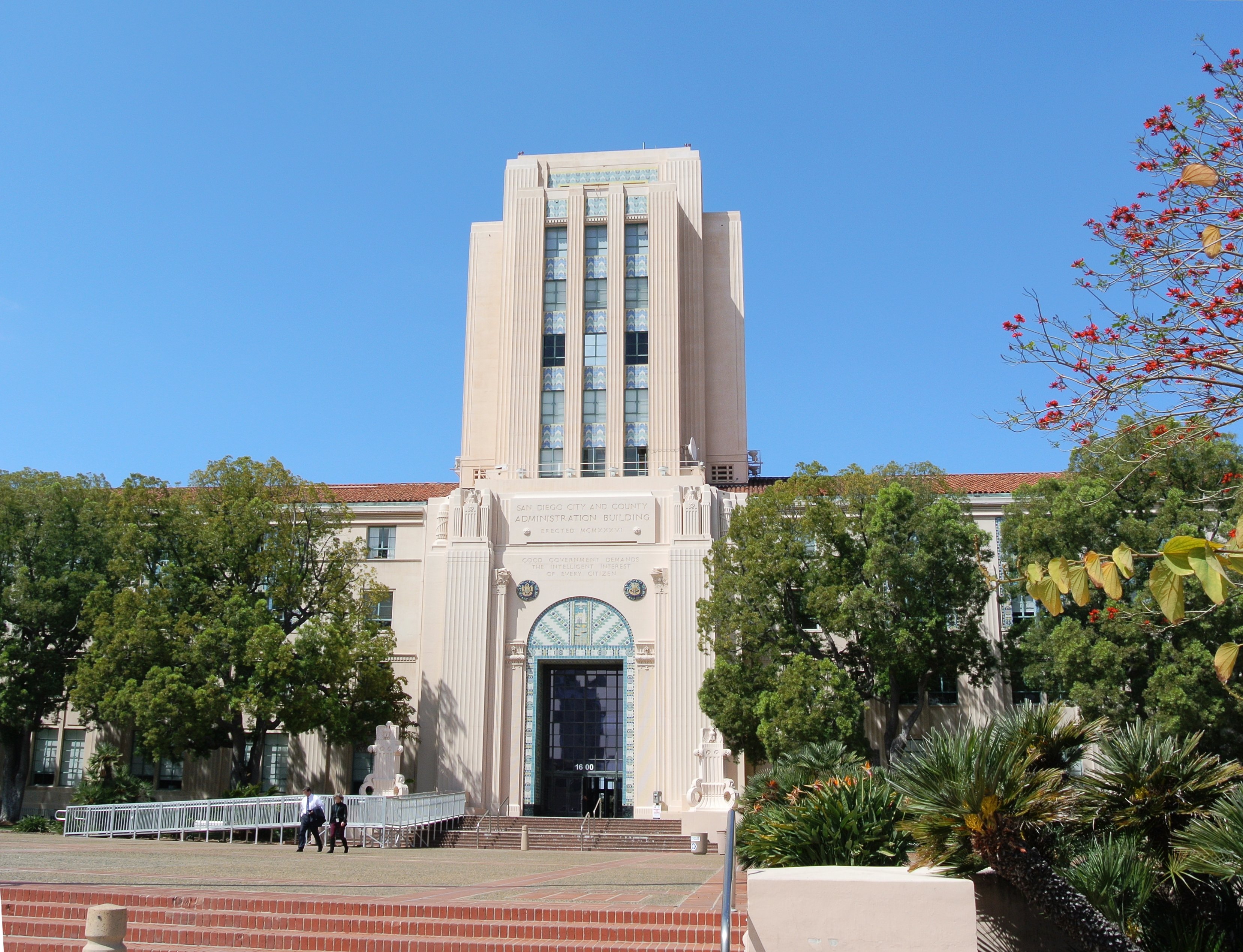
The Jewel on the Bay
They built the county administration center on reclaimed tidelands, which meant they were building it on mud. The engineers solved this problem by driving 30-foot steel pilings into the ground, alternating their angles to bear lateral stress — a technique considered cutting-edge in the late 1930s and still structurally sound today. The building that resulted is called the Jewel on the Bay, and it fronts San Diego Harbor with the confidence of something that knows exactly where it belongs.
John Nolen's Plan
The problem that the San Diego County Administration Center was built to solve was the scattering of city and county offices across downtown San Diego — the inefficiency and confusion of government spread across buildings that were not designed to work together. City planner John Nolen was engaged to design a solution.
Nolen's first proposal, submitted in 1908, would have placed the civic center in a conventional downtown location. San Diego voters rejected it. His second plan, completed in 1926, proposed a more ambitious solution: build on the dredged tidelands along the harbor, creating a civic campus that would face the bay rather than turning its back on it. Voters approved this version in a March 1927 election, despite considerable opposition from those who worried about building stability on reclaimed waterfront land.
Building on the Bay
The opposition to tidelands construction was not irrational. Building on reclaimed mud presented genuine engineering challenges, particularly earthquake risk — San Diego sits in seismically active Southern California, and the soil conditions on the tidelands were not ideal for heavy construction. The solution the engineers developed was the system of alternating steel pilings, driven 30 feet into the ground at angles calculated to distribute lateral forces. It was novel enough at the time to attract attention beyond San Diego.
The construction was completed in 1938. The building that emerged was a substantial civic monument in the Beaux-Arts and Spanish Colonial Revival tradition, its facade facing the harbor with the kind of formal grandeur that civic architecture of the era was supposed to convey. The National Register of Historic Places added it in 1988, recognizing both its architectural significance and its role in San Diego's civic history.
The Name It Earned
The nickname 'Jewel on the Bay' captures something genuine about the building's relationship to its setting. The waterfront location that seemed controversial in the 1920s has become, in retrospect, one of the building's defining assets. The harbor has developed around it — piers, hotels, the convention center, the maritime museum — but the administration center's placement remains logical and even graceful, a civic anchor for the downtown waterfront.
In 2014, the parking lots that had occupied the land between the building and the water were converted to Waterfront Park, giving San Diego residents direct access to the harbor edge in a location that had been functionally inaccessible for decades. The fountains and playgrounds of Waterfront Park now sit between the county's Beaux-Arts monument and the water it was built to face.
Still Governing
The San Diego County Administration Center has not become a museum piece. The Board of Supervisors still meets here. The Chief Administrative Officer, the Assessor, the County Clerk, and the Treasurer/Tax Collector all maintain offices in the building. Public records are held here. The ordinary business of county government flows through the corridors that John Nolen planned on reclaimed tidelands almost a century ago.
This functional continuity is part of what makes the building interesting as a civic object. Many historic structures of this vintage have been converted to other uses as governments outgrew them or moved to more modern facilities. San Diego's county building still governs, still issues records, still hosts the elected officials who make county policy. The pilings still hold. The Jewel on the Bay still works.
From the Air
The San Diego County Administration Center is visible along the downtown waterfront, its formal Beaux-Arts facade facing San Diego Bay, adjacent to the Waterfront Park that opened in 2014.