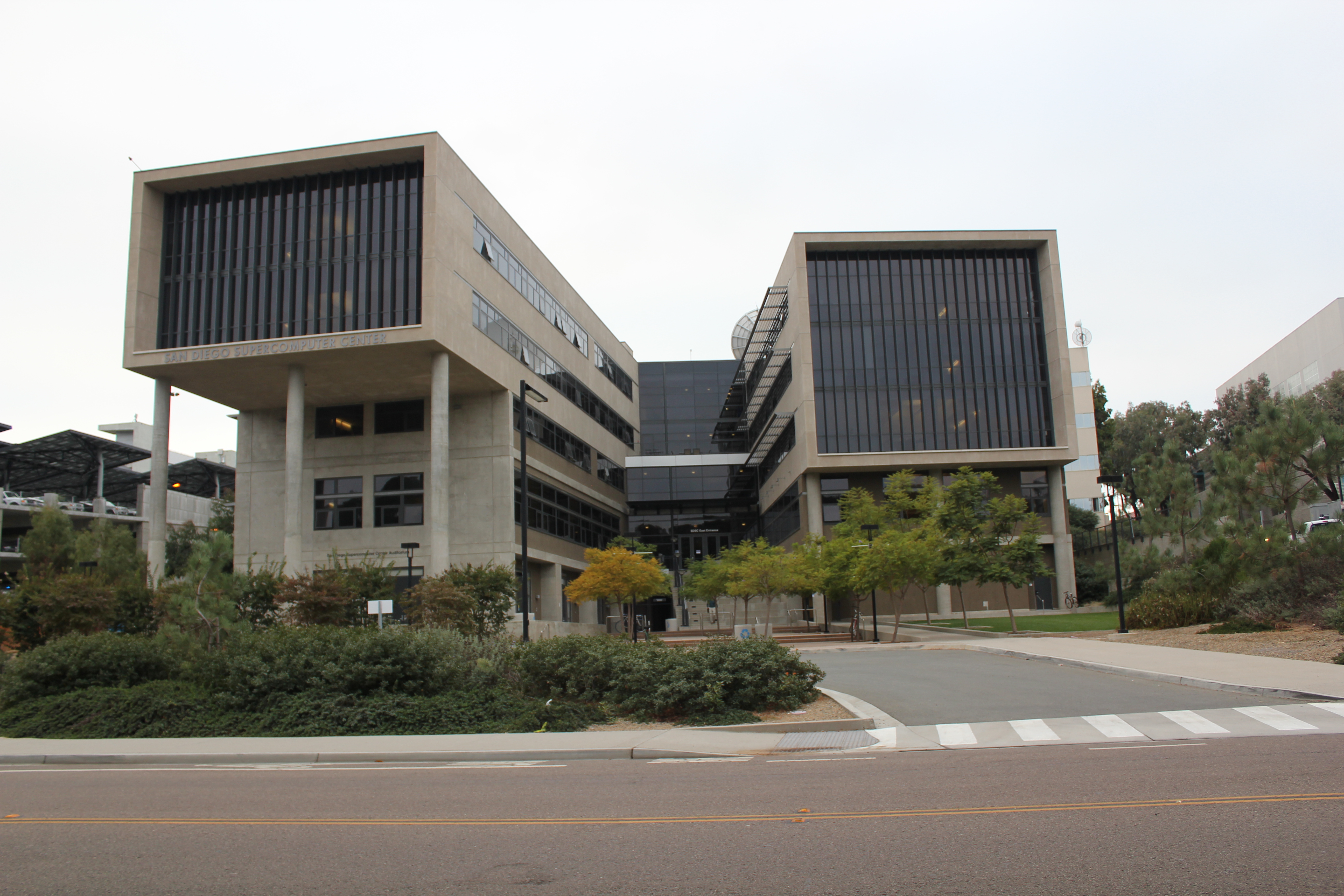
San Diego Supercomputer Center
In 1985, the National Science Foundation made a decision that shaped the next forty years of American science: it funded five supercomputer centers at universities across the country, creating the infrastructure that would allow researchers in any field to run computations previously available only to weapons labs and defense agencies. The San Diego Supercomputer Center was one of those five, established at UC San Diego on the Torrey Pines Mesa. In the decades since, it has moved through successive generations of computing technology while maintaining its core mission: giving scientists access to computational power that no single university could afford to build alone.
The Original Five
The NSF's 1985 decision to create a national supercomputing network reflected a recognition that computational science had become foundational across disciplines — physics, chemistry, biology, materials science, climate modeling, and engineering all required computing resources that exceeded what research universities could provide from their own budgets. The five centers it funded were geographically distributed: Cornell (the Cornell Theory Center), the University of Illinois (the National Center for Supercomputing Applications), the Pittsburgh Supercomputing Center (jointly run by Carnegie Mellon, the University of Pittsburgh, and Westinghouse), the John von Neumann Center at Princeton, and UC San Diego each received substantial funding to acquire and operate high-performance computing systems and make them available to researchers nationwide.
This was a deliberate act of scientific infrastructure building — the computational equivalent of funding telescope observatories or particle accelerators. Individual researchers submitting proposals to the NSF could request computing time at these centers just as they might request telescope time at a national observatory. The model democratized access to supercomputing in a way that transformed what was computationally possible for academic research.
San Diego's center was from the beginning more than a data center with expensive hardware. It pursued research in the methodologies of high-performance computing itself — in how to design algorithms, software, and data management systems that could make effective use of the fastest machines available — and in applications to fields ranging from computational biology to geoinformatics to visualization.
The Protein Data Bank and the Grid
Among SDSC's most enduring contributions is its role in creating and maintaining the Protein Data Bank — a worldwide repository of three-dimensional structural data for biological molecules, primarily proteins and nucleic acids. Structural biology, which determines the three-dimensional shapes of molecules using techniques like X-ray crystallography and electron microscopy, generates data that is useless to the broader research community unless it is archived, standardized, and made freely accessible. The Protein Data Bank, which SDSC manages in partnership with other institutions, provides that infrastructure.
The database matters enormously in an era when drug discovery depends on understanding how proteins are shaped and how potential drug molecules might interact with those shapes. The COVID-19 vaccines that were developed with unprecedented speed depended on structural data about the SARS-CoV-2 spike protein that was deposited in databases like the Protein Data Bank within weeks of the virus being sequenced. The value of open, accessible scientific data infrastructure becomes most visible in moments of crisis, when the accumulated work of decades can be mobilized rapidly.
SDSC was also one of four original sites of the TeraGrid — the NSF-funded computational grid that connected supercomputer centers, data archives, and specialized resources across the United States into an integrated network. The TeraGrid was a precursor to the more distributed computational infrastructure that now characterizes scientific computing, where work is distributed across many nodes rather than concentrated on a single large machine.
Flash Memory and the Gordon System
Supercomputing advances through a succession of hardware generations, and SDSC has navigated each transition. In 2009, the center's 'Dash' system won the HPC Challenge Data Challenge by exploiting flash memory — solid-state storage that was faster than conventional hard drives but had not yet been widely adopted in high-performance computing. The insight that flash memory could accelerate certain classes of computation led directly to the 'Gordon' system, deployed in 2011 with 256 terabytes of flash memory — at the time, an extraordinary amount of solid-state storage in a single system.
Gordon was designed for 'data-intensive' computing — problems where the bottleneck is moving data in and out of storage rather than raw arithmetic processing speed. Genomics, climate modeling, and social science research involving large datasets all benefit from systems that can handle data at very high rates. The design reflected SDSC's ongoing effort to match computing architecture to the actual requirements of scientific problems rather than simply pursuing raw performance metrics.
Frank Würthwein, who became SDSC's director in July 2021, leads an institution that is approaching its fortieth year. The computing landscape has changed enormously since 1985 — cloud computing, GPU acceleration, machine learning, and distributed data infrastructure have all transformed what scientific computing means — but the center's fundamental mission has not: to give researchers access to computational capabilities they could not build or sustain alone, and to advance the science of computing itself in ways that benefit the broader research community. From the Torrey Pines Mesa above La Jolla, it continues to do both.
From the Air
The San Diego Supercomputer Center sits at 32.88°N, 117.24°W on the UC San Diego campus on Torrey Pines Mesa. The UCSD campus is visible from altitude as a dense academic complex between the Torrey Pines State Reserve and the Sorrento Valley commercial corridor, west of I-5. SDSC occupies a distinctive building within the campus cluster. Nearest airports: KMYF (Montgomery-Gibbs Executive, 8 miles east) and KSAN (San Diego International, 12 miles south). The campus sits on the mesa above the Sorrento Valley canyon, with the Pacific visible to the west on clear days.