The Cup That Came to the Pacific
The America's Cup is the oldest international trophy in sport, predating the modern Olympics by nearly half a century. For most of its history it resided in New York, contested in waters that American yachting had long dominated. Then Dennis Conner sailed Stars and Stripes to victory in Fremantle, Australia in 1987, and the Cup came to San Diego — to a yacht club that had been founded just over a century earlier by a handful of people who wanted to go sailing together.
Founded on the Bay
The San Diego Yacht Club was established on June 7, 1886, when a group of sailors who shared an interest in racing organized themselves formally enough to hold meetings and keep records. The bay that would become the heart of American naval aviation, the bay that Cabrillo had entered in 1542, was also ideal sailing water — protected enough from Pacific swells to allow racing, open enough to generate good breeze.
The early history of the club was that of most nineteenth-century yacht clubs: races, social functions, arguments about rules, the gradual accumulation of traditions and infrastructure. The clubhouse moved locations over the years; in 1934, the entire building was relocated by barge to its current site — a practical solution to real estate circumstances that also demonstrated the members' attachment to a structure they had built.
Dennis Conner and the Cup
Dennis Conner is San Diego's most famous sailor. He is also, in a complicated twist, the man who lost the America's Cup in 1983 — the first American defeat in the trophy's 132-year history — before winning it back in 1987 in Fremantle with his 12-meter Stars and Stripes, which outperformed the Australian defender Kookaburra III in a four-race sweep.
Conner was deeply connected to the San Diego Yacht Club; his 1987 victory brought the Cup to the club and to the city. The following defense, in 1988, was unusual and controversial: New Zealand challenged with a monohull, and the San Diego Yacht Club defended with a catamaran, which is inherently faster in many conditions. The American boat won, but the controversy over the mismatch led to years of legal disputes and rule changes for future competitions.
Three Cups on San Diego Bay
San Diego hosted three America's Cup competitions: the 1987 victory in Fremantle that brought the Cup here, the 1988 defense, and the 1992 defense in which the club successfully defended against Il Moro di Venezia, the Italian challenger, with America3 skippered by Bill Koch.
The 1992 defense was particularly notable for the America3 campaign's use of an all-women crew — including navigator Dawn Riley — which raced in the defender selection series, a first in America's Cup history. The cup-winning match itself was sailed by the primary crew, but the women's participation marked a significant milestone for the competition.
After the 1992 defense, the Cup passed to New Zealand in 1995, ending San Diego's run as host city for the oldest trophy in international sport.
What Remains
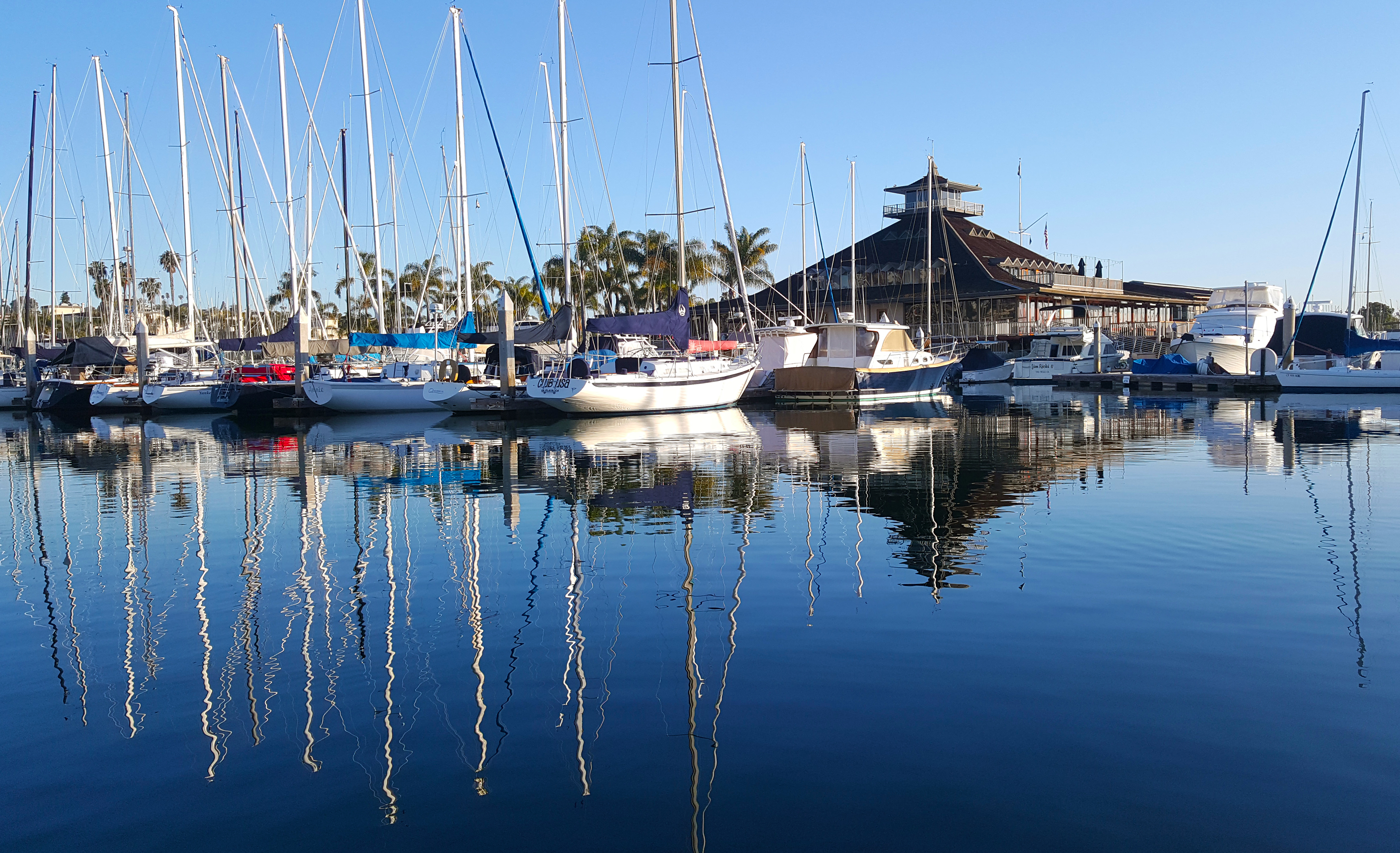
The San Diego Yacht Club's Point Loma location — on Anchorage Lane at the edge of San Diego Bay — remains an active racing and sailing facility more than 130 years after the club's founding. The club has been at its present Point Loma site since 1924, with San Diego Bay providing the sailing water that made those America's Cup campaigns possible.
The club's America's Cup years gave San Diego a connection to international yachting that it had not previously possessed. The infrastructure built for those competitions — the facilities, the community of professional sailors and designers who relocated here, the institutional knowledge accumulated through three Cup campaigns — left lasting marks on the regional sailing culture. The Cup is gone, held elsewhere now, but the tradition it established on the bay is not.
From the Air
The San Diego Yacht Club is located in Point Loma at 1011 Anchorage Lane, on the eastern shore of San Diego Bay near the foot of the Coronado Bridge approach. Its boat docks and sailing facilities are visible from the air along the bay's western edge.