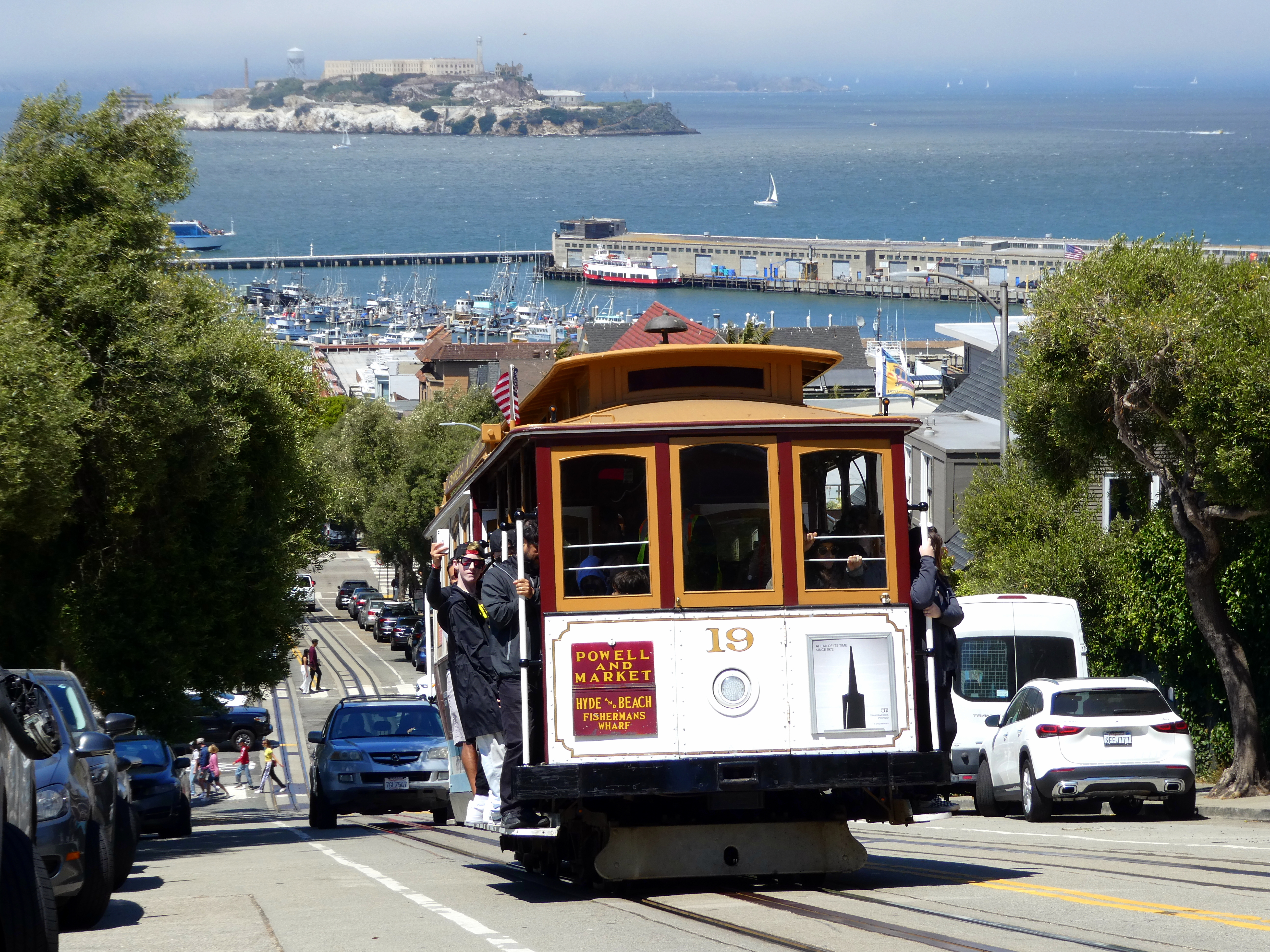
San Francisco Cable Car System
Andrew Hallidie's invention was born from a sight he could not forget: horses struggling and falling on San Francisco's wet, steep streets, dragging heavy loads up grades that should never have been paved. On August 2, 1873, the first cable car descended Clay Street hill, pulled by a continuously moving underground cable that the car's grip operator could clamp onto or release. The technology was elegant: a steam engine at a central powerhouse turned the cable, and the cars simply held on. San Francisco's impossible topography had found its match.
The Grip and the Cable
The system's genius lies in its simplicity. A steel cable, roughly 1.25 inches in diameter, runs in a slot beneath the street at a constant 9.5 miles per hour. The grip car carries a mechanical device -- the grip -- that reaches down through the slot and clamps onto the moving cable. To start, the grip operator squeezes the cable. To stop, they release it and apply the brakes. The skill required is considerable: the grip weighs several hundred pounds and requires significant arm strength, and the operator must judge grades, curves, and traffic while managing a vehicle with no engine and no electrical power. The term 'gripman' became synonymous with the operator, and the position remains one of San Francisco's most distinctive jobs.
Earthquake, Buses, and the Citizen Revolt
At its peak in the early 20th century, the cable car system covered much of the city with eight lines. The 1906 earthquake destroyed most of the infrastructure, and only a few lines were rebuilt. By the 1940s, city officials wanted to replace the remaining cable cars with buses, which were cheaper to operate. The public revolted. A citizen's campaign led by Friedel Klussmann successfully blocked the removal of the cable cars, and in 1964 the system was designated a National Historic Landmark -- the only moving one in the United States. Today three lines operate: Powell-Mason, Powell-Hyde, and California Street.
A Working Anachronism
The cable car system is both a tourist attraction and a functioning transit line. Approximately seven million passengers ride annually, a mix of visitors who line up at the turntables for the experience and commuters who use the California Street line as daily transportation. The system requires a dedicated powerhouse, miles of underground cable, specialized maintenance skills, and a fleet of cars that are hand-built and hand-maintained. The cost per passenger mile is vastly higher than modern transit. But San Francisco has decided, repeatedly and emphatically, that the cable cars are worth the expense. They are not relics maintained for nostalgia. They are a daily choice -- a city declaring that some things matter more than efficiency.
From the Air
Located at 37.80°N, 122.41°W. The cable car lines run through central San Francisco: Powell-Mason and Powell-Hyde from Powell and Market to Fisherman's Wharf, and California Street from Market to Van Ness. KSFO is 11 nm south.