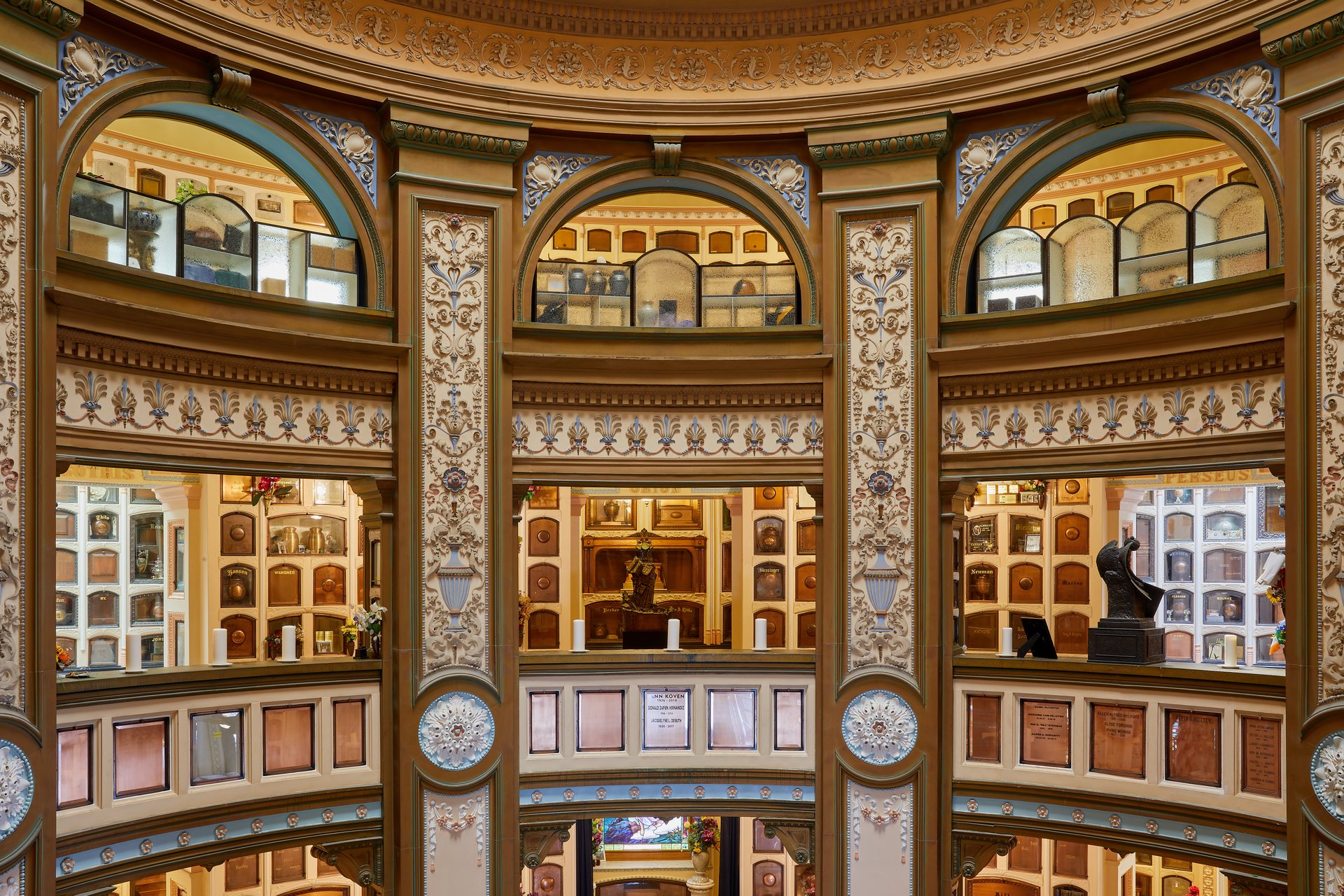
San Francisco Columbarium & Funeral Home
Somewhere between Fortran and a magic trick, the San Francisco Columbarium holds its secrets. John Backus, the computer scientist who invented the programming language that launched the modern software industry, rests in a niche not far from Harry August Jansen, a Danish-born magician who performed as Dante the Great. Nearby lie Ernst Baruth and Otto Schinkel, the German immigrants who founded Anchor Brewing Company. This 1898 neoclassical rotunda, tucked into a quiet cul-de-sac just north of Golden Gate Park, is one of the last places in San Francisco where the dead are still welcome.
A City That Banished Its Dead
San Francisco has an uneasy relationship with its cemeteries. In 1902, the Board of Supervisors prohibited further burials within city limits. By 1910, cremation was also banned. Over the following decades, the city systematically relocated its dead, exhuming bodies from Laurel Hill, Calvary, Masonic, and Odd Fellows cemeteries and moving them south to Colma, the tiny town that became known as the City of the Dead. Amid this mass eviction, the Columbarium survived -- barely. As it passed from the Bay Cities Cemetery Association to Cypress Abbey and through other hands, the building fell into neglect. Stained glass cracked, plaster crumbled, and the once-grand rotunda gathered dust. It was not until 1980, when the Neptune Society of Northern California purchased the building, that restoration began in earnest.
Rooms Named for Winds and Stars
Architect Bernard J.S. Cahill designed the Columbarium in 1898, drawing inspiration from the World's Columbian Exposition of 1893 in Chicago. The building blends baroque ornamentation with neoclassical proportion: a rotunda 64 feet in diameter, 29 feet across the inner circle, rising to a dome 45 feet overhead. Eight rooms on the ground floor bear the names of the mythological winds -- the Anemoi of ancient Greece. The first-floor rooms carry the names of constellations. Six ground-floor rooms feature stained glass windows, including one in the Aquilo room depicting three angels in flight, attributed to either Louis Comfort Tiffany or John LaFarge. No one has settled the question definitively. The upper floors are simpler in design, but throughout the building, the interments tell stories of their own. Many niches feature personal items, creative dedications, and idiosyncratic memorials that feel more like shrines to a life lived than somber markers of death.
The Living Among the Dead
What makes the Columbarium extraordinary is not just its architecture but its inhabitants. Ed Aulerich-Sugai, an artist and AIDS activist who died in 1994, designed his own tomb before he passed. Robert Gluck later wrote a book about him. Frank E. Hill, a Medal of Honor recipient from the American Indian Wars, occupies a niche here. Thomas N. Howard, who spent decades as a concert promoter for Bill Graham Presents, keeps eternal company with the musicians he helped bring to San Francisco stages. The building itself became a San Francisco Designated Landmark on March 3, 1996 -- an official recognition that this palace of ashes deserves the same protection as the city's living landmarks. On the grounds, a fountain sculpture of Coit Tower provides a whimsical touch, as if to remind visitors they are still in San Francisco.
The Palace of Ashes Endures
Today the Columbarium operates as the only place within San Francisco city limits where you can leave your remains permanently. It is owned and operated by Dignity Memorial, but the spirit of the place transcends corporate stewardship. Visitors come for the architecture, the history, and the peculiar intimacy of reading niche inscriptions that range from deeply moving to unexpectedly funny. In a city famous for reinvention and impermanence, where neighborhoods transform in a decade and residents cycle through faster than the fog, the Columbarium offers something rare: a permanent address. The dead of San Francisco, long exiled to Colma, find in this baroque rotunda the one place the living city could not quite bring itself to close.
From the Air
The San Francisco Columbarium sits at 37.78N, -122.46W, near the intersection of Stanyan and Anza Streets, just north of Golden Gate Park's eastern end. From the air, look for the distinctive domed rotunda tucked into the residential grid of the Inner Richmond neighborhood. The building is small but the surrounding cemetery grounds are visible. Nearest airports: San Francisco International (KSFO) 11nm south, Oakland International (KOAK) 10nm east. Best viewed at low altitude in clear conditions.