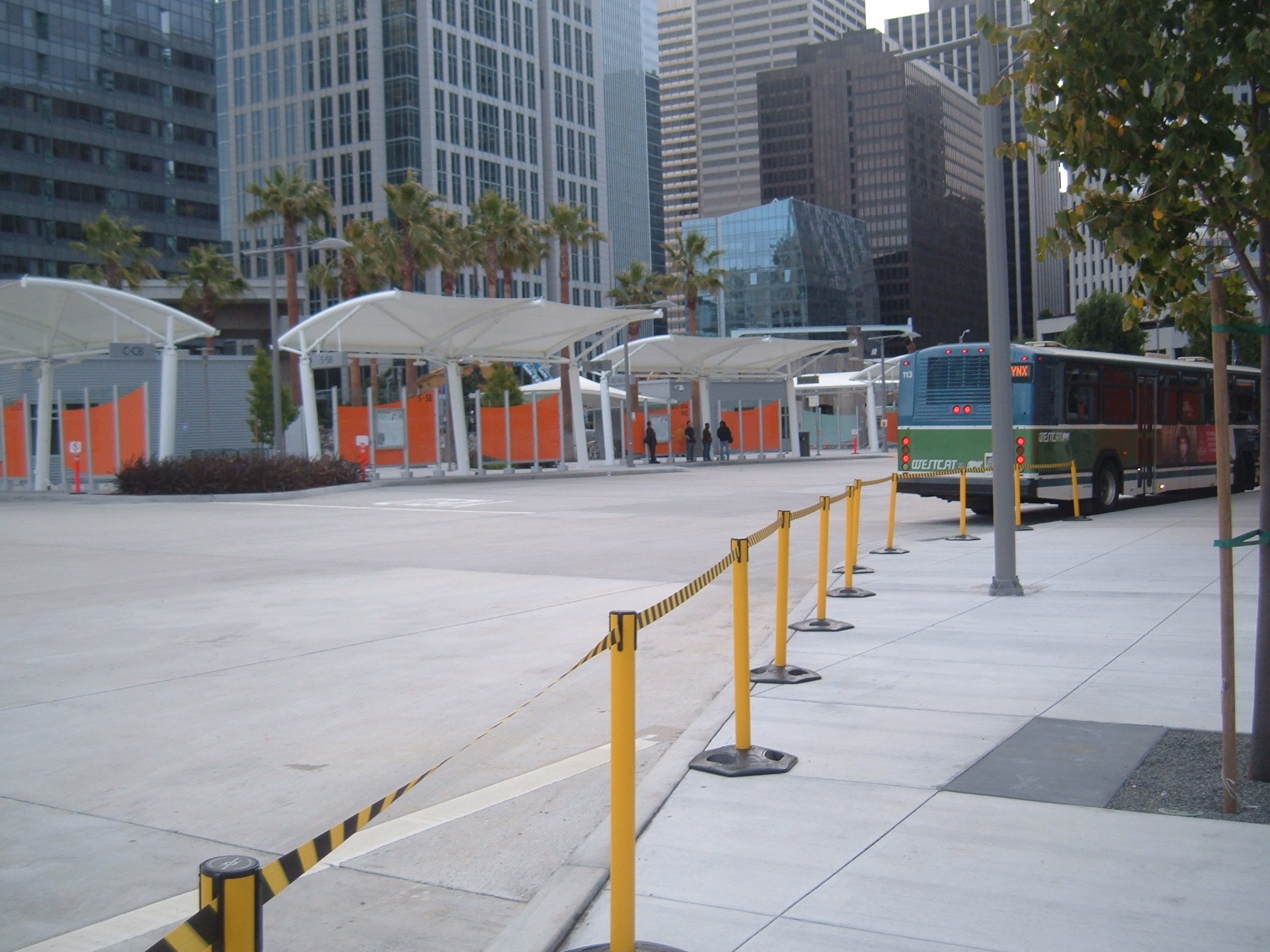
San Francisco Transbay Terminal
Trains once ran across the Bay Bridge. This fact surprises most people, because the trains stopped so long ago that the infrastructure vanished and the memory faded. But from 1939 to 1958, electric commuter trains operated on the lower deck of the San Francisco-Oakland Bay Bridge, terminating at the Transbay Terminal in downtown San Francisco. At peak ridership in 1945 -- driven by wartime gasoline rationing -- 37.3 million passengers crossed the bridge by rail. By 1957, that number had plummeted to 6.1 million. The trains stopped running less than twenty years after they started, a cautionary tale about transit investment abandoned to automobile supremacy.
Timothy Pflueger's Art Moderne Palace
The Transbay Terminal was designed by Timothy L. Pflueger, Arthur Brown Jr., and John Donovan in the Art Moderne style. Excavation began in July 1937, and the terminal formally opened on January 14, 1939, serving three electric railroad companies: the Interurban Electric (Southern Pacific), the Key System, and the Sacramento Northern (Western Pacific). Governor Frank Merriam piloted the ceremonial first train across the bridge on September 23, 1938. The terminal featured six tracks, a turnaround loop, and a custom electric switchboard that was considerably simpler than the mechanical lever systems of the era. Surprisingly, no track connection was ever built to the Southern Pacific's Third and Townsend Depot -- a missing link that might have extended the system's usefulness southward.
The Trains Disappear
The decline was swift and deliberate. By November 1940, barely a year after the terminal opened, the Interurban Electric was seeking permission to abandon East Bay service. Southern Pacific and Sacramento Northern trains ceased running in 1941 -- just two years after the terminal's completion. The Key System held on longer, but its petitions consistently asked for service cuts and fare increases, driving riders away in a self-fulfilling spiral. In 1955, the Key System won permission to discontinue service. The last train crossed the bridge in 1958. The terminal was rebuilt as a bus depot the following year, serving AC Transit, Greyhound, and local Muni lines. Its cocktail lounge, diner, and newsstand persisted until the 1990s. The vast overpass structures became unofficial shelter for homeless residents.
Demolition and the Troubled Replacement
The Transbay Terminal closed on August 7, 2010, to make way for its replacement, the Salesforce Transit Center. Demolition by wrecking ball began that December. The new transit center, which broke ground with Nancy Pelosi and Gavin Newsom in attendance, opened on August 12, 2018. It closed six weeks later, on September 25, when inspectors discovered cracks in critical support beams. Investigation revealed that welding crews had skipped a crucial step required by the building code, creating micro-cracks that grew into structural failures. Multiple inspections had missed the error. After a year of repairs, the transit center reopened on August 11, 2019. The old terminal's Art Moderne elegance, long since demolished, was mourned by the same architectural community that had watched it decline into a bus depot.
The Bridge Trains That Might Have Been
Several attempts have been made to restore rail service across the Bay Bridge, though none have succeeded. The Transbay Terminal's story is ultimately about what happens when transit investment is treated as temporary -- built with public money, turned over to private operators, then abandoned when those operators decide the economics no longer work. The 37 million passengers who rode the bridge trains in 1945 did not stop needing to cross the bay. They simply shifted to automobiles, filling the very bridge lanes that had once carried their trains. BART, which opened in 1972 with its own transbay tube beneath the water, eventually provided the rail connection the Bay Bridge trains had lost. But the original terminal's turnaround loop, which AC Transit buses used until 2010, remained the last physical trace of the trains that once made the crossing.
From the Air
The former Transbay Terminal site is at 37.79N, -122.40W in San Francisco's South of Market district. The replacement Salesforce Transit Center, with its distinctive rooftop park, is visible from the air at roughly the same location. The Bay Bridge extends eastward from this area. The lower deck where trains once ran is now exclusively for westbound automobile traffic. Nearest airports: KSFO 11nm south, KOAK 8nm east.