San Gimignano
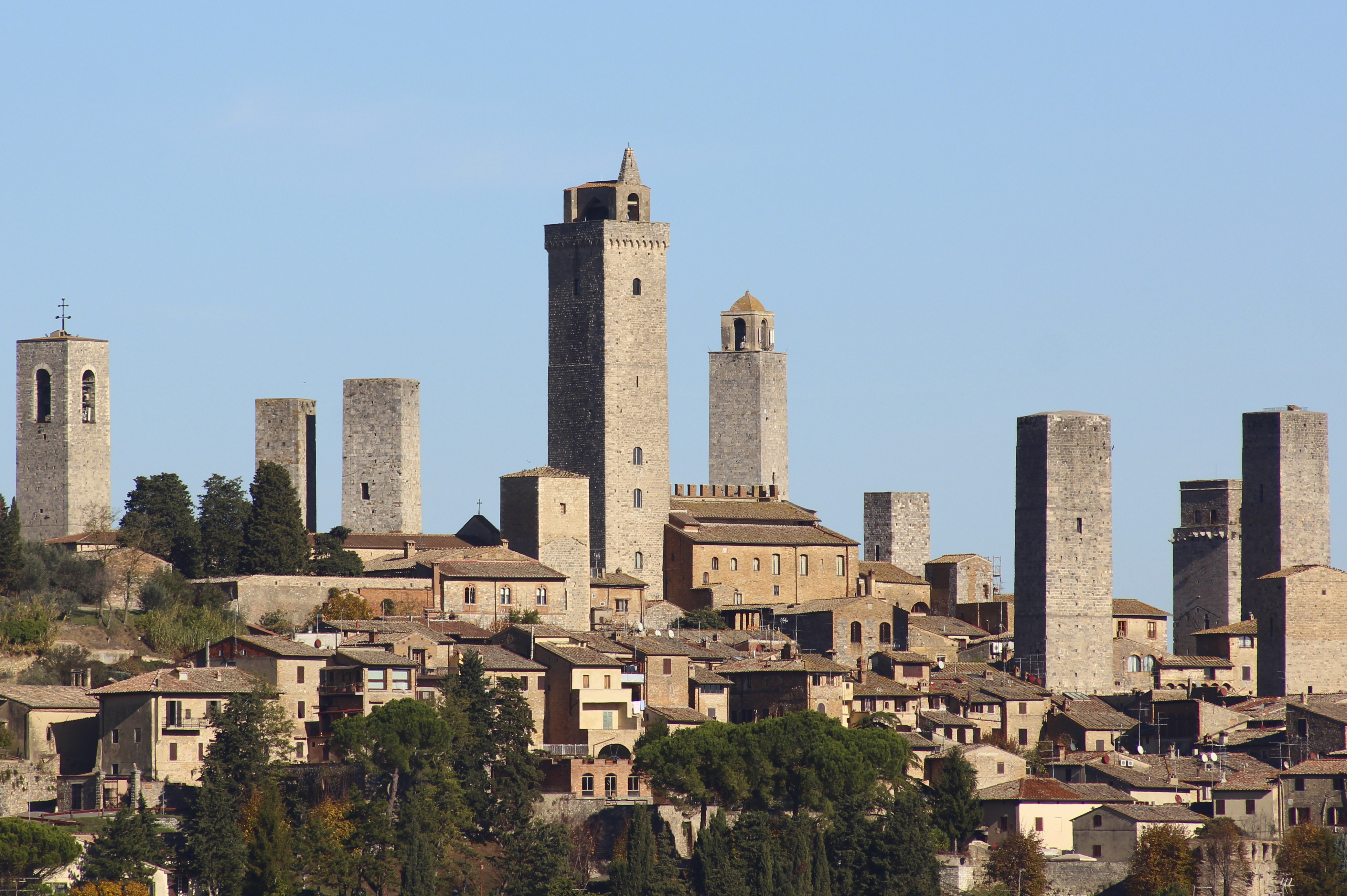
Fourteen towers still stand. In the 13th century, there were seventy-two. Each one was a family's boast carved in stone -- the taller the tower, the greater the wealth, the deeper the ambition. San Gimignano's medieval skyline survives because the town's fortunes collapsed before anyone had reason to tear the towers down. The Black Death of 1348 killed roughly half the population, and San Gimignano submitted to Florentine rule. Development stopped. What remained was a medieval city preserved almost by accident, its towers silhouetted against the Tuscan sky like a row of exclamation marks at the end of an interrupted sentence.
From Etruscan Village to Medieval Manhattan
The site was occupied before Rome was a republic. A small Etruscan village stood here in the 3rd century BC. Local chroniclers trace the town's founding legend to two patrician brothers, Muzio and Silvio, who fled Rome during the Catiline conspiracy and built castles in the Val d'Elsa. The name came later -- in 450 AD, Bishop Geminianus of Modena reportedly intervened to spare the settlement from destruction by the followers of Attila the Hun. The town flourished as a stop on the Via Francigena, the pilgrim road connecting Rome to northern Europe. Wealth from trade and saffron cultivation fueled a building boom that produced the extraordinary cluster of tower houses. Rival families competed to build the tallest, and for a time this small hill town -- covering just 138 square kilometers -- bristled with more towers per capita than any city in Italy.
The Cistern and the Squares
At the heart of San Gimignano lie four connected piazzas that form the town's social and architectural center. The Piazza della Cisterna, triangular and ringed by Romanesque and Gothic palazzi, takes its name from the well built in 1287 that served as the town's primary water source. Parts of the paving date to the 13th century. Adjacent to it, the Piazza Duomo houses the Collegiate Church, reached by a broad flight of steps. Despite its name, this was never a cathedral -- the piazza's grandeur reflects civic pride rather than episcopal authority. The Palazzo Comunale, once the seat of the podesta, now contains a gallery with works by Pinturicchio, Benozzo Gozzoli, and Filippino Lippi. From inside, visitors can climb the Torre Grossa, completed in 1311 and standing 54 meters high -- the tallest surviving tower, and the only one open to the public.
Saffron, Wine, and Golden Ham
San Gimignano's identity extends beyond architecture. The town has produced Vernaccia di San Gimignano since at least the 13th century, making it one of Italy's oldest documented white wines. The grape -- Vernaccia -- grows on the sandstone hillsides surrounding the town, and the wine earned Italy's first Denominazione di Origine Controllata in 1966. Saffron, cultivated here since the medieval period, flavors the town's signature Golden Ham, a dry-aged specialty infused with the spice. Pecorino cheese rounds out a culinary tradition that visitors encounter at every turn. These are not recent inventions for tourists -- they are the products that made the town wealthy enough to build those towers in the first place.
Preserved by Misfortune
When the Black Death struck in 1348, San Gimignano's population and economy collapsed. Under Florentine rule, some Gothic palazzi were built in the new Florentine style, and many towers were cut down to the height of surrounding houses. But large-scale development simply stopped. For centuries, San Gimignano slept. It was not until the 19th century that travelers began recognizing the town's medieval character as remarkable rather than merely backward. UNESCO designated the historic center a World Heritage Site, and today visitors walk streets whose layout has barely changed since the 14th century. The encircling walls, entered through eight gates set into the second of three defensive rings dating to the 12th and 13th centuries, still define the boundary between the medieval town and the modern world outside. From the air, the cluster of towers rising from the hilltop ridge is unmistakable -- a silhouette that has not fundamentally changed in seven hundred years.
From the Air
Located at 43.47N, 11.04E in the Tuscan hills, province of Siena. The medieval towers are distinctive from the air, rising from a hilltop ridge running north-south. The town sits in the Val d'Elsa between Siena and Florence. Nearest airports are Florence-Peretola (LIRQ) approximately 55 km northeast and Siena-Ampugnano (LIQS). The surrounding landscape of vineyards and olive groves on rolling hills is characteristic of central Tuscany.