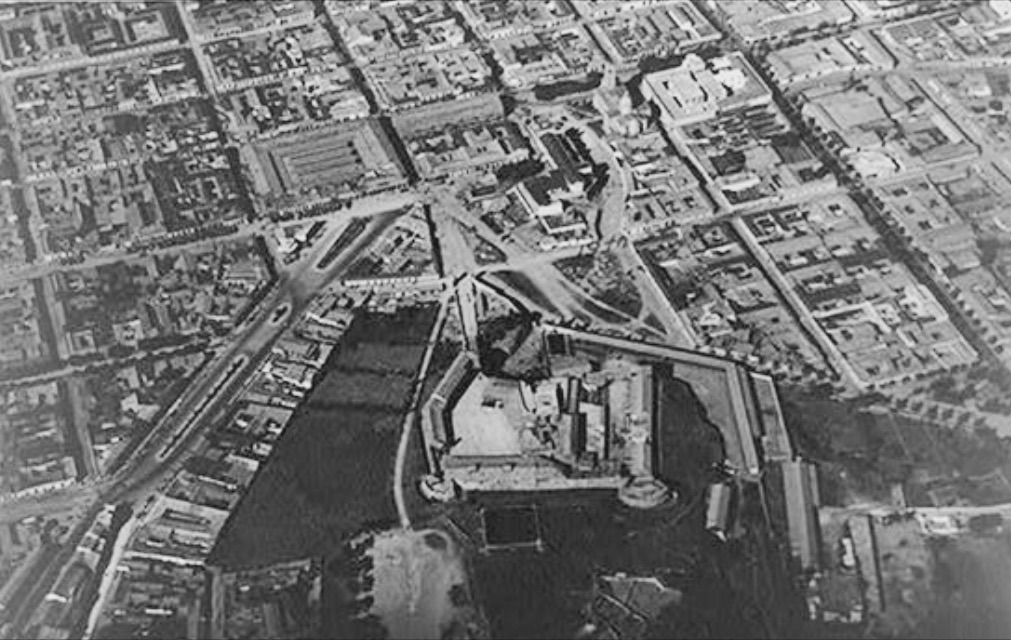
San Jose Castle (Guatemala City)
On the morning of April 9, 1920, Guatemala City woke to machine-gun fire. Shells fell in every quarter. From the high ground of San Jose Castle, government troops poured fire down into the streets below while citizens scrambled to build barricades from whatever they could find — knives, machetes, saloon rifles, axes, crowbars. By nightfall the water mains were shattered, the electrical cables severed, and the capital lay in darkness. The fortress that had protected Guatemala City for seven decades had become the instrument of its bombardment. San Jose Castle, built by one dictator to defend against foreign invasion, was being used by another to wage war on his own people.
Carrera's Fortress on the Hill
The fort owes its existence to hard experience. In 1829, the Honduran general Francisco Morazan had invaded Guatemala and used Buena Vista Hill — a prominence on the city's southeastern edge, rising at least 20 meters above the valley floor — to place troops that helped defeat the Guatemalan army. The lesson was not lost on Rafael Carrera, the conservative strongman who took power in 1839. After repelling Morazan's second invasion in 1840, Carrera resolved to ring Guatemala City with fortifications. San Jose was the first. In 1843, he appointed the city builder Jose Maria Cervantes to design and construct a fort atop Buena Vista Hill. The work took three years, driven by urgency — revolts by the Lucios faction and the Cruz brothers in eastern Guatemala made defense a pressing matter. Carrera opened the completed fort on May 25, 1846, with a mass at the nearby El Calvario church and a procession of the Virgin of Santa Barbara to the fortress walls, where the image was blessed and installed.
Arsenal and Prison
Originally, the fort was surrounded by water and accessed by a bridge, with imposing protective walls that gave it the feel of a European castle transplanted to the Central American highlands. It contained a shooting range, ammunition warehouses, horse stables, dining facilities, and a small pond the soldiers called the "Soldier's Pond." By 1852, the name San Jose had become common among Guatemala City's inhabitants, though the military formally designated it the Santa Barbara Artillery Brigade. Carrera, who was named president for life, soon put the fort to darker use — as a prison for political opponents. In 1854, after seizing the artillery from Honduras's Omoa Castle, he consolidated all military equipment at San Jose, making it Guatemala's most important ammunition depot. The fort's commanding elevation, which had once been a purely military advantage, became a symbol of the surveillance and control Carrera exercised over the capital and the country.
Six Days That Shook the Capital
San Jose Castle's most dramatic chapter came in April 1920, during what Guatemalans call the Semana Tragica — the Tragic Week. President Manuel Estrada Cabrera had held power for 22 years when, on April 8, the National Assembly declared him mentally unfit to continue in office. He refused to accept the verdict. From his compound at La Palma — a sprawling, garish estate with small buildings painted in crude colors and landscape murals blazing on the walls — Estrada Cabrera launched his counterattack. French field-howitzers and machine guns fired from La Palma while the garrisons at San Jose and its companion fortress Matamoros maintained steady fire from the heights. The revolutionaries, who called themselves Unionistas, were initially caught with almost no weapons. They raided government buildings for arms and improvised, distributing white badges marked "Unionista" so they could distinguish friend from foe after early friendly-fire casualties. Red Cross vehicles raced through the streets with nurses carrying medical supplies in one hand and machetes tucked in their belts.
The Fort Falls, the Dictator Surrenders
For five days, truces were proclaimed and broken within minutes. The city lay in darkness, its water supply destroyed, its telephone and telegraph lines severed. Rumors were the only source of news. The turning point came on April 14, when San Jose Castle itself fell — partly because its defenders were starving, and partly because some were bribed to switch sides. The fort's elevation, which had allowed it to dominate La Palma and the surrounding city, meant that once it changed hands, Estrada Cabrera's position became untenable. By the following afternoon, the revolutionaries controlled the capital. The firing gradually ceased, and Estrada Cabrera surrendered with the remainder of his forces, numbering about five thousand. The fort that had been built to defend Guatemala City from foreign armies had, in the end, determined the outcome of a fight between Guatemalans. The castle no longer stands — later administrations demolished it to build a new city hall, a national theater, and part of Bolivar Avenue — but Buena Vista Hill remains, and with it the memory of the week when a fortress changed the fate of a dictator.
From the Air
The site of San Jose Castle is at 14.643°N, 90.516°W on the southeastern side of Guatemala City's historic center, on the prominence once known as Buena Vista Hill. From 3,000-5,000 feet AGL, the area is identifiable by the cluster of civic buildings — city hall and theater structures — that replaced the fort. The Parque Central and National Palace are visible roughly 500 meters to the northwest. La Aurora International Airport (MGGT) lies approximately 4 km south-southwest. Guatemala City occupies a highland valley at roughly 4,900 feet elevation. Volcanic peaks — Agua, Fuego, and Acatenango — are visible to the west and southwest on clear days.