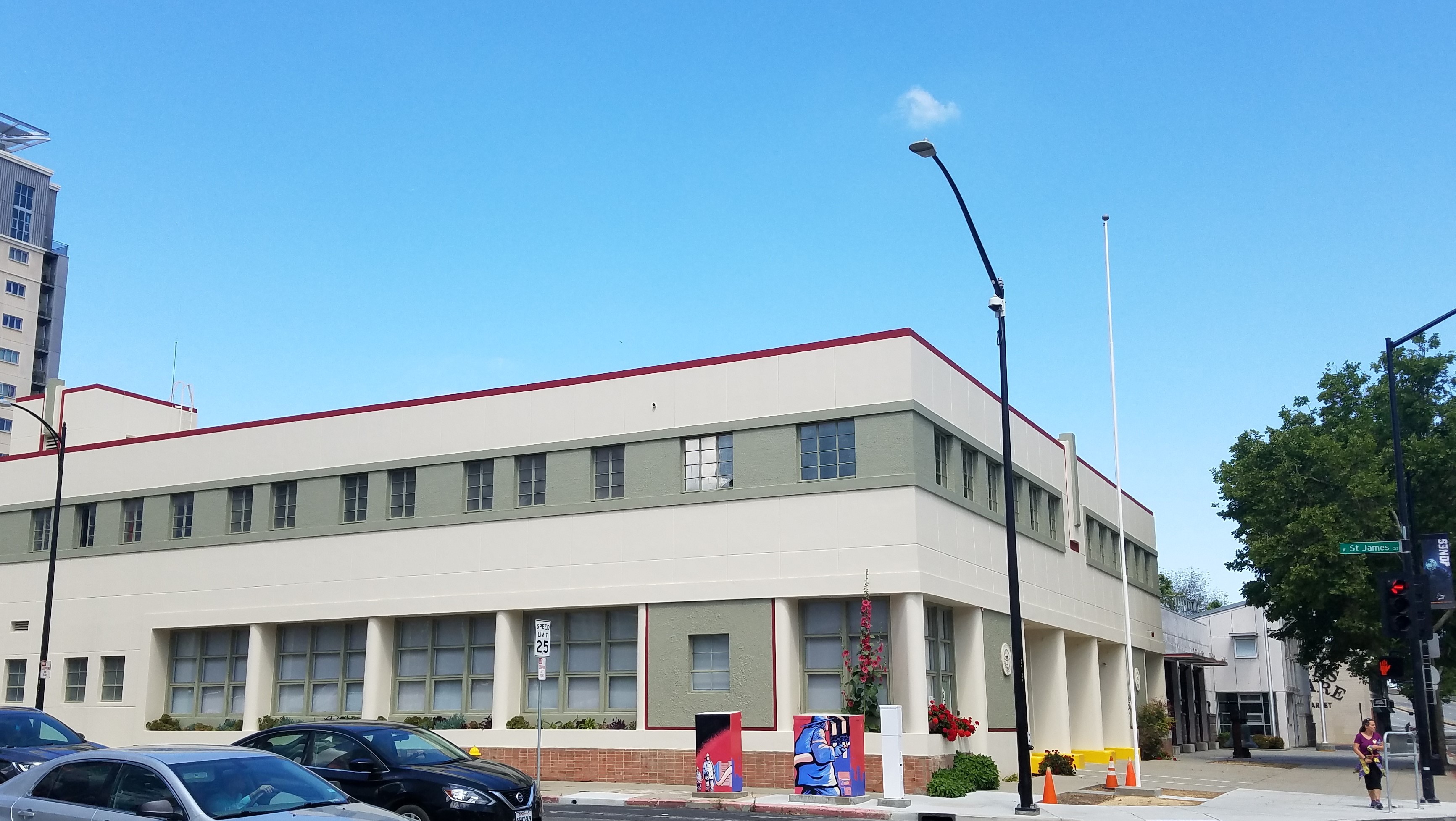
San Jose Central Fire Station
Three bay doors, each one tall enough to swallow a fire truck, face North Market Street with the words Battalion 1, Truck 1, and Engine 1 still legible above them. The San Jose Central Fire Station opened in 1951, and for decades those doors flew open at all hours, sending apparatus screaming into a city that was growing faster than anyone had planned. What makes this particular firehouse worth remembering is not just what rolled out of it but what it represented: San Jose's first purpose-built command center for a fire department that had been operating out of buildings designed for horses. The station was built for the automobile age, and its architecture said so plainly. Today the trucks inside are museum pieces, the sirens are silent, and the building itself is a landmark on the National Register of Historic Places.
Postwar Bet on a Growing City
After World War II, San Jose was still an agricultural town, but the returning veterans and the industries that followed them were about to change that. In 1946, the fire department raised a $350,000 bond to fund five new stations across the city. Station No. 1, the Central Fire Station, was designated as the hub, the place where emergency communications for the entire department would be coordinated. It opened in 1951, just as San Jose's population was beginning its explosive climb from a modest valley community toward the sprawling metropolis it would become. The timing was not coincidental. City leaders understood that growth without infrastructure was a recipe for disaster, and they made fire protection one of the first systems they modernized. The station served as both a working firehouse and a command center, its new communication system connecting every firehouse in San Jose to a single dispatch point.
Clean Lines and Drive-Through Bays
Architects William Binder and Ernest N. Curtis of the firm Binder & Curtis designed a building that looked nothing like the Victorian firehouses of the previous century. The two-story structure is International Style with Art Moderne touches: horizontal bands of windows wrap around the upper floor, their integrated concrete headers and sills creating a visual ribbon that unifies the facade. The exterior walls are cast-in-place concrete, scored both horizontally and vertically to suggest massive stone blocks. But the real innovation was functional. The Central Fire Station was the first firehouse built with drive-through bays, allowing trucks to enter from one side and exit from the other without the dangerous, time-consuming process of backing in. Each of the three bays could hold two vehicles, giving the station capacity for six pieces of apparatus at a time. It was efficiency made architectural, form following the urgent function of getting engines on the road in seconds.
From Orchards to Silicon Valley
The station's period of significance, as the National Register nomination puts it, runs from 1951 to 1954. Those three years bracket a transformation so thorough it erased the city that had existed before. San Jose in 1951 was surrounded by orchards. By the mid-1950s, the annexation campaigns that would eventually make it the largest city in Northern California were well underway. The Central Fire Station stood at the hinge point of that change, its communications center dispatching crews to protect neighborhoods that had been prune fields a few years earlier. The building earned its place on the National Register in 2015 under two criteria: its association with San Jose's mid-century expansion from agricultural community to the heart of Silicon Valley, and its architectural merit as an example of the later work of Binder & Curtis. The City of San Jose had already designated it a local landmark in 2012.
The Museum on Market Street
The old station eventually gave way to a modern replacement, San Jose Fire Station No. 1, which now stands at the opposite end of the same block on North Market and West St. James Streets. The original building found a second life as the San Jose Fire Museum, its bays filled not with active apparatus but with artifacts tracing the department's history back to 1810: hand-drawn pumpers, leather helmets, brass nozzles, logbooks recording fires that predate California statehood. John McMillan, the museum's president, has described the goal simply: restore the building and make it a destination. The collection tells the story of a city's relationship with fire across two centuries, from the bucket brigades of a Spanish pueblo to the motorized companies of a modern metropolis. The building that once housed the future of firefighting now preserves its past, and the drive-through bays that were revolutionary in 1951 frame a different kind of passage: visitors walking through history.
From the Air
Located at 37.339N, 121.894W in downtown San Jose, California, at the intersection of North Market and West St. James Streets. The two-story International Style building with its three prominent bay doors is visible among the taller structures of the downtown core. Nearest airports: San Jose International (KSJC, 2nm NW), Reid-Hillview (KRHV, 5nm SE). Best viewed at 2,000-3,000 feet AGL, where the horizontal window banding and bay doors distinguish the building from surrounding modern development.