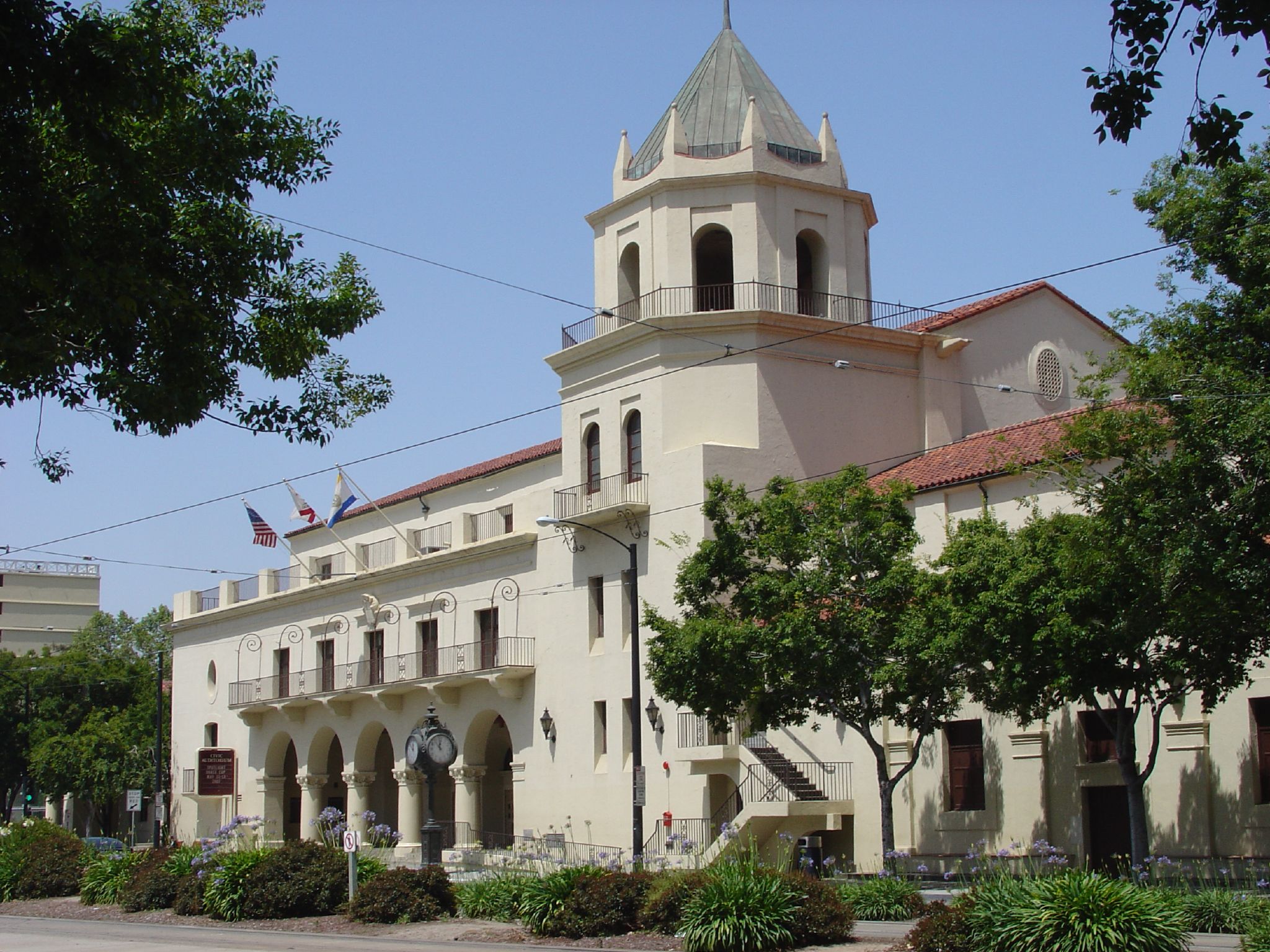
San Jose Civic
On the night of December 12, 1965, Bob Dylan walked onto the stage of the San Jose Civic Auditorium, plugged in his Fender Stratocaster, and played rock and roll to an audience that had come expecting folk music. Allen Ginsberg was in the crowd with a tape recorder, capturing a performance now preserved in the Stanford University Libraries. But Dylan was only one chapter in a story that stretches back to the Depression, when a newspaper publisher's wife and a federal works program conspired to give downtown San Jose something it had never had: a stage worthy of the city's ambitions.
Born of the New Deal
The San Jose Civic owes its existence to a convergence of generosity and crisis. Mr. and Mrs. T. S. Montgomery donated the property, and the Public Works Administration provided federal funding as part of the New Deal's campaign to put Americans back to work by building public infrastructure. Architects Binder & Curtis drew up plans in the Spanish Colonial and California Mission Revival style, giving the building the kind of arched windows, tile roofwork, and warm stucco walls that tied it to the region's architectural heritage. When it opened in 1936, the auditorium seated more than 3,000 people, making it the largest indoor venue between San Francisco and Los Angeles. It was, from the start, a civic institution in the truest sense: publicly funded, publicly owned, and built for the public's use.
Where Legends Came to Play
The roster of performers who have graced the Civic reads like a survey of twentieth-century American entertainment. Jack Dempsey and Joe Louis fought boxing matches on its floor. Barbra Streisand appeared there during her first concert tour in 1963, still years away from superstardom. Earlier that same decade, the Rolling Stones played a concert attended by Ken Kesey and his Merry Pranksters, who threw an electrified party afterward reportedly attended by members of the band. Richard Nixon made national headlines when an anti-war demonstration erupted during his appearance at the venue. The building hosted the trampoline events of the inaugural World Games in 1981, and decades later, in 2016, it served as the venue for the GENESIS 3 Super Smash Bros. tournament. Few buildings can claim to have witnessed both heavyweight championship boxing and competitive video gaming.
A Name That Keeps Changing
The auditorium has cycled through identities almost as often as it has hosted performers. It opened as the San Jose Municipal Auditorium, became the San Jose Civic Auditorium, then surrendered its name to a corporate sponsor in December 2013 when City National Bank purchased the naming rights and rechristened it City National Civic. The corporate branding lasted less than six years. In May 2019, the venue's original civic identity was restored, and it became simply the San Jose Civic. The Montgomery Theater, a 486-seat house attached to the east side of the building, has been more constant, serving as the primary home of CMT San Jose's community theater productions.
Reinvention and Resilience
By the early 2000s, the Civic was showing its age. The decades-old molded plastic chairs had grown uncomfortable, the sound system was a relic, and the loading dock made setup difficult for modern touring acts. In 2007, the city approved a $25 million renovation. Work began in 2009, bringing a state-of-the-art sound and video system, a refurbished floor, an exterior lighting system, upgraded seating, additional restrooms, and a modernized concessions program. The west wing, which had served as the San Jose Convention Center from 1977 until a new facility opened across the street in 1989, was demolished in 2019 to make way for redevelopment. The main auditorium survived, its Mission Revival facade intact, still seating over 3,000 people in a city that has grown up around it.
The Stage Endures
Today the San Jose Civic operates as a concert venue and theater managed by Team San Jose and booked by Nederlander Concerts. Its 3,036 seats can expand to 3,326 for general admission shows. It sits in the heart of downtown San Jose, surrounded by the tech campuses and high-rise apartments of a city that has reinvented itself as the capital of Silicon Valley. The auditorium is a reminder that this place was a city before it was a tech hub, and that its culture was built not by algorithms but by boxers, folk singers, rock bands, and the generation of New Deal workers who poured its foundations during the worst economic crisis the country had known.
From the Air
Located at 37.331N, 121.890W in downtown San Jose. The Spanish Colonial Revival building is visible near the intersection of Park Avenue and Market Street. Nearest airports: San Jose International (KSJC) approximately 2 nm northwest, Reid-Hillview (KRHV) approximately 5 nm east, Moffett Federal Airfield (KNUQ) approximately 8 nm northwest. Best viewed at 2,000-3,000 ft AGL for downtown context.