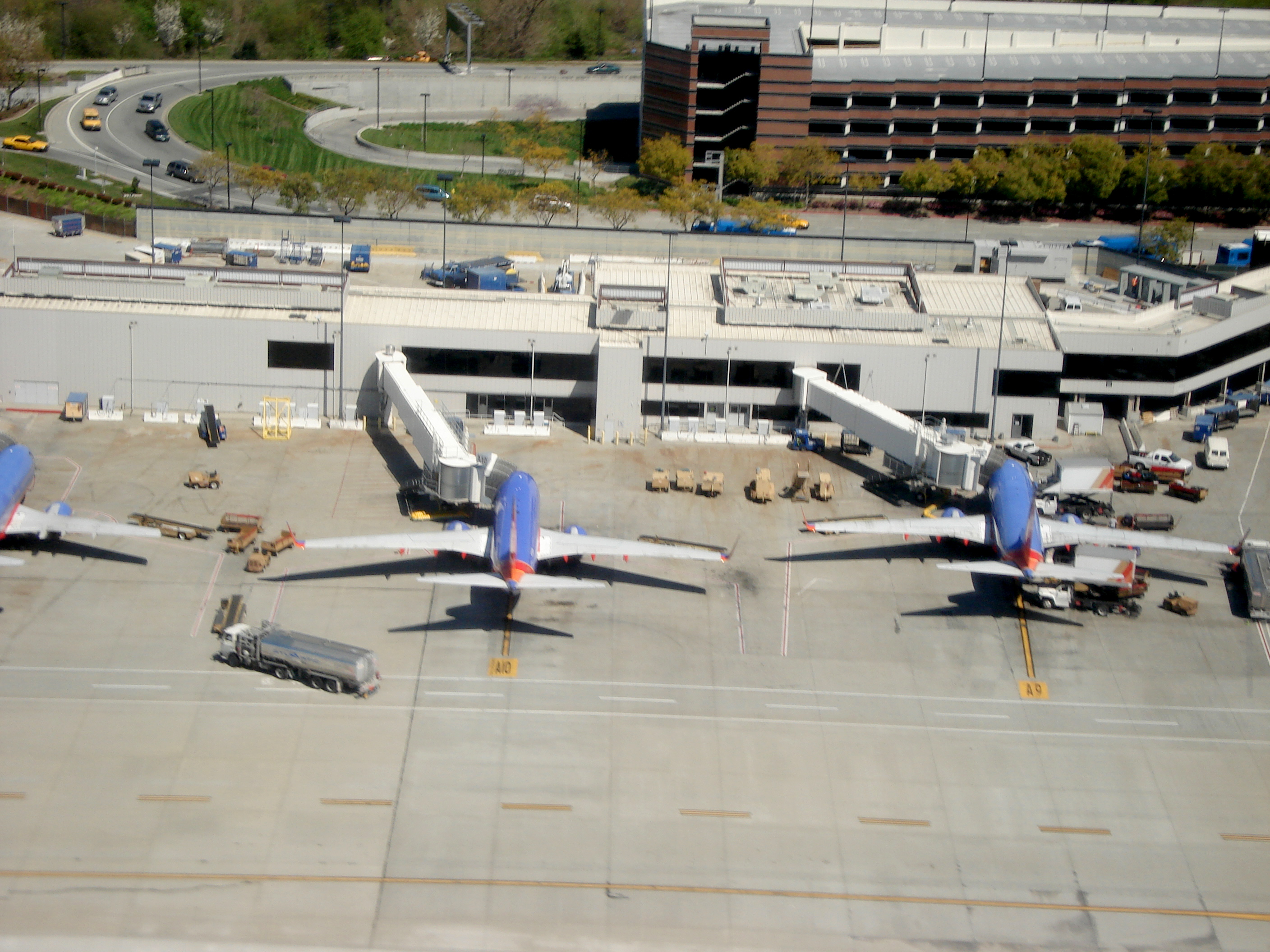
San Jose International Airport
In April 2014, a teenage boy scaled a perimeter fence at San Jose International Airport under cover of darkness, climbed into the wheel well of a Hawaiian Airlines Boeing 767, and survived a five-hour flight to Maui at altitudes where temperatures drop below negative 80 degrees Fahrenheit. When asked how this was possible, an airport spokeswoman offered a candid assessment: no system is 100 percent. That admission captures something essential about this airport -- KSJC, as pilots know it -- which has served Silicon Valley since its days as a municipal airfield. It is a place where the ordinary business of moving millions of passengers intersects with extraordinary stories, where the height of downtown buildings is governed by approach corridors, and where the surrounding freeways carry as much significance as the runways.
Silicon Valley's Front Door
San Jose International Airport sits between Interstate 880 and US Route 101, connected to the city center by California State Route 87. For decades it played second fiddle to San Francisco International, but the tech industry's southward migration changed the equation. By 2018, San Jose surpassed Oakland in passenger volume. Airlines responded: British Airways launched Dreamliner service to London in 2016, All Nippon Airways connected the airport to Tokyo, Lufthansa added Frankfurt service, and Hainan Airlines flew to Beijing. The airport that once served mostly domestic Southwest and Alaska Airlines routes became a genuine international gateway. Terminal B, which opened in June 2010, gave the airport a modern face with public art installations and a design that drew rave reviews from first-day passengers.
The Night on the Jetway
The airport's most dramatic incident unfolded over two hours on the night of September 14, 1975. Fred Salomon, a 24-year-old San Jose resident, arrived at what was then San Jose Municipal Airport at the end of a crime spree that included assault, robbery, car theft, and kidnapping. He took two airline mechanics hostage aboard a parked Continental Airlines Boeing 727, demanding they start the engines. As the jet began rolling toward the runway, police shot out its tires. Salomon stood in the aircraft doorway, a hostage in front of him, negotiating. When he pointed his weapon at officers, a police sharpshooter positioned atop the main terminal fired a single shot. The crisis ended. The incident was one of several that shaped airport security in the years before September 11 made such measures universal.
Under the Flight Path
Few airports shape the city around them as visibly as KSJC shapes San Jose. Federal Aviation Administration regulations governing obstacle heights near runways have directly constrained how tall downtown buildings can be. In 2006, the city commissioned a study to understand the tradeoff between downtown development capacity and airport operations, a tension that most cities resolve by pushing their airports to the periphery. San Jose's airport sits barely two miles from City Hall. The result is a skyline that remains conspicuously low for a city of over a million people, a physical reminder that the airspace above belongs to the aircraft descending through it.
A Helicopter, a Wheel Well, and a Lesson
The airport's incident history reads like a catalog of aviation's edge cases. In October 1999, a San Jose Police Department helicopter -- a McDonnell Douglas 500N with NOTAR technology instead of a conventional tail rotor -- lost control while entering the traffic pattern at KSJC during a maintenance ferry flight. It crashed into a city street, killing both occupants. The NTSB investigation found that temporary repairs meant to get the helicopter back to SJC had actually worsened the controllability problem. In 1994, FedEx Express Flight 705, destined for San Jose, was the target of a hijacking attempt shortly after takeoff from Memphis. A FedEx employee attacked the three-person crew with hammers and a speargun. The crew, though seriously injured, fought him off and landed safely. Each incident left its mark -- in revised procedures, improved training, or simply in the institutional memory of what can go wrong.
Getting There by Ground
For an airport named international, KSJC remains remarkably integrated into the local transit fabric. The Santa Clara Valley Transportation Authority runs a free bus shuttle between Terminals A and B. Route 60 connects the airport to the Santa Clara Transit Center, where passengers can transfer to Caltrain, Altamont Corridor Express, or Amtrak. VTA light rail links the airport station to Milpitas and Winchester, and the Milpitas station connects to BART. Private and corporate aircraft operate from the west side of the airfield off Coleman Avenue, where three fixed-base operators -- Atlantic Aviation, AvBase, and Signature Flight Support -- serve general aviation. It is a working airport in a working city, one whose runways and transit connections reflect the valley it serves.
From the Air
Norman Y. Mineta San Jose International Airport (KSJC) at 37.36°N, 121.93°W. Two parallel runways (12L/30R and 12R/30L). Class C airspace. Elevation 62 feet. Approach from the northwest overflies suburban neighborhoods; approach from the southeast crosses the Diablo Range foothills. Reid-Hillview Airport (KRHV), a general aviation reliever, is 4 miles ESE. Moffett Federal Airfield (KNUQ) is approximately 8 miles northwest.