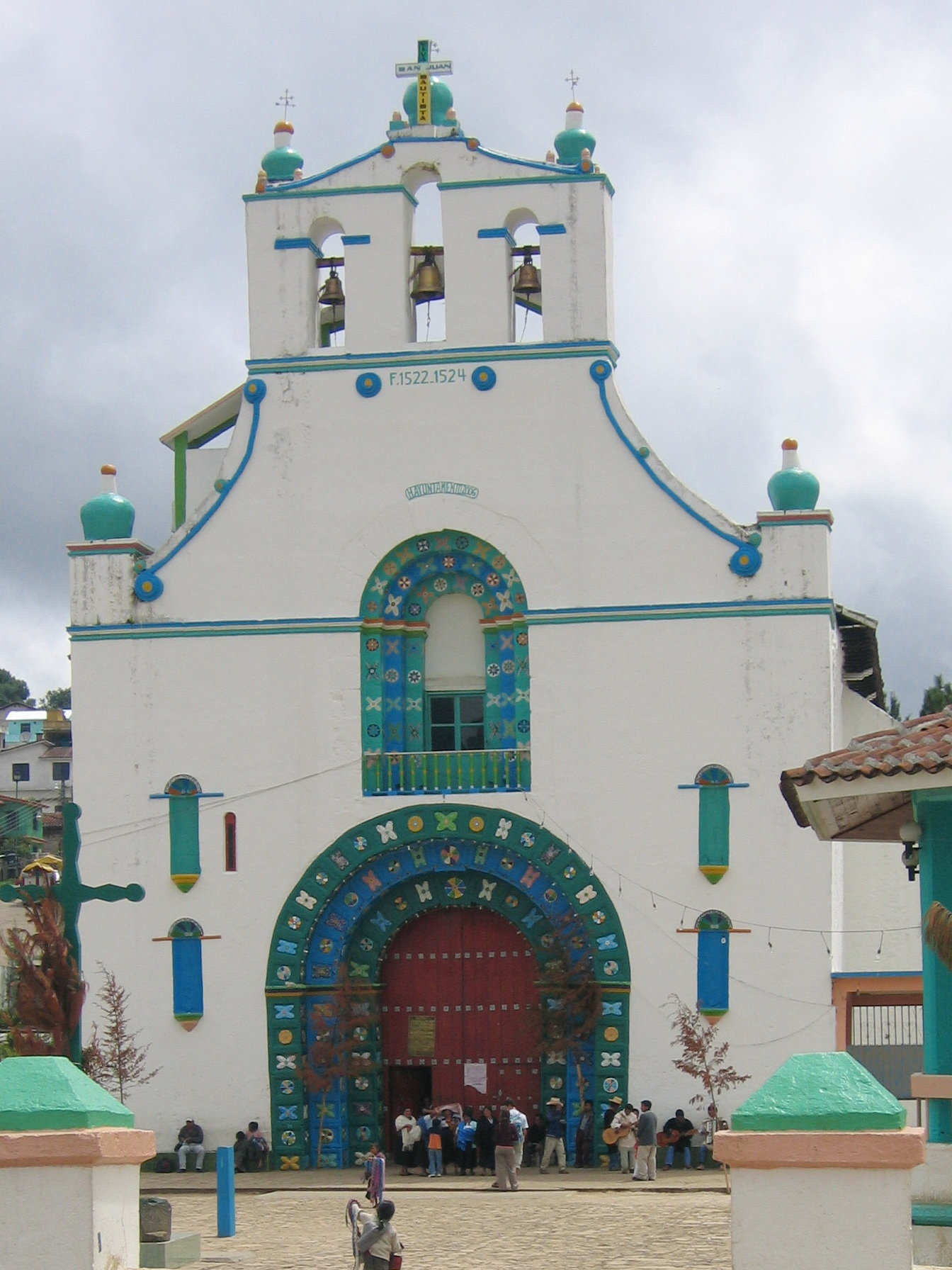
San Juan Chamula
No photographs. That is the first rule visitors learn in San Juan Chamula, a town of roughly 80,000 Tzotzil Maya people in the misty highlands of Chiapas, southern Mexico. The second rule is subtler: nothing here works the way outsiders expect. The town maintains its own police force, enforces its own justice, and keeps state and federal authorities at arm's length. Twenty minutes by colectivo from the colonial city of San Cristobal de las Casas, Chamula occupies a different world entirely -- one where Catholicism arrived five centuries ago and was reshaped into something the Vatican would barely recognize.
The Church That Swallowed Two Faiths
Step inside the Church of San Juan Chamula and the floor is covered not with pews but with pine needles. Thousands of candles burn in clusters on the ground, their wax pooling and hardening into pale rivers. Families kneel among the flames, chanting prayers that blend Catholic saints with Maya cosmology. Coca-Cola bottles line up beside the candles -- not as litter, but as ritual offerings. In Chamula's syncretic faith, the carbonation helps worshippers release evil spirits through belching. Chickens are sometimes sacrificed inside the church as part of healing ceremonies. Statues of saints line the walls, each dressed in clothing that reflects Maya, not European, traditions. The atmosphere is dense with smoke and murmured prayer. This is not performance for tourists. This is daily worship, shaped by centuries of blending the religion the Spaniards brought with the spiritual practices the Tzotzil refused to abandon.
Wool, Wealth, and the Weight of Poverty
Traditional clothing in Chamula tells a story before anyone speaks. Women wear heavy black skirts made from naturally tanned wool; men wear white wool vests. The thickness of the fabric and the purity of the color signal economic status -- heavy, pristine garments mark prosperity, while thin, uneven ones mark its absence. Most Chamulas fall into the latter category. The vast majority of the population lives in deep poverty, farming small plots and selling handmade wool goods at the market that spreads in front of the church. Purses, dolls, skirts, and woven bags cover the stalls. The market is one of the few places where outsiders can interact freely, though even here the rules apply: point a camera at a vendor without permission and the consequences may be swift.
Justice on Their Own Terms
Chamula governs itself with a directness that unsettles visitors accustomed to the Mexican legal system. The town has its own police, its own courts, and its own sense of what constitutes order. Regular police and military are not permitted inside the village. Disputes are resolved locally, sometimes through mediation, sometimes through force. The system emerged from centuries of neglect -- or worse -- by state and federal authorities, a history that also produced the nearby Zapatista movement, though Chamula took a sharply different path. Where the Zapatistas organized and made demands of the national government, Chamula simply withdrew. The result is a community that functions as a kind of autonomous zone within Mexico, one where the rule of law operates by local definition.
Spirits of Corn and Sugarcane
Tzotzil communities are credited with inventing pox, a distilled spirit common across Chiapas. Typically 80 to 100 proof, pox is made from a blend of corn, wheat bran, and sugarcane or piloncillo -- a raw cane sugar. The taste falls somewhere between rum and whiskey, earthy and rough. But pox is more than a drink in Chamula. According to local tradition, consuming it allows a person to glimpse the underworld, making it as much a sacramental substance as a social one. It appears at ceremonies, at healing rituals, and alongside the Coca-Cola on the church floor. For the Tzotzil, intoxication is not recreation. It is a doorway.
A World Apart, Twenty Minutes Away
Most visitors arrive from San Cristobal de las Casas by colectivo, a twenty-minute ride that costs about 22 Mexican pesos. There are no hotels in Chamula; the town does not want overnight guests. Half-day guided tours from San Cristobal pair Chamula with the neighboring village of Zinacantan, another traditional Tzotzil community known for its flower-draped churches and vibrant textiles. A good guide provides context that transforms a bewildering visit into a profound one. Without one, the rituals and restrictions can feel opaque. Chamula tolerates tourism because it brings income to a desperately poor community, but tolerance should not be mistaken for welcome. Visitors are guests in a place that has spent centuries defining itself by what it refuses to accept from the outside.
From the Air
Located at 16.78N, 92.68W in the Chiapas highlands at approximately 2,200 meters elevation. The town sits in a mountain valley surrounded by cloud forest. Nearest airports are San Cristobal de las Casas (no ICAO, small airfield) and Tuxtla Gutierrez Angel Albino Corzo International Airport (MMTG), about 85 km to the west. The church and central market square are the most visible features from low altitude. Terrain is rugged mountainous highland.